
Review · WALKING TOURS
Absolutely Amsterdam – the Essential Introductory Walking Tour
Amsterdam reveals itself on foot. This 2.5-hour introductory walk links the old harbor, canals, Chinatown, markets, royal landmarks, and quiet historic corners into one clear city story. I especially like the low upfront price and the way the guides connect famous sights with difficult subjects such as prostitution, colonial trade, drug policy, and wartime persecution.
I also like the visual aids and local tips, which help make complicated events easier to follow. The main consideration is that you remain outside several attractions, including Our Lord in the Attic Museum and the Royal Palace, and busy streets can make it harder to hear or keep pace.
In This Review
- Key points to know before booking
- Why this walking tour works as a first look at Amsterdam
- Beurs van Berlage: Amsterdam begins with water and money
- Damrak and the Red Light District: religion, law, and hard choices
- Our Lord in the Attic: tolerance without entering the church
- Chinatown and Dutch drug policy
- The Waag and Rembrandt’s early breakthrough
- Oostindisch Huis: the Golden Age with its darker side
- Waterlooplein: Jewish Amsterdam and the hunger winter
- The Amstel and the logic of canal houses
- Oudemanhuispoort and Amsterdam’s bicycle culture
- Dam Square and the Royal Palace
- What the guides add to the experience
- Timing, group size, and practical value
- Who should book this Amsterdam walk?
- Should you book Absolutely Amsterdam?
- FAQ
- How long does Absolutely Amsterdam last?
- What language is the tour offered in?
- How much does the tour cost?
- Where does the tour start?
- Where does the tour finish?
- Does the tour enter Our Lord in the Attic Museum?
- Does the tour include entry to the Royal Palace?
- What is the maximum group size?
- Can I cancel for a refund?
Key points to know before booking

- Ten central stops in about 2.5 hours: You cover major sights without spending time on buses or trams.
- A tip-based price of $5.93: This is excellent value if you want orientation before choosing paid museums.
- Serious subjects are part of the route: Expect frank discussion of prostitution, religious tolerance, colonialism, Jewish persecution, and Dutch drug policy.
- Small groups of up to 15 people: This should feel more personal than a large city walk.
- Guides bring humor and visual aids: Guides including Raymond, Jaap, Sergio, David, Roman, and others are praised for clear storytelling and helpful recommendations.
- Comfortable shoes matter: You walk through busy central streets, and bicycles are an ever-present part of Amsterdam’s traffic.
Why this walking tour works as a first look at Amsterdam
This is not simply a parade of postcard views. The route uses Amsterdam’s center to explain how the city developed through water, trade, religion, finance, empire, war, and social policy.
That makes the tour useful during your first day or two. You get your bearings, learn which districts connect to one another, and collect ideas for places to revisit. Several guides also offer suggestions for food and later activities, so you can turn the walk into a practical plan for the rest of your stay.
The route is offered in English and usually lasts about two hours and thirty minutes. The group is capped at 15, a sensible limit in narrow streets where a large crowd would be awkward. The pace is described as manageable, though you should still expect steady walking and regular stops.
The price is unusually low at $5.93 per person. This is a tip-based experience, so the listed amount is best understood as an inexpensive way to reserve a place, not necessarily the full amount you may choose to pay. For that cost, you receive a broad introduction rather than entry to a series of museums.
The tour has a current rating of 4.9 from 3,629 ratings, with 98 percent recommending it. The strongest praise centers on the guides’ humor, local knowledge, storytelling, and ability to keep the group involved. Names repeatedly singled out include Raymond, Jaap, Sergio, David, Roman, Fernando, and Sebastien.
More Walking Tours in Amsterdam
- Anne Frank’s Story – Guided Walking Tour through Amsterdam
★ 5.0 · 11,619 reviews - Amsterdam: Life of Anne Frank and World War II Walking Tour
★ 4.8 · 10,467 reviews - Amsterdam: Anne Frank Guided Small Group Walking Tour
★ 4.8 · 2,722 reviews
Beurs van Berlage: Amsterdam begins with water and money
The meeting point is Freedam Tours at Beursplein 5, near the Beurs van Berlage. This is a fitting place to begin because the area once carried the Amstel River, and the exchange buildings reflect Amsterdam’s long connection with commerce.
You start with the city’s origins and the role of water in shaping its growth. The discussion then turns to finance, which helps explain why this small northern European city became such a major trading center.
This opening stop lasts about 20 minutes and requires no admission ticket. It gives you a useful framework for everything that follows. The canals are not just pretty scenery, and the grand old buildings are not just decoration. They are evidence of a city built around shipping, trade, and financial risk.
Damrak and the Red Light District: religion, law, and hard choices
At Damrak, the old harbor, the tour examines one of Amsterdam’s most famous and misunderstood areas. You hear how the Red Light District developed, how the Church became involved in the neighborhood’s economy, and how religious ideals and commercial interests sometimes existed side by side.
The guide also explains how prostitution became a legal profession in the 20th and 21st centuries, along with the changes and present problems affecting the area. This is handled as a social and political subject rather than as a cheap joke.
That approach matters. Amsterdam’s reputation for personal freedom did not appear by magic. It grew through a complicated mix of law, commerce, religion, and practical tolerance. The 15-minute stop is brief, but it gives you enough context to look at the neighborhood with more care.
Our Lord in the Attic: tolerance without entering the church
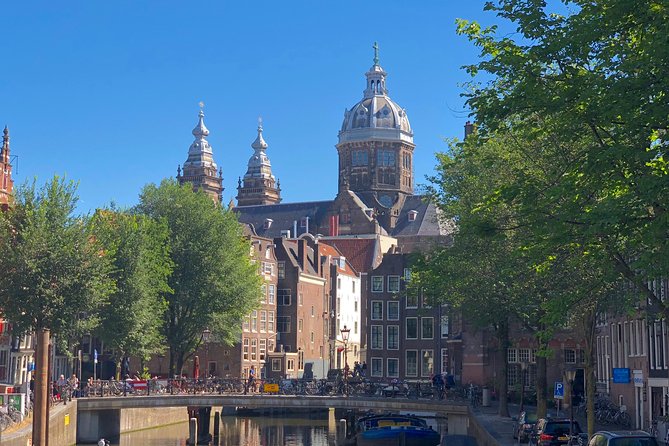
At Our Lord in the Attic Museum, you discuss how Catholic worship continued after Catholicism became illegal in the 17th century. The key point is the difference between formal freedom and practical tolerance.
Catholics could not worship openly, yet religious life continued under strict and unusual conditions. The guide draws a comparison with the way tolerance operates today, which gives this short stop modern relevance.
You do not enter the museum or the hidden church on this walk. You see the building from outside, and the guide has interior photographs to show the group. If the church interests you, you will need to return later and purchase a separate admission ticket.
This is one of the clearest examples of the tour’s limits. You receive context and a useful preview, but not the full museum experience.
A different kind of day out entirely:
- Amsterdam: Van Gogh Museum Ticket
★ 4.7 · 52,054 reviews - Amsterdam Classic Saloon Boat Cruise with Drinks and Cheese
★ 5.0 · 31,825 reviews - Amsterdam Luxury Canal Cruise + Unlimited Drinks & Bites option
★ 5.0 · 30,518 reviews - Amsterdam: Heineken Experience Ticket
★ 4.6 · 30,055 reviews
Chinatown and Dutch drug policy
The Chinatown stop introduces Dutch drug policy and the history of coffeeshops. You learn how this district became a no-go area in the 1970s and how that crisis helped lead to the development of businesses dedicated to selling marijuana.
The subject is presented as part of Amsterdam’s urban history, not as an invitation to buy anything. That distinction is useful, especially if your view of Dutch drug policy comes mostly from travel clichés.
The 15-minute discussion helps explain why Amsterdam’s approach is often described as tolerant, even though the legal and practical details are more complicated than many first-time visitors realize.
The Waag and Rembrandt’s early breakthrough
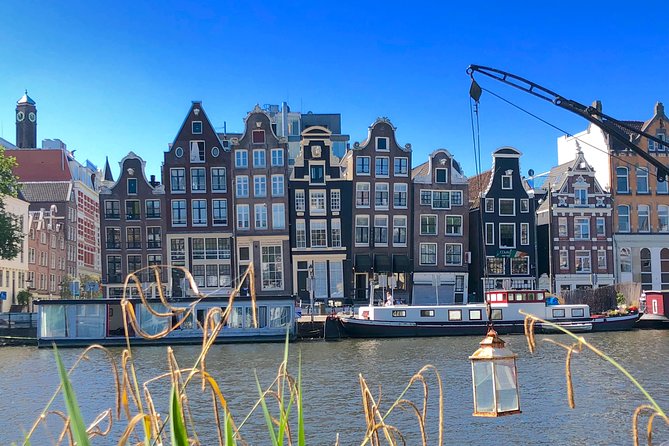
The Waag offers a shorter stop, about 10 minutes, with a focus on Rembrandt. The guide explains where he painted his first major work and why it changed portrait making.
A copy of the painting is used to point out specific details. That small teaching aid makes a difference. Looking at a reproduction while the guide explains the composition is more useful than simply hearing that Rembrandt was important.
You do not enter the building as part of the walk, and admission is not included. Still, the stop connects a familiar Dutch name with a specific place and a clear artistic change.
Oostindisch Huis: the Golden Age with its darker side
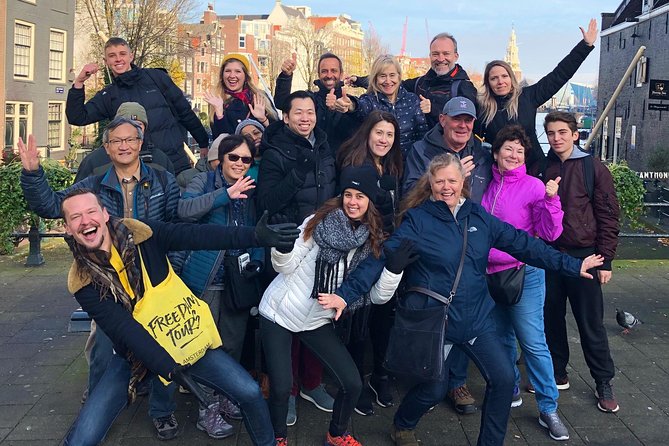
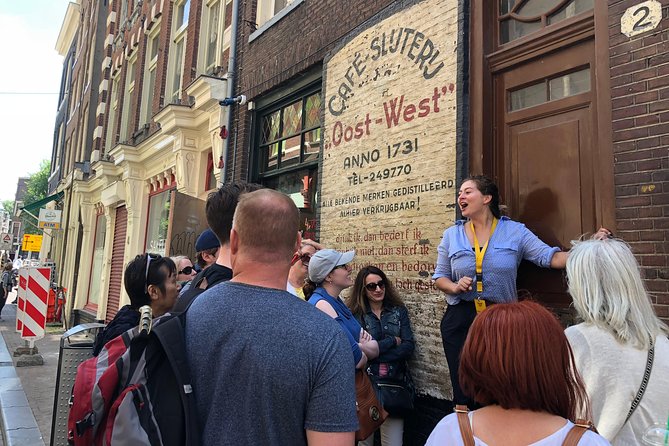
One of the most worthwhile stops is Oostindisch Huis, the former headquarters of the Dutch East India Company. During weekdays, you may be able to see its 17th-century courtyard, which is otherwise not always accessible.
Here the tour explains how Amsterdam became the center of a global trading empire and one of the wealthiest cities in the world during the 17th century. You also learn how this company helped shape modern capitalism.
The important feature is the balance. The discussion does not treat the Golden Age as a simple success story. It addresses the darker legacy of the period as well as the commercial achievements.
The courtyard is free to see when access is available, but the weekday qualification matters. If seeing it is important to you, check the day and current access details before you book.
Waterlooplein: Jewish Amsterdam and the hunger winter
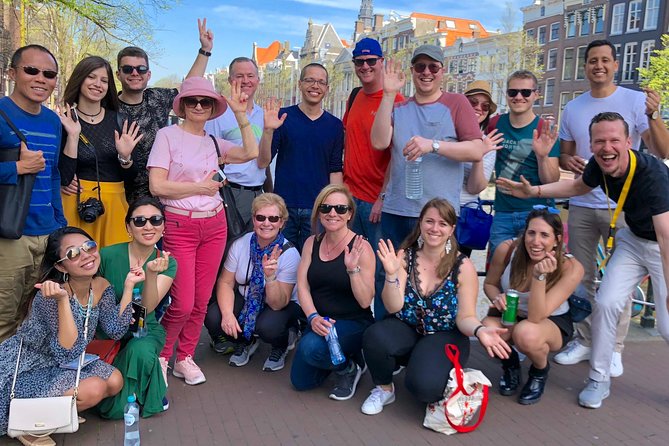
At Waterlooplein Market, you reach Amsterdam’s former Jewish Quarter. This is the oldest market in the city, but the stop is also a serious account of what happened to the neighborhood during and after the Second World War.
The guide explains how Nazi occupation decimated the Jewish population of a place that had once offered safety to persecuted Jews from across Europe. You also hear about the hunger winter and the choices Amsterdammers had to make to survive.
The route does not turn wartime suffering into a quick dramatic anecdote. It places the market, streets, and quarter in a human setting. That makes this part of the walk especially valuable, though some people may find the subject heavy after the lighter discussions of art, bicycles, and royal gossip.
The Amstel and the logic of canal houses
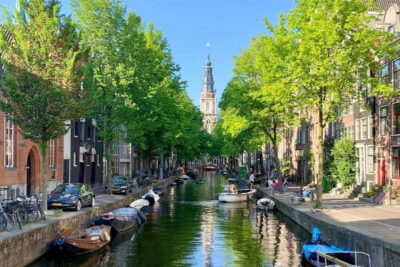
Near the Amstel, or another canal depending on weather and the guide, the tour explains why Amsterdam has canals and how the famous canal houses were built.
You learn why many houses are narrow, why some lean, and why the front hooks matter. The guide also explains the open curtains often seen in Dutch homes. These details are small, but they help you read the city instead of merely photographing it.
Because the stop can shift with the weather, you should treat it as a theme rather than a promise of one exact viewpoint. The focus is on architecture and daily life, not a long scenic pause.
Oudemanhuispoort and Amsterdam’s bicycle culture
Oudemanhuispoort is a tucked-away former monastery that later became a hospital and now forms part of the University of Amsterdam. It provides a quieter setting for a discussion of Dutch bicycle culture.
The guide explains why Amsterdam has more bicycles than people and why many bikes look plain and battered rather than sleek and expensive. That last point is a useful correction to the polished cycling image often presented abroad.
You will also need to stay alert around bikes during the whole walk. One rating specifically notes the challenge of dodging bicycles, but that is simply part of moving through central Amsterdam. Good shoes and attention at crossings will make the route easier.
Dam Square and the Royal Palace
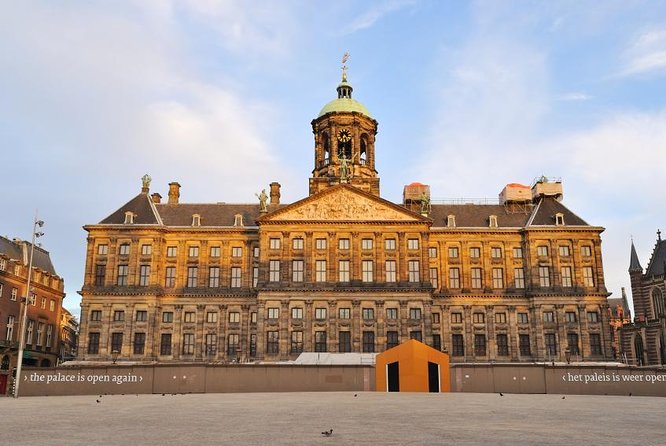
The final main stop is the Royal Palace Amsterdam on Dam Square. Here you learn how the Netherlands moved from a republic to a monarchy and receive an introduction to the current royal family.
The guide uses photographs and adds a little royal gossip. That lighter tone is welcome after the serious material at Waterlooplein, and it gives the tour a relaxed finish.
You do not enter the Royal Palace, and admission is not included. The route is described as ending at Dam Square, while the meeting details also state that the activity ends back at the meeting point. Since those details do not perfectly match, confirm the exact finishing point when booking.
What the guides add to the experience
The guide can make or break a city walk, and this experience receives strong praise for its staff. Raymond is described as a lifelong local who explains the city with humor. Jaap is praised for funny, lively presentations and strong knowledge of Dutch history.
Sergio is noted for passion and helpfulness, while David is praised for enthusiasm and storytelling. Roman is especially associated with remembering people’s names and adding Dutch food suggestions. Fernando is credited with offering practical ideas for places to visit later.
Sebastien’s storytelling is described as strong enough to hold attention throughout the walk. Other guides, including Gianni, Esi, Samuel, Dani, Alex, Alexander, Ramses, and Carl, are also praised for friendly delivery, useful facts, and an easy pace.
You cannot choose a particular guide from the information provided, so expect some variation in style. The consistent strengths are humor, visual aids, local perspective, and an effort to include the whole group.
Timing, group size, and practical value
The tour is usually booked 24 days ahead, so it is sensible to reserve early if your dates are fixed. Confirmation is provided at booking, and free cancellation is available up to 24 hours before the start time.
The group limit is 15 people. That is small enough for questions and personal attention, but central Amsterdam can still be noisy and crowded. One useful tip is to avoid the busiest times if possible, since narrow streets fill quickly.
Most people can take part, and service animals are allowed. The route is near public transportation, but no specific transport instructions are supplied. Wear comfortable shoes, bring water, and expect bicycles, uneven city movement, and changing weather.
Who should book this Amsterdam walk?
I would choose this tour for a first visit, especially if you want a quick map of central Amsterdam before committing to museums or longer excursions. It is also a good fit if you prefer social history and everyday customs alongside landmark views.
It suits solo visitors, couples, and small groups who enjoy asking questions and listening to a guide’s personal recommendations. Repeat visitors can still find value, particularly at Oostindisch Huis, Waterlooplein, Oudemanhuispoort, and the discussions of law and tolerance.
You may want something else if you need wheelchair-specific route details, want to enter several attractions, or dislike serious topics mixed with humor. The tour is broad rather than deep, so it cannot replace a full visit to the hidden church, Royal Palace, or a dedicated Jewish history museum.
Should you book Absolutely Amsterdam?
Yes, if you want an inexpensive, well-paced introduction with more substance than a simple landmark checklist. The best parts are the guide-led connections between canals, commerce, religion, art, war, bikes, and royal life.
Book it early, wear good shoes, and arrive ready for both jokes and difficult history. I would treat the $5.93 price as a starting point for a tip-based experience, then use the route to decide which places deserve a second visit with paid entry.
FAQ
How long does Absolutely Amsterdam last?
The tour lasts approximately two hours and thirty minutes.
What language is the tour offered in?
The experience is offered in English.
How much does the tour cost?
The listed price is $5.93 per person. It is a tip-based tour, so you can tip as much as you would like.
Where does the tour start?
It starts at Freedam Tours, Beursplein 5, 1012 GZ Amsterdam, Netherlands.
Where does the tour finish?
The route information identifies Dam Square as the ending point, while the meeting details also state that the activity ends back at the meeting point. Confirm the exact end point when booking.
Does the tour enter Our Lord in the Attic Museum?
No. The guide discusses the museum from outside and provides photographs of the interior. Admission is not included.
Does the tour include entry to the Royal Palace?
No. The Royal Palace is discussed from outside, and admission is not included.
What is the maximum group size?
The tour accepts a maximum of 15 participants.
Can I cancel for a refund?
You can cancel up to 24 hours before the experience start time for a full refund. Cancellations or changes made within 24 hours are not refunded or accepted.
Just added in Amsterdam
- Private Tour Zaanse Schans Windmills and Volendam in Jaguar★ 5.0 · 10 reviews
- Zaanse Schans and Giethoorn Unique Day Trip with Boat Cruise★ 4.5 · 17 reviews
- Windmills-Volendam-Giethoorn Private Tour in Jaguar★ 5.0 · 2 reviews
- Half-Day Private Guided Sightseeing Tour of Zaanse Schans★ 5.0 · 14 reviews
- Best of Netherlands: Zaanse Schans Mills, The Hague & Rotterdam★ 4.5 · 10 reviews
- Zaanse Schans Private Tour Windmills★ 5.0 · 18 reviews
- Zaanse Schans Windmills Edam Volendam and Marken from Amsterdam★ 5.0 · 1 review
- Half Day Keukenhof Tulip Paradise Trip from Amsterdam★ 5.0 · 1 review
Walking Tours, compared.

Anne Frank’s Story – Guided Walking Tour through Amsterdam
Read our review →
Life of Anne Frank and World War II Walking Tour
Read our review →
Anne Frank Walking Tour – Guided in EN/DE/IT/ES
Read our review →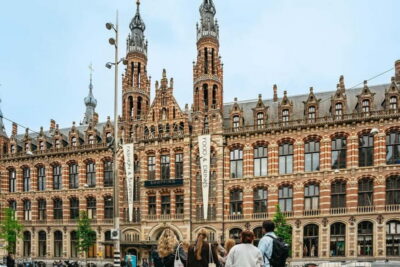
Anne Frank Walking Tour Amsterdam Including Jewish Cultural Quarter
Read our review →
Amsterdam Highlights Walking Tour: Small Group Experience
Read our review →Browse the lists this tour appears in