
Review · ANNE FRANK TOURS
Amsterdam: Anne Frank Walking Tour – Guided in EN/DE/IT/ES
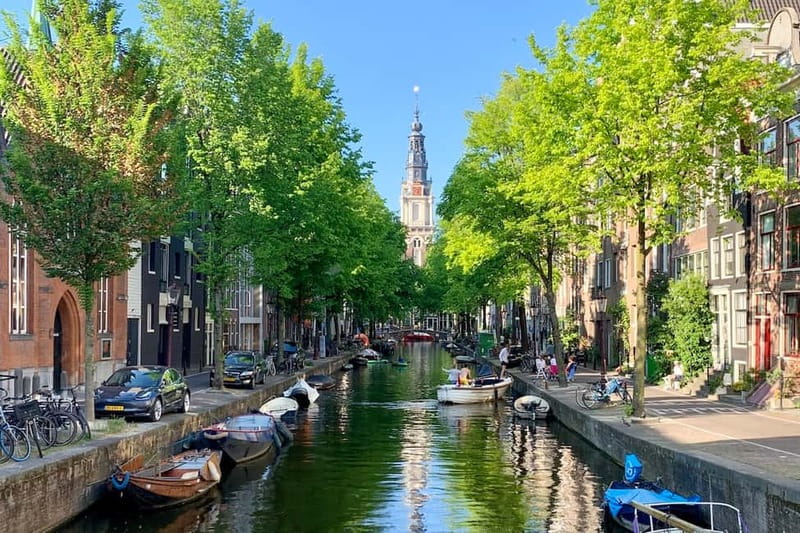
History feels close here. This two-hour walk through Amsterdam’s former Jewish Quarter links Anne Frank’s diary to synagogues, memorials, resistance sites, and streets shaped by centuries of Jewish life. It is less about seeing a single famous address and more about understanding the city around it.
I especially like the diary passages read along the route, which give the tour a human voice instead of turning World War II into a list of dates. I also like the way the walk includes both Jewish and non-Jewish resistance, from the February Strike to individual acts of courage. The main drawback is important: you will not visit or see the Anne Frank House, and the subject matter is often painful.
The tour costs $28 per person and covers about 2 to 3 kilometers on foot. That is a fair price for a live guide, a carefully connected route, and two hours of context at places you could otherwise pass without understanding. Guides such as Valentina, Josh, Emilia, Julia, Deborah, Charlotte, Bianca, Kaya, and David have been praised for clear storytelling, emotional sensitivity, and a willingness to answer questions.
In This Review
- Key points to know before booking
- Starting at De Waag in Nieuwmarkt
- Nieuwmarkt and Zuiderkerk: setting the Jewish Quarter
- Huis de Pinto and the city’s old homes
- Rembrandt House: Jewish Amsterdam beyond Anne Frank
- Sint Antoniesluis and the physical feel of the route
- Portuguese Synagogue and Jewish cultural life
- Jewish Historical Museum and the continuing community
- Auschwitz Monument and the February Strike
- The Dokwerker and acts of resistance
- Stolpersteine and small signs of remembrance
- National Holocaust Names Monument: a quiet finish
- The guides and the way the story is told
- What $28 buys you
- Who should book this walk?
- Final verdict: a moving walk with clear limits
- FAQ
- Does the tour visit the Anne Frank House?
- How long does the tour last?
- How far do you walk?
- What languages are available?
- Where does the tour start?
- How do I find the correct side of De Waag?
- Is the tour wheelchair accessible?
- Are admission fees included?
- What should I bring?
Key points to know before booking

- Anne Frank’s diary shapes the walk: Short readings from the diary connect personal experience with the places around Amsterdam.
- The route covers major Jewish Quarter sites: You pass the Portuguese Synagogue, Rembrandt House, the Auschwitz Monument, The Dokwerker, and the National Holocaust Names Monument.
- This is not an Anne Frank House visit: The house is not visited or visible during the tour, so book a separate ticket if that is a priority.
- The guides receive strong praise: Valentina, Josh, Emilia, Julia, Deborah, Charlotte, Bianca, Kaya, and David are singled out for warmth, good pacing, and strong subject knowledge.
- Expect a serious history lesson: The tour covers Jewish life, Nazi persecution, deportation, the Holocaust, and resistance. It is moving rather than light entertainment.
- The walk works in all weather: Bring water, comfortable shoes, weather-appropriate clothing, and an umbrella if rain is forecast.
Starting at De Waag in Nieuwmarkt

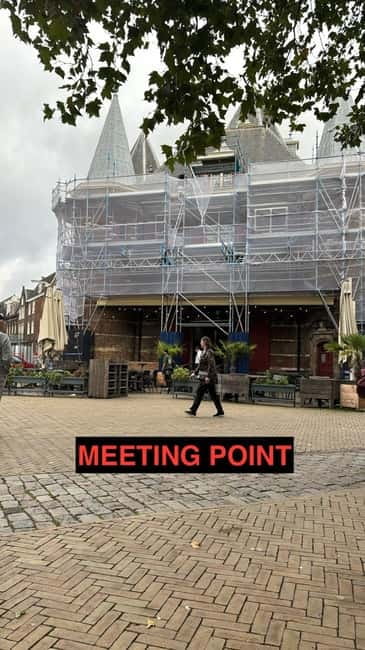
The meeting point is De Waag, the old building that looks a little like a small castle in the center of Nieuwmarkt. Look for the guide wearing a red name tag around the neck.
This detail matters because map apps can send you to the back of the building. If you see the coffeeshop called Jolly Joker, you are on the wrong side. Walk around De Waag to find the restaurant entrance.
Nieuwmarkt is a useful starting point. It places you near the old Jewish Quarter and gives the guide room to explain how Amsterdam grew as a commercial city. The area also makes a practical first stop before the tour moves into more solemn subjects.
The group walks in all weather and covers roughly 2 to 3 kilometers. I would wear shoes you can comfortably use on uneven city streets and bring water. The route is wheelchair accessible, although anyone who needs extra time should tell the operator when booking.
The tour is offered in English, German, Spanish, or Italian. It is not bilingual, so choose the correct language option. The supplied details list English and German for the guide, while the live-tour information also lists Spanish and Italian, so check the available departure option carefully.
More Walking Tours in Amsterdam
- Anne Frank’s Story – Guided Walking Tour through Amsterdam
★ 5.0 · 11,619 reviews - Amsterdam: Life of Anne Frank and World War II Walking Tour
★ 4.8 · 10,467 reviews - Absolutely Amsterdam – the Essential Introductory Walking Tour
★ 5.0 · 3,629 reviews
Nieuwmarkt and Zuiderkerk: setting the Jewish Quarter
At Nieuwmarkt Square, the guide begins placing the Jewish Quarter within Amsterdam rather than treating Anne Frank’s story as an isolated event. The Jewish community helped shape the city’s commercial life after Jews expelled by the Spanish Inquisition settled in Amsterdam.
The guide explains why this part of the city became home to the Jewish community and how the Jodenbuurt, or Jewish Quarter, developed. You also get a sense of the Jewish Triangle, one of the area’s best-known sections.
The next stop is Zuiderkerk, where the guided visit lasts about ten minutes. Here the story continues through the changing city around the Jewish community. The church is a useful reminder that Jewish life developed within a wider Amsterdam neighborhood, alongside other religious and civic institutions.
These early stops are valuable because they give you more than wartime suffering. You hear about trade, settlement, homes, and daily life before the Nazi occupation. That context makes the later destruction harder to reduce to a few figures.
Huis de Pinto and the city’s old homes

Huis de Pinto receives a shorter explanation, about five minutes. Its value is not necessarily in a long interior visit, since this is an outdoor walking tour, but in the way the guide uses buildings and streets to show the presence of established Jewish families.
The route also points out stately homes and other Jewish relics. These details help correct the idea that Amsterdam’s Jewish Quarter was only a poor or temporary district. Jewish residents shaped the city’s architecture, business life, and public identity.
You will want to listen closely here. Some of the most useful information comes between the headline attractions, when the guide explains who lived in the area and why this particular ground mattered to the community.
Rembrandt House: Jewish Amsterdam beyond Anne Frank
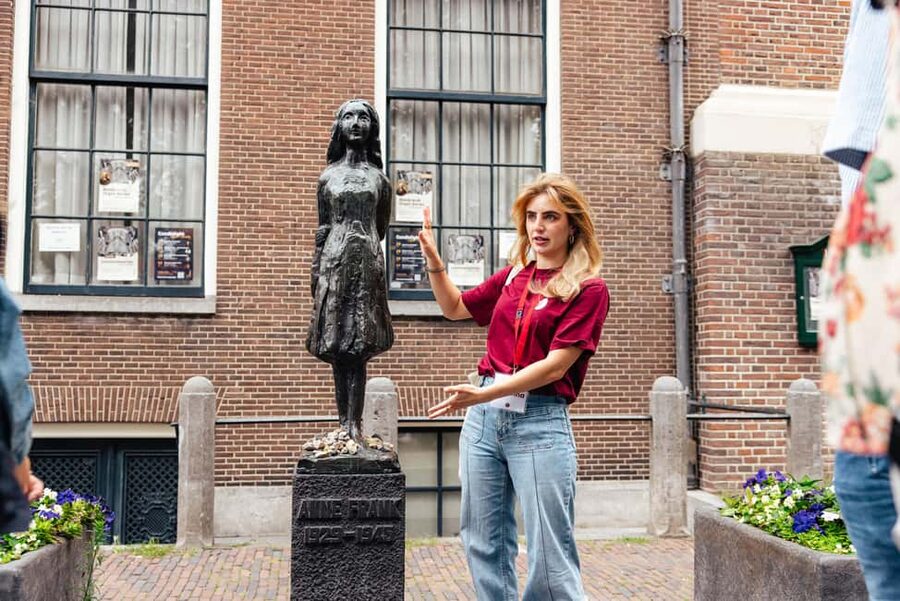
The stop at Rembrandt House lasts about fifteen minutes, making it one of the longer pauses. Rembrandt van Rijn lived in the middle of the Jewish Quarter, and his connection to the neighborhood helps broaden the story beyond Jewish residents alone.
This is a smart part of the route. It shows that the quarter was not sealed off from the rest of Amsterdam. Jewish and non-Jewish residents lived near one another, shared commercial space, and shaped the same streets.
The guide uses Rembrandt’s home as a way to discuss the city’s social fabric. You are not simply moving from one memorial to another. You are seeing how an ordinary neighborhood developed and how its residents were later targeted under Nazi rule.
The tour does not include admission to Rembrandt House. You view the location from the walking route and receive a guided explanation. If you want to go inside, plan that as a separate visit.
More Anne Frank tours:
- Amsterdam: Anne Frank Guided Small Group Walking Tour
★ 4.8 · 2,722 reviews - Anne Frank Walking Tour Amsterdam Including Jewish Cultural Quarter
★ 5.0 · 1,879 reviews - Anne Frank’s Last Walk & See Anne Frank House in Virtual Reality
★ 5.0 · 957 reviews - Anne Frank and Jewish Quarter Amsterdam Private Walking Tour
★ 5.0 · 684 reviews
Sint Antoniesluis and the physical feel of the route
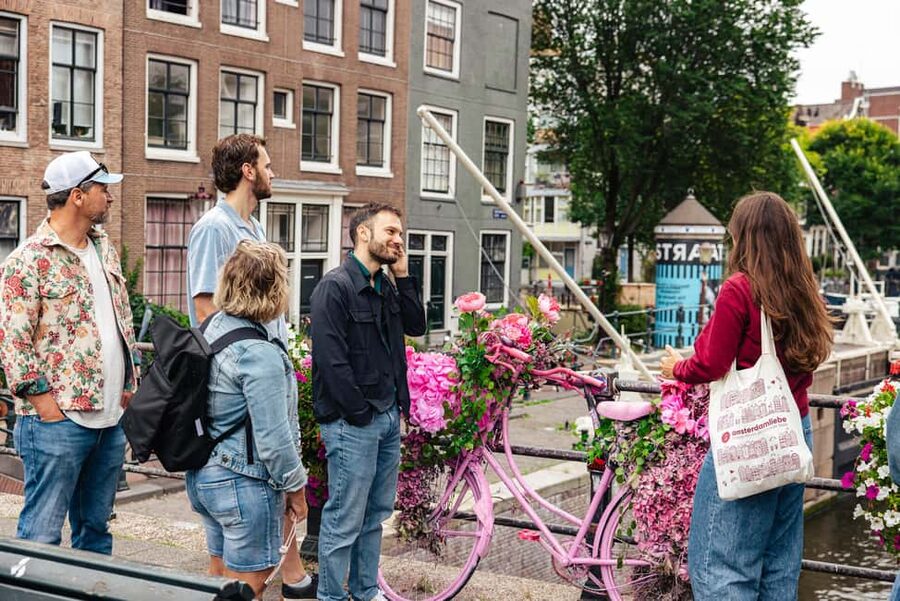
Sint Antoniesluis is another brief stop, with about ten minutes of explanation. By this point, the walk has settled into the old Jewish Quarter, and the canals, bridges, and narrow streets become part of the lesson.
I like this kind of sightseeing because the city itself becomes the reference material. You are not only listening to an account of the past. You are standing in the places where homes, businesses, religious buildings, and community institutions once formed a working neighborhood.
The walk is not described as strenuous, but it is continuous. A good pace is one of its strengths. Several guides, including Amelia and Josh, have been praised for walking at a comfortable speed, checking in with the group, and allowing time for questions.
Because the tour takes place outdoors, the weather can affect your experience. Rain will not cancel the walk automatically, so bring an umbrella and dress for the forecast. In poor weather, the emotional weight of the subject may feel even heavier, and there are no included food or drink stops.
Portuguese Synagogue and Jewish cultural life
The Portuguese Synagogue receives a ten-minute guided explanation and photo stop. It is one of the clearest reminders that Amsterdam’s Jewish story began long before World War II.
The synagogue connects to the earlier story of Jewish people arriving in Amsterdam after persecution elsewhere in Europe. It also points to the variety within Amsterdam’s Jewish community, rather than presenting it as one single group with one background.
You can take photographs at this stop, but the value is mainly historical. The tour does not list an interior admission or a separate synagogue visit. You remain on the walking route and hear the guide explain the building and its place in the district.
This stop also helps prepare you for the contrast ahead. The tour moves from community, worship, and cultural life to persecution, deportation, and remembrance. That change is deliberate, and the guides handle it with a serious tone.
Jewish Historical Museum and the continuing community

The Jewish Historical Museum is covered in about five minutes. Again, this is a guided outdoor stop rather than a museum admission.
The guide uses the site to connect Amsterdam’s Jewish past with its present. You hear about current Jewish life in a multicultural Amsterdam, which keeps the tour from ending with the Holocaust as the final word.
That balance is one of the strongest parts of the experience. The tour does not ignore the grief and destruction, but it also recognizes that Jewish culture and community continue. For me, that makes the route feel more honest and less like a memorial-only circuit.
If you want museum displays, artifacts, or more time with exhibits, you will need to buy a separate ticket and return independently. The walking tour gives you a framework, not a full museum visit.
Auschwitz Monument and the February Strike
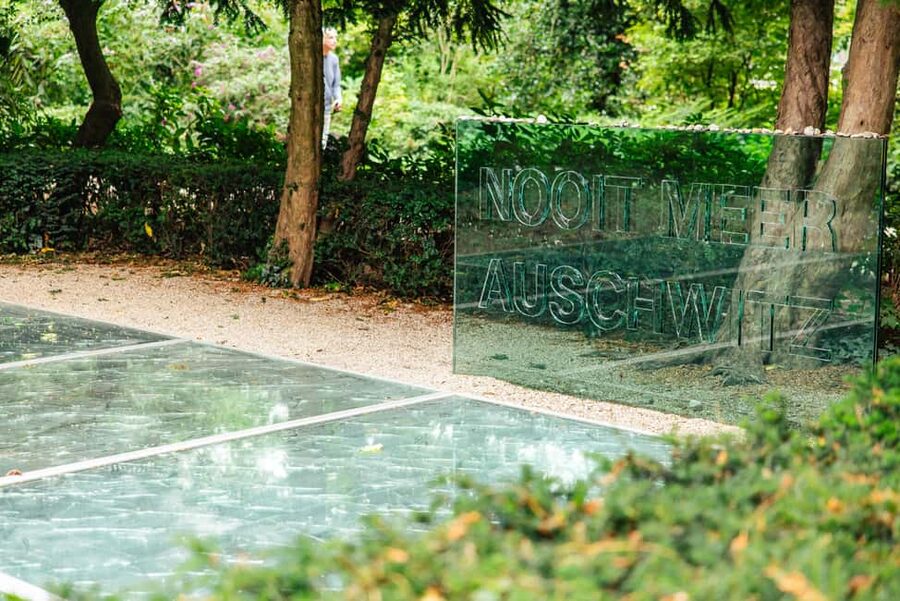
The Auschwitz Monument is one of the most serious stops. The guided explanation lasts about ten minutes and focuses attention on the people murdered during the Holocaust.
The guide discusses deportation from Amsterdam and the fact that very few of those deported returned. Anne Frank’s story becomes part of this larger history. Her diary offers an individual voice, while the monument points toward the scale of the crime.
The tour also covers the February Strike of 1941. This is an essential part of Amsterdam’s wartime story because it shows that some non-Jewish Amsterdammers refused to accept the persecution of their Jewish neighbors.
The subject is difficult, and the presentation is intended to be respectful rather than sensational. Guides such as Julia and David have been praised for reading diary passages with care and for leaving room for questions. Josh is also praised for sharing historical images and personal insight during the walk.
The Dokwerker and acts of resistance
At The Dokwerker, the guide spends about five minutes discussing resistance. The monument commemorates the February Strike and gives the story a visible public marker.
This is where the tour makes an important moral point. Resistance did not come only from one group. Jewish and non-Jewish people took risks, helped others, and challenged the Nazi system, sometimes at great personal cost.
You hear about people who endangered their own lives to save others. The guide may also discuss how difficult those choices were, rather than presenting resistance as simple or automatic.
The stop is short, but it works because the tour has already built the background. After hearing about Jewish life, Nazi discrimination, and deportation, The Dokwerker represents a refusal to remain passive.
Stolpersteine and small signs of remembrance
Stolpersteine, or small memorial stones set into the pavement, appear as part of the route’s Jewish relics. They are easy to miss if you walk alone, especially in a city where you are already watching bicycles, trams, and canals.
Your guide points out these markers and explains how they preserve individual names and lives. This is one of the tour’s most useful services. A memorial can be large and obvious, but a small stone at your feet can make the past feel personal.
The route also includes the gate of an old plague cemetery and other monuments connected with Jewish life, the Third Reich, and World War II. These are not all long stops, but together they make the quarter readable.
I would pay attention to the transitions between official monuments and ordinary streets. The tour’s power comes partly from seeing how remembrance exists beside everyday Amsterdam.
National Holocaust Names Monument: a quiet finish
The final major stop is the National Holocaust Names Monument, where the tour allows about fifteen minutes for guided explanation and photographs. It is the longest stop near the end of the route, and that extra time is appropriate.
The monument brings the personal and public stories together. Anne Frank’s diary has followed the walk, but here the focus broadens to the names of those murdered.
The route information lists the National Holocaust Names Monument as the finish. The meeting details also say the activity ends back at the meeting point, so confirm the exact ending arrangement when you book. Either way, this is not a route that returns you to Anne Frank House.
Give yourself a little quiet time after the tour. The final stop is not simply a convenient place to end. It asks you to pause and consider the scale of what happened to Amsterdam’s Jewish community.
The guides and the way the story is told
The strongest praise goes to the guides’ delivery. Valentina is praised for passionate presentation and excellent English. Emilia is described as friendly, detailed, and ready to answer questions about World War II and Anne Frank.
Josh receives repeated praise for patience, warmth, historical detail, and the use of pictures. Julia is valued for combining strong subject knowledge with a respectful tone. Deborah is praised for explaining the Jewish Quarter and Nazi occupation while also answering wider questions about Dutch life.
Other guides bring their own strengths. Bianca is described as warm and emotionally expressive, while Kaya combines diary readings with practical Amsterdam suggestions. Charlotte is praised for leaving crowded areas quickly and keeping the walk from turning into a shouting match with other tour groups.
That last point is practical. Some parts of Amsterdam can be crowded, but the route does not remain in the busiest tourist areas. A small group can make it easier to hear the guide and ask questions. A private group is also available if you want a more personal format.
The guide may be enthusiastic and emotional, but the subject calls for restraint. The best fit is someone who wants serious historical explanation, not a fast list of photo stops.
What $28 buys you
At $28 per person, this tour offers good value if you want structure and context. You could walk through the Jewish Quarter independently, but you would likely miss the meaning of the Stolpersteine, the connection between Rembrandt and the district, and the historical links between the monuments.
You also receive a live guide in your chosen language and diary readings woven into the route. There are no entrance fees during the walk, and food and drinks are not included.
The price does not cover the Anne Frank House, the Jewish Historical Museum, or an interior visit to the Portuguese Synagogue. That is not a flaw as long as you understand what you are buying: a guided historical walk, not a museum pass.
Free cancellation up to 24 hours before the start and reserve-now, pay-later booking make it easier to fit the tour into a changing Amsterdam schedule. Private groups are available, and the tour is listed as wheelchair accessible.
Who should book this walk?
I would recommend it to first-time Amsterdam visitors who want to understand the Jewish Quarter before visiting other museums or memorials. It also suits anyone who has read Anne Frank’s diary and wants to place her story within the wider city.
Families with older children may find the walk useful, provided the group is ready for frank discussion of persecution and death. The diary readings can help younger listeners connect with the subject, but this is not a light sightseeing activity.
History-minded visitors will get the most from the route. You should also book it if you value a guide who can answer questions, adjust the pace, and explain how Jewish and non-Jewish residents shaped the story.
I would skip it if your main goal is to enter Anne Frank House. This tour will not take you there or show it to you. I would also think twice if you dislike walking in rain or prefer indoor attractions, since the route operates in all weather.
Final verdict: a moving walk with clear limits
This is a strong, fairly priced introduction to Amsterdam’s Jewish Quarter and its World War II history. The diary readings, resistance stories, memorials, and thoughtful guides give the route emotional force without reducing the city to one famous person.
Book it for context, not entry tickets. Choose your language carefully, meet at the correct side of De Waag, wear comfortable shoes, and bring an umbrella. If you want a serious two-hour walk that connects Anne Frank’s story with the wider Jewish community of Amsterdam, I would book it.
FAQ
Does the tour visit the Anne Frank House?
No. The Anne Frank House is not visited or seen during this walking tour.
How long does the tour last?
The tour lasts two hours.
How far do you walk?
The route covers about 2 to 3 kilometers.
What languages are available?
The live guide is listed as available in English, German, Spanish, and Italian. The tour is conducted in one language, not bilingually.
Where does the tour start?
The meeting point is at the entrance to restaurant De Waag, in the center of Nieuwmarkt Square.
How do I find the correct side of De Waag?
Google Maps may lead you to the back. If you see the coffeeshop Jolly Joker, walk around the building to reach the restaurant entrance.
Is the tour wheelchair accessible?
Yes. The activity is listed as wheelchair accessible.
Are admission fees included?
There are no admission fees during the walking tour because the sights visited on the route can be seen for free. Entry to the Anne Frank House, museums, and other paid attractions is not included.
What should I bring?
Bring comfortable shoes, water, and clothing suited to the weather. The tour runs in all weather, so take an umbrella if rain is possible.
Just added in Amsterdam
- Private Tour Zaanse Schans Windmills and Volendam in Jaguar★ 5.0 · 10 reviews
- Windmills-Volendam-Giethoorn Private Tour in Jaguar★ 5.0 · 2 reviews
- Half-Day Private Guided Sightseeing Tour of Zaanse Schans★ 5.0 · 14 reviews
- Zaanse Schans and Giethoorn Unique Day Trip with Boat Cruise★ 4.5 · 17 reviews
- Best of Netherlands: Zaanse Schans Mills, The Hague & Rotterdam★ 4.5 · 10 reviews
- Zaanse Schans Private Tour Windmills★ 5.0 · 18 reviews
- Zaanse Schans Windmills Edam Volendam and Marken from Amsterdam★ 5.0 · 1 review
- Zaanse Schans Edam Volendam Private Day Tour from Amsterdam★ 5.0 · 3 reviews
Anne Frank Tours, compared.

Anne Frank’s Story – Guided Walking Tour through Amsterdam
Read our review →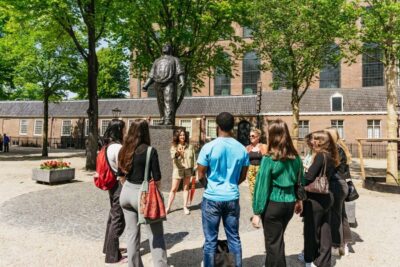
Life of Anne Frank and World War II Walking Tour
Read our review →
Anne Frank Walking Tour Amsterdam Including Jewish Cultural Quarter
Read our review →
Anne Frank’s Last Walk & See Anne Frank House in Virtual Reality
Read our review →
Anne Frank and Jewish Quarter Amsterdam Private Walking Tour
Read our review →
Browse the lists this tour appears in