
Review · CANAL CRUISES
Amsterdam: Historic City Sightseeing Canal Cruise
Amsterdam reveals itself from the water. This one-hour canal cruise gives you an easy look at the UNESCO-listed Canal Ring, grand canal houses, old churches, modern museums, and the wide waters of the IJ without making you march across town. At $18.71 per person, it is a sensible way to get your bearings, especially if your visit is short.
I like the central meeting point in front of the Anne Frank House, and I like the route’s mix of old and new Amsterdam. You can pass 400-year-old waterways, Amsterdam Centraal, the EYE Filmmuseum, the Hermitage building, and the Stopera in one sitting. The main caution is the commentary. Some sailings have a warm, funny captain who adds local color, while others depend heavily on recorded narration that can be hard to hear.
In This Review
- Five details that shape the experience
- Starting beside the Anne Frank House
- The Canal Ring, seen from street level below
- Westerkerk and the Prinsengracht
- Life aboard the Hendrika Maria
- Small canals and grand canal houses
- Bridges with stories of their own
- The former Lutheran church and Amsterdam’s changing uses
- Centraal Station, the IJ, and modern Amsterdam
- The Posthoornkerk and the Amstel
- Hermitage Amsterdam and the Stopera
- Commentary, comfort, and the real quality of the ride
- Is $18.71 good value?
- Who should book this Amsterdam canal cruise?
- FAQ
- Where does the Amsterdam canal cruise meet?
- How long does the canal cruise last?
- How much does the cruise cost?
- Is the cruise offered in English?
- How many people can join the cruise?
- Can I cancel for a full refund?
- Are service animals allowed?
Five details that shape the experience
- The route begins near the Anne Frank House: This makes the cruise easy to pair with a visit to the Jordaan or the Prinsengracht.
- You see more than postcard canals: The route includes historic canal houses, houseboats, churches, the IJ waterfront, and modern Amsterdam.
- The price is modest for a city overview: At $18.71, the cruise can save valuable walking time on a short visit.
- Live commentary is not always consistent: Guides such as Robert and Captain Rolif have been praised for humor and useful stories, but some departures rely on audio that can be unclear.
- The boat suits different weather: You can use the enclosed interior or, when conditions allow, sit outside for open views.
Starting beside the Anne Frank House
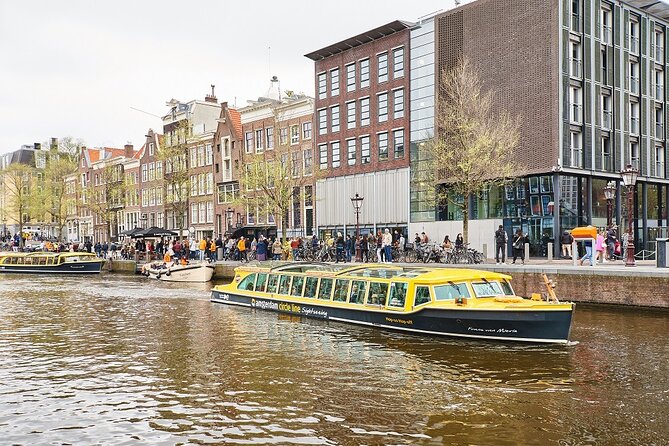
The departure point in front of the Anne Frank House is one of the strongest practical features. It is in central Amsterdam, close to the Westerkerk and the Jordaan, so you can fit the cruise neatly into a day of sightseeing.
You do not need to enter the Anne Frank House to find the canal departure area. Still, the location can be busy, and you should arrive on time rather than treating the start time as a loose suggestion. One especially important tip: check the exact departure details on your confirmation. Information connected with canal boats can vary by departure point, and an incorrect location or a changed sailing time can spoil an otherwise simple outing.
The Anne Frank House itself gives the canal a serious human meaning. Anne Frank and her family hid in the Secret Annex at the rear of the 17th-century building during the Second World War. The house is now a biographical museum dedicated to Anne and her diary, which was published in 1947. If you plan to visit, arrange that separately and well ahead of time, since same-day tickets may not be available.
The cruise does not replace a visit to the museum. It offers a different view of the Prinsengracht, showing the canal as part of a living city rather than only as the setting for one important building.
More Boat Tours in Amsterdam
- Amsterdam Classic Saloon Boat Cruise with Drinks and Cheese
★ 5.0 · 31,825 reviews - Amsterdam Luxury Canal Cruise + Unlimited Drinks & Bites option
★ 5.0 · 30,518 reviews - Amsterdam: Classic Boat Cruise with Optional Cheese & Wine
★ 4.6 · 22,925 reviews
The Canal Ring, seen from street level below
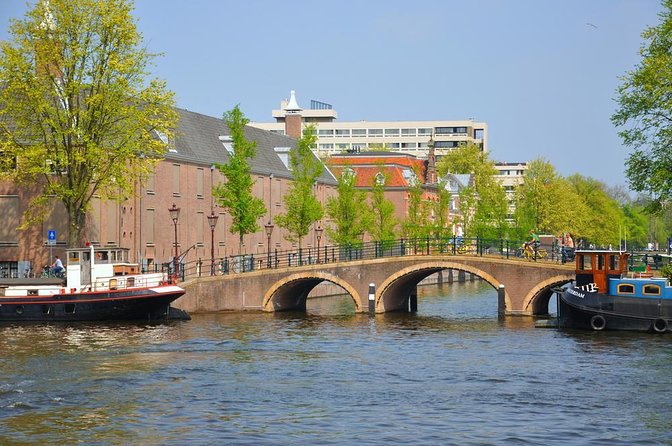
Amsterdam’s canal belt is most legible from a boat. Streets twist, bridges interrupt your view, and many historic facades are easier to appreciate from the canal than from a pavement crowded with bicycles.
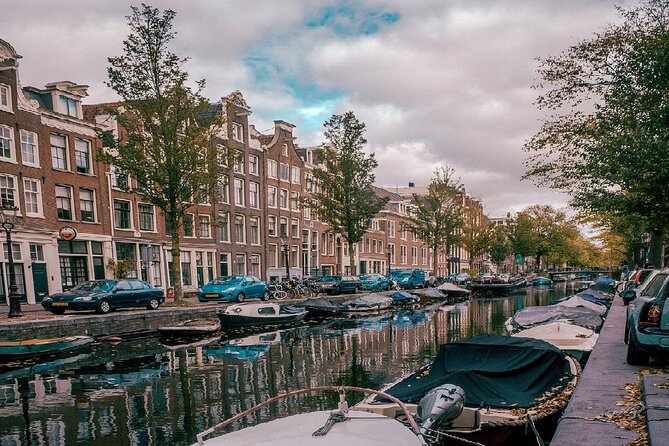
The route introduces you to canals developed over roughly 400 years. The waterway itself is the attraction, but the details around it make the ride worthwhile: narrow houses, varied rooflines, bridges, churches, houseboats, and old commercial buildings. You get a sense of how Amsterdam grew around water instead of simply building beside it.
The Museum of the Canals is part of the historical story presented along the route. The cruise does not give you a full museum visit, but it helps explain why the Canal Ring matters and how the city’s waterways shaped trade, housing, and movement.
Expect a relaxed pace rather than a detailed architectural lecture at every building. On the strongest departures, the captain adds small facts and jokes that make the city feel more approachable. On weaker ones, the trip is mainly scenic, with the recorded voice carrying most of the information.
Westerkerk and the Prinsengracht
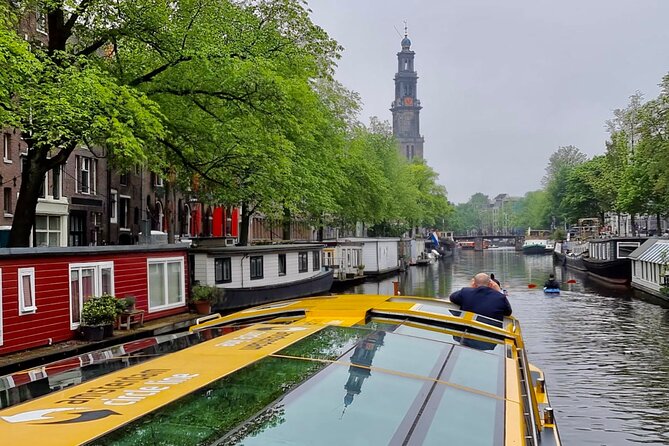
The Westerkerk is one of the most recognizable churches along this part of the city. It is a Reformed church in the Dutch Calvinist tradition, located beside the Jordaan between the Prinsengracht and Keizersgracht.
From the boat, its position helps you understand Amsterdam’s layout. The church sits right beside the Canal Ring, not in a detached square, so the building feels woven into the neighborhood. The nearby Anne Frank House adds another layer to the view, linking religious history, wartime memory, and ordinary city life in a very small area.
The cruise gives you an outside view only. If church interiors or detailed religious history matter to you, you will need a separate visit. For most people, the boat’s value here is the setting and the wider picture.
Life aboard the Hendrika Maria
The Houseboat Museum adds a pleasant change of scale to the route. It is located aboard the Hendrika Maria, a former cargo ship built in 1914. Its cargo hold became a compact home with living space and modern comforts.
This stop is useful because houseboats are part of Amsterdam’s everyday identity, not just a decorative feature for photographs. From the cruise, you can see how closely people live with the water and how old working vessels found new uses.
You should not expect the canal cruise to include a full visit inside the Houseboat Museum. Instead, the route lets you connect the museum’s idea with the many boats moored around the city. That is one of the more authentic parts of the outing, since it shows Amsterdam as a place where canals remain part of daily life.
More History Tours in Amsterdam
- Amsterdam Food and Cultural Tour with Tastings
★ 5.0 · 2,442 reviews - Amsterdam: Haunted History and Ghost Walking Tour
★ 4.5 · 488 reviews - Amsterdam High-End Dutch Food & History Tour – Up to 8 guests
★ 5.0 · 482 reviews - Amsterdam: Historical Highlights Walking Tour with Tasting
★ 4.6 · 381 reviews
Small canals and grand canal houses
The cruise passes the Leidsegracht, a cross-canal linking several major waterways in central Amsterdam. It is a good reminder that the city is not made up of one neat loop. Canals connect, cross, narrow, and change character as the boat moves through them.
You also pass the De Beulingsloot, one of the oldest and shortest canals in the center. It lacks the grand scale of the main waterways, but details like this reward you if you pay attention to the commentary and the turns of the route.
At Herengracht 170 to 172, the Bartolotti House gives you one of the Canal Ring’s best examples of wealth and ambition. It was built around 1617 for Willem van den Heuvel tot Beichlingen, who inherited money from his uncle by marriage, Giovanni Battista Bartolotti, a merchant from Bologna. From the canal, you see the ornate facade and the narrow proportions typical of Amsterdam’s historic houses.
The story is more interesting than simply calling the building pretty. These houses reflect the city’s commercial power and the social ladder of the canal belt. Look upward as you pass. Facades, gables, window patterns, and decorative details can be easy to miss from the street.
Bridges with stories of their own
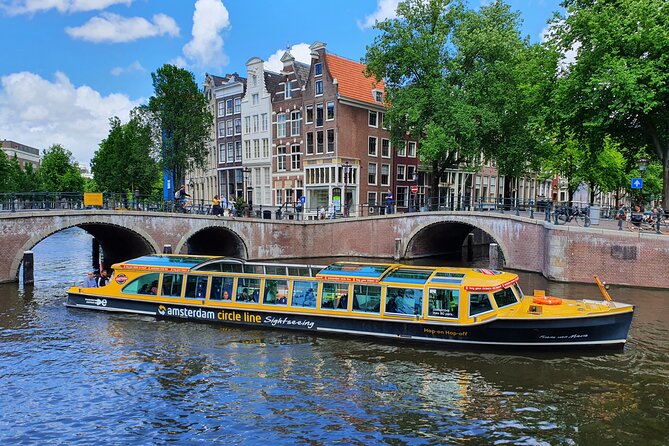
The Melkmeisjesbrug is a fixed bridge in central Amsterdam with a long history. Earlier versions appeared on maps from 1625, 1649, and 1662. A pedestrian drawbridge was replaced by a permanent bridge in 1883, then rebuilt in 1903 and again in steel in 1966.
Its name comes from the milk market once held nearby. Later, a restaurant displayed a milkmaid sign, helping preserve the name. This is exactly the sort of small local detail that can make a canal ride more enjoyable, provided your captain or audio system points it out clearly.
The bridge is also a reminder that the canal network changed as shipping patterns changed. It was possible to replace the drawbridge because boat traffic in that spot had largely ended, though the passage first proved too narrow. You are not only looking at an attractive crossing. You are seeing the city adjust its streets and waterways to new needs.
Brouwersgracht marks the northwestern edge of the Canal Ring and the northern edge of the Jordaan between the Prinsengracht and the Singelgracht. It was voted Amsterdam’s most beautiful street by readers of Het Parool in 2007. The canal is especially useful for understanding the border between the planned canal belt and the older-feeling Jordaan.
The former Lutheran church and Amsterdam’s changing uses
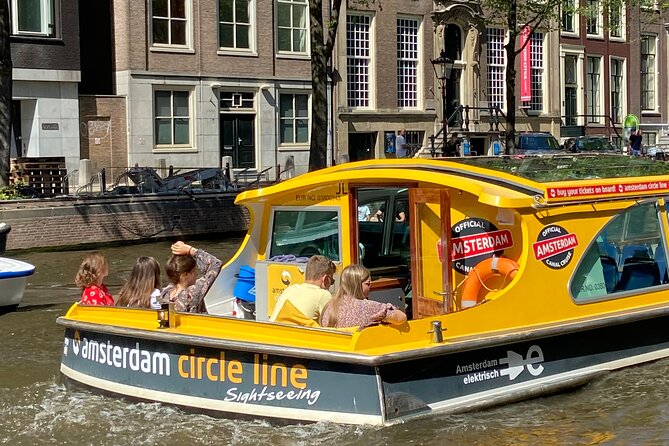
Another building along the route is a church designed by Adriaan Dortsman and opened in 1671. It was badly damaged in 1822, rebuilt in 1826, and later used as a concert hall after the Lutherans left in 1935.
The building’s later story is just as striking. A tunnel was built in 1975 for the neighboring hotel, and a restoration in the 1980s was followed by a dome fire in 1993. The church was restored again. From the water, you get a quick look at a building that changed from religious space to performance venue while remaining part of the city’s architectural fabric.
This section shows why a live guide can make a difference. A recorded narration may provide dates, but a captain who explains the building’s changing role can turn a passing facade into a memorable stop.
Centraal Station, the IJ, and modern Amsterdam
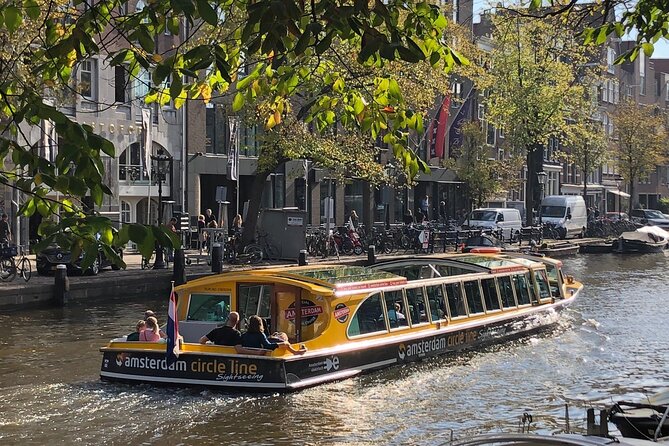
Amsterdam Centraal gives the cruise a grand urban landmark. The station was designed by Pierre Cuypers, the architect also associated with the Rijksmuseum. Cuypers is credited mainly with the decorative design, while railway engineers likely handled much of the structural work.
Seen from the water, the station forms a strong transition between the historic center and Amsterdam’s waterfront. After the tighter canals, the route reaches the IJ, the body of water that forms Amsterdam’s northern waterfront.
This wider stretch can feel like a breath of fresh air. You see a different Amsterdam here, one shaped by transport, ferries, modern housing, and large public buildings rather than only narrow canal houses. The change also gives you a better sense of the city’s geographic position.
The EYE Filmmuseum sits across the waterfront in a sharply modern building designed by Delugan Meissl Associated Architects. Its facilities include two gallery spaces, a 300-seat cinema, two 127-seat cinemas, and a smaller cinema with about 67 seats. You may not see all of that from the boat, but the building’s shape is easy to recognize.
This is one of the route’s most useful contrasts. In a single hour, Amsterdam moves from 17th-century canal planning to present-day film culture and waterfront design.
The Posthoornkerk and the Amstel
The Posthoornkerk was designed by P.J.H. Cuypers and built in stages from 1860 to 1889. It replaced an earlier hidden church on the Prinsengracht and had to be made especially tall because it could not be built free-standing.
Its exterior is neo-Gothic, while the interior drew on the late Romanesque Munsterkerk in Roermond. Galleries above the side aisles helped the builders use limited space efficiently. Again, the best details are easy to miss without some explanation, so listen carefully if the narration identifies the church.
The route also reaches the Amstel, the river that gave Amsterdam its name. It flows north toward the IJ and remains part of major city events, including the Liberation Day concert, the Head of the River rowing race, and the annual Pride boat parade.
The river section feels broader and more open than the enclosed Canal Ring. It gives you a pause from close-set facades and makes clear that Amsterdam’s waterways are not all alike.
Hermitage Amsterdam and the Stopera
The Hermitage Amsterdam occupies the former Amstelhof, a classical building from 1681 on the Amstel’s banks. The Amsterdam branch of the Hermitage opened its main museum in 2009 and included large exhibition halls, smaller galleries, lecture rooms, offices, and a restaurant.
Even if you do not enter, the building adds an impressive classical note to the riverfront. You can use the cruise to mark places you may want to return to on foot.
The Stopera comes next as a very Amsterdam kind of building: practical, large, and politically contentious. It houses Amsterdam’s city hall and the Dutch National Opera and Ballet. Architects Wilhelm Holzbauer and Cees Dam designed the complex.
Its name came from the protest slogan Stop the Opera, not from a blend of city hall and opera. That small fact captures Amsterdam’s habit of arguing openly about major public projects. The cruise presents the building as part of the city’s current civic life, not just as another facade.
Commentary, comfort, and the real quality of the ride
The boats are described as comfortable, smooth, and suitable for different weather. You can choose an enclosed interior or an outdoor area when conditions permit. Glass and open viewing areas can give you good sightlines, though rear seats may offer less audible commentary.
That point matters. Several departures have been praised for friendly, funny captains and clear local stories. Robert has been singled out for showing off the city with warmth, while Captain Rolif has been praised for speaking several languages, adding humor, and offering useful suggestions for other things to do.
The weak point is sound. Some people have struggled to hear the taped narration, especially toward the back of the boat or in rainy conditions. Recorded information may switch between languages without much pause, and one account noted that the audio was sometimes only in Dutch. The experience is offered in English, but you should not assume every seat receives equally clear English commentary.
If learning about architecture and history is your main reason for booking, sit where you can hear the guide or speaker. If views matter more, choose the position with the clearest sightlines. The maximum group size is 68, so the atmosphere may range from roomy and relaxed to fairly full depending on the sailing.
Is $18.71 good value?
For $18.71, I think the cruise offers good value as a first look at Amsterdam. You get a compact overview of the Canal Ring, the IJ, the Amstel, historic buildings, houseboats, and modern landmarks without paying for a long excursion.
The value is strongest if you have only a day or two. A sunny ride can show you places you might not have time to reach on foot, and the route helps you decide where to return later. Families, solo visitors, and people who want a low-effort introduction to the city can all make good use of it.
It is less compelling if you want a specialist architecture tour or a fully guided history lesson. The content can vary by captain, and the audio system is not perfect. I would treat the cruise as a scenic orientation, not as your only source of information about Amsterdam.
Free cancellation is available if you cancel at least 24 hours before the start time. Changes or cancellations inside that window are not accepted for a refund. Service animals are allowed, public transportation is nearby, and most people can participate.
Who should book this Amsterdam canal cruise?
Book it if you want a short, affordable overview and prefer seeing the city from the water. It is particularly useful at the start of a visit, after the Anne Frank House, or during a packed itinerary when your feet need a break.
I would also recommend it for anyone interested in the contrast between Amsterdam’s old canal belt and its newer waterfront. The route covers a lot of ground in a short time.
Skip it if you need guaranteed, detailed live commentary at every landmark. In that case, look for a smaller specialist tour with a clearly advertised live guide. For most visitors, though, this is an easy and pleasant way to see Amsterdam’s structure, stories, and waterways before exploring deeper on foot.
FAQ
Where does the Amsterdam canal cruise meet?
The meeting point is in front of the Anne Frank House in central Amsterdam.
How long does the canal cruise last?
The experience lasts approximately one hour.
How much does the cruise cost?
The listed price is $18.71 per person.
Is the cruise offered in English?
Yes. The experience is offered in English, though some departures use recorded narration in multiple languages.
How many people can join the cruise?
The activity has a maximum group size of 68 people.
Can I cancel for a full refund?
Yes, if you cancel at least 24 hours before the experience start time. Cancellations made less than 24 hours in advance are not refunded.
Are service animals allowed?
Yes, service animals are allowed on the experience.
More Canal Cruises in Amsterdam
- Amsterdam: 75 Minute City Canal Cruise with Audio Guide
★ 4.4 · 17,501 reviews - Amsterdam: City Centre Canal Cruise
★ 4.2 · 12,827 reviews - Amsterdam: City Canal Cruise and Heineken Experience Ticket
★ 4.5 · 5,367 reviews - Amsterdam Canal Cruise in Open Boat with Unlimited Drinks Option
★ 5.0 · 4,976 reviews
Just added in Amsterdam
- Private Tour Zaanse Schans Windmills and Volendam in Jaguar★ 5.0 · 10 reviews
- Zaanse Schans and Giethoorn Unique Day Trip with Boat Cruise★ 4.5 · 17 reviews
- Windmills-Volendam-Giethoorn Private Tour in Jaguar★ 5.0 · 2 reviews
- Half-Day Private Guided Sightseeing Tour of Zaanse Schans★ 5.0 · 14 reviews
- Best of Netherlands: Zaanse Schans Mills, The Hague & Rotterdam★ 4.5 · 10 reviews
- Zaanse Schans Private Tour Windmills★ 5.0 · 18 reviews
- Zaanse Schans Windmills Edam Volendam and Marken from Amsterdam★ 5.0 · 1 review
- Half Day Keukenhof Tulip Paradise Trip from Amsterdam★ 5.0 · 1 review
Canal Cruises, compared.
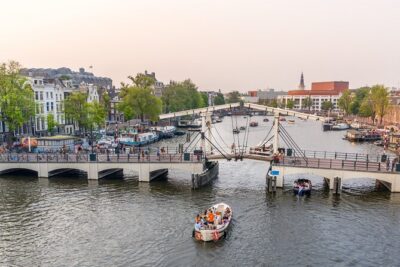
Amsterdam Luxury Canal Cruise + Unlimited Drinks & Bites option
Read our review →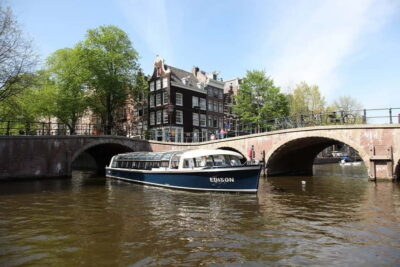
75 Minute City Canal Cruise with Audio Guide
Read our review →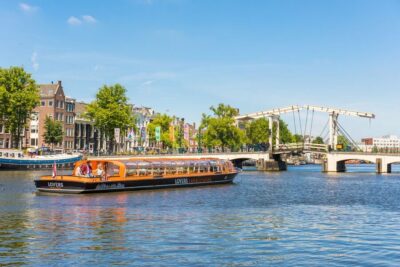
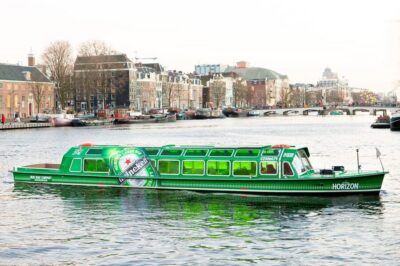
City Canal Cruise and Heineken Experience Ticket
Read our review →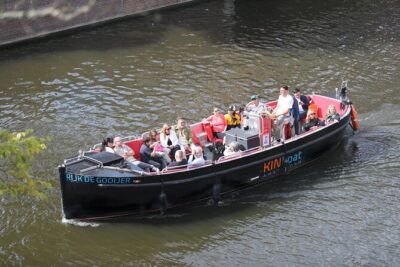
Amsterdam Canal Cruise in Open Boat with Unlimited Drinks Option
Read our review →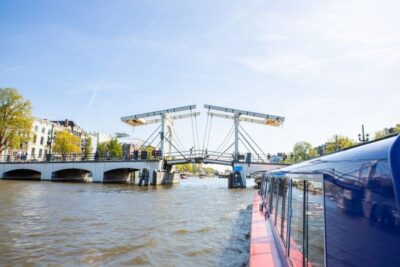

Amsterdam Evening Canal Cruise with Live Guide and Onboard Bar
Read our review →
Browse the lists this tour appears in