

Review · SCAVENGER HUNTS & CITY GAMES
e-Scavenger hunt Utrecht: Explore the city at your own pace
Utrecht rewards curious walkers. This self-guided city trail turns the center into a quiz board, leading you from the Dom Tower and old canals to flower stalls, churches, courtyards, and less obvious corners. I like the freedom to pause for lunch, take a wrong turn, or spend extra time at a favorite square without waiting for a guide.
I also like the price: $37.21 per group of up to six, not per person. That makes it a sensible choice for friends or family groups. The main drawback is the app. A few questions and map pins can feel unclear, and the answers do not always provide enough explanation for anyone wanting a serious history lesson.
In This Review
- Key points before you book
- Starting beneath Utrecht’s 112.5-meter symbol
- From musical boxes to Utrecht’s oldest churches
- Flower stalls and the Oudegracht
- A fort, a university garden, and the railway story
- Neude, Nicolaïkerk, and the city’s changing shape
- Quiet lanes at De Zeven Steegjes
- Janskerk, Paushuize, and Utrecht’s civic center
- How the app and puzzles work in practice
- Price, timing, and who gets the best value
- Should you book the Utrecht e-scavenger hunt?
- FAQ
- Where does the e-scavenger hunt begin?
- Where does the activity end?
- How long does the hunt take?
- How many people can join one booking?
- Is a smartphone included?
- What language is the activity offered in?
- Is this a private activity?
- Can I cancel for a full refund?
Key points before you book

- The route begins and ends at Domplein 20, placing you beside Utrecht’s most famous landmark.
- A group of up to six shares one booking, so the cost can be excellent value for a small team.
- Expect roughly two to four hours, although taking breaks and following side streets can make the outing much longer.
- The route mixes famous sights with quieter places, including De Zeven Steegjes and Sterrehof.
- You play through your own smartphone, and mobile data is not included.
- The challenge is best for people who enjoy light puzzles, not for those seeking a detailed, guide-led history tour.
Starting beneath Utrecht’s 112.5-meter symbol
The trail starts at Domplein, in the heart of Utrecht, with the Dom Tower as your natural reference point. At 112.5 meters, it is the tallest church tower in the Netherlands and the city’s best-known symbol. Even if you do not spend long at the square, beginning here gives the game a clear sense of place.
This is a good starting point for a self-guided activity because you can get your bearings before the route sends you into the surrounding streets. You are not being hurried through a speech or asked to keep up with a group. Instead, you read the prompt, look around, and decide how much time you want to give each stop.
The trail is designed around questions, facts, and location-based tasks. When you reach a point, remember to activate any bonus points in the app. That small step matters if your group wants to compare scores at the end.
The competitive element is light but useful. It gives children, mixed-age families, and friends a reason to pay attention to details they might otherwise walk past. I would treat the score as entertainment rather than a serious contest, especially since one incorrect answer or a poorly worded question can affect the result.
More Scavenger Hunts in Utrecht:
- Discover Utrecht with a self-guided Outside Escape city game tour
★ 4.5 · 51 reviews - Utrecht Scavenger Hunt and Highlights Self Guided Audio Tour
★ 4.0 · 10 reviews - Discover Utrecht’s Zocherpark in this Outside Escape game tour!
★ 5.0 · 2 reviews
From musical boxes to Utrecht’s oldest churches
One stop focuses on a collection of self-playing musical instruments. The displays include music boxes, clocks, pianolas, and barrel organs. That is a welcome change from a route made up only of grand buildings and church facades. It adds a mechanical, musical side to Utrecht’s cultural life.
The stop works especially well for groups with different interests. Someone who is not eager to inspect another medieval building may enjoy the unusual instruments, while history-minded players still get a break from the standard sightseeing circuit.
The route then brings you to one of the city’s oldest churches. Construction began in 1039, and the church was inaugurated on May 1, 1048. Dates like these are useful reminders that Utrecht is not simply a pretty canal city. Its story reaches far back into the early medieval period.
You should keep your expectations in check, however. The game gives you a prompt or a short piece of information, but it does not offer the sort of extended explanation you would receive from a specialist guide. If a particular church catches your attention, note its name and investigate it later.
Flower stalls and the Oudegracht
The flower market adds color and movement to the middle of the route. You can expect cut flowers and plants in a range of colors, with the market feeling comfortably busy rather than overwhelming. It is a pleasant place to slow down and look around, even if you are mainly there to answer a question.
I like this kind of stop because it shows daily Utrecht, not just official monuments. A market tells you something about how the city is used now. It also gives your group a natural chance to pause before continuing.
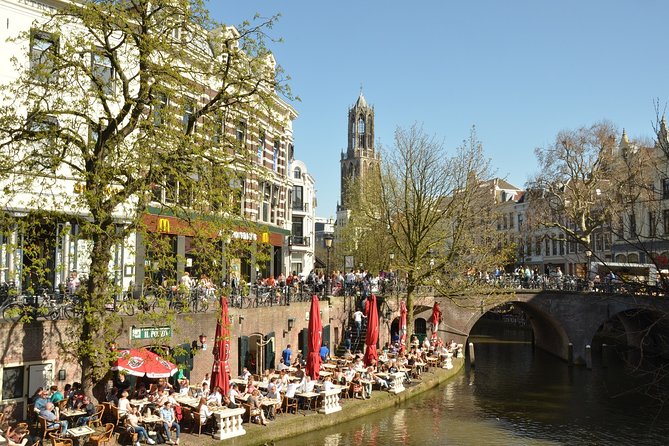
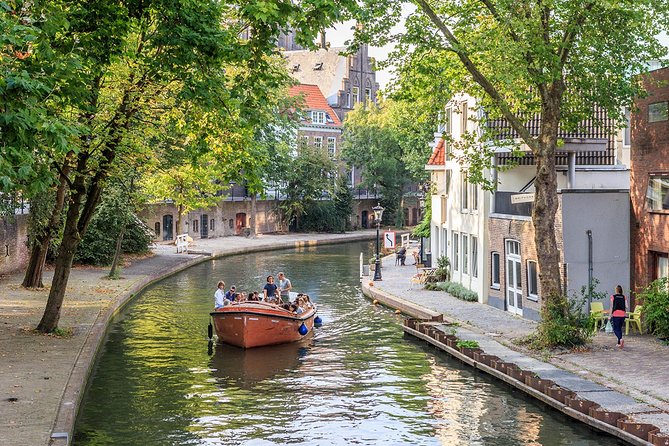
Next comes the Oudegracht, or old canal, which runs through the center. Utrecht’s canal is different from the broad canal views many people associate with Amsterdam. Restaurants sit along the lower canal level, creating an unusual layout and giving the waterway a lively social side.
You will likely want to allow extra time here. The route may ask you to look closely at the surroundings, but the real pleasure is simply walking beside the water and noticing the old buildings, bridges, and restaurant terraces. The trail is flexible enough for a drink or meal along the way.
One practical point: the advertised duration is two to four hours, but that is not a strict limit. A group that pauses for food, takes detours, and explores every stop can walk much farther. One outing covered about 10 kilometers. You should wear comfortable shoes and avoid planning a tight appointment immediately afterward.
A fort, a university garden, and the railway story
The botanical garden is located on the Utrecht University campus around a former fort. That fort was part of the Holland Water Defence system, a military line that used controlled flooding as protection. It is an interesting change of scene from the city center, linking plants, university life, and Dutch defensive engineering.
The supplied route information does not say that admission to the botanical garden is included, so you should treat this as an exterior or location-based stop unless the app clearly states otherwise. That distinction matters if you are hoping to spend time inside every attraction.
The Railway Museum provides another change of subject. It is described as much more than a standard museum, with a focus on the excitement of rail travel as well as its objects and stories. For families, this can be one of the more appealing stops because trains tend to hold attention across age groups.
Again, check the activity’s scope. The e-scavenger hunt includes the city trail, not a separate museum admission. You may pass the museum or use it as a reason to plan a return visit, but do not assume the $37.21 group price covers entry.
These two stops also show the broad range of the route. You are not only ticking off famous churches. You are moving through Utrecht’s military past, university setting, transport history, and public spaces.
A few more options to weigh up in Utrecht
- Utrecht: City Canal Cruise
★ 4.3 · 2,895 reviews - Utrecht: De Haar Castle & Park Entry Ticket
★ 4.7 · 1,350 reviews - Utrecht: DOMunder Entry Ticket with Guide
★ 4.4 · 706 reviews - Utrecht: Dom Tower Entry Ticket and Guided Tour
★ 4.6 · 513 reviews
Neude, Nicolaïkerk, and the city’s changing shape

Neude is one of Utrecht’s important squares. Its name comes from node, meaning swamp, and the area was once much lower than it is today. That is the sort of compact fact that makes a city walk more rewarding. You begin to picture how the ground itself, not only the buildings, has changed over time.
The square is also a useful break point. If your group needs food, a drink, or a short rest, this kind of open city space is more practical than stopping in the middle of a narrow lane.
The Nicolaïkerk, also called the Nicolaaskerk, is located at Nicolaaskerkhof 8. Its two names can be useful to know because Utrecht uses both the formal and popular versions. The church gives the route another chance to show how religious buildings shaped the city’s neighborhoods.
I would not expect every stop to deliver a full explanation of its architecture. The questions are designed to keep you moving and playing. They are educational in a light way, but the activity is not a substitute for a church tour or a history book.
That balance is important. I like the game most when I treat each answer as a prompt to notice something. If you want every date, architectural term, and historical connection explained on the spot, you may find the content too thin.
Quiet lanes at De Zeven Steegjes

De Zeven Steegjes is one of the last working-class neighborhoods in central Utrecht. Its characteristic workers’ houses near the Oudegracht give you a look at a more modest side of the city.
This is one of the route’s best ideas. Famous landmarks are easy to find on a standard city map. Small residential lanes are easier to miss, yet they often tell you more about ordinary urban life. The narrow streets and compact homes provide a contrast with the ceremonial spaces around the Dom Tower.
You should keep the neighborhood respectful. It is a lived-in area, not an open-air stage set. Walk quietly, avoid blocking entrances, and remember that people live behind the doors you are examining.
The route also includes the Sterrehof, a city courtyard valued as a national monument. Courtyards reward a slower pace. From the main street, you may not expect a peaceful enclosed space nearby, which is exactly why this type of stop works well in a scavenger hunt.
I appreciate that the activity uses these places to break up the grand sightseeing. You get churches and civic buildings, but also residential history and small urban spaces. That mix gives the walk more character.
Janskerk, Paushuize, and Utrecht’s civic center
The Janskerk sits on Janskerkhof. Bishop Bernold founded it shortly after 1040, and it is dedicated to John the Baptist. The church helps connect Utrecht’s religious past with the city’s present-day public squares.
Paushuize, on Pausdam, dates from the beginning of the sixteenth century. It is an important monumental building and gives the route a look at a later period of Utrecht’s history. The name and location also make it an easy stop to remember.
The city hall brings the story into civic life. Its oldest parts date from 806, although the building developed into its present form over centuries. That long timeline is useful because it shows that Utrecht’s city center was not built in one period. It is a mixture of additions, changes, and adaptations.
The route also passes the foundation building on Agnietenstraat. Completed in 1761, it was originally a boarding school for orphaned boys and is regarded as a major example of Dutch rococo architecture. This is a particularly good stop for architecture fans because it adds an eighteenth-century style to a route otherwise weighted toward medieval buildings.
You may find the sequence of topics a little jumpy. The trail can move from a church to a courtyard, then to a civic building or architectural detail without much connecting explanation. That is a weakness if you want a carefully narrated story. It is less of a problem if you see the activity as a collection of short discoveries linked by a walk.
How the app and puzzles work in practice
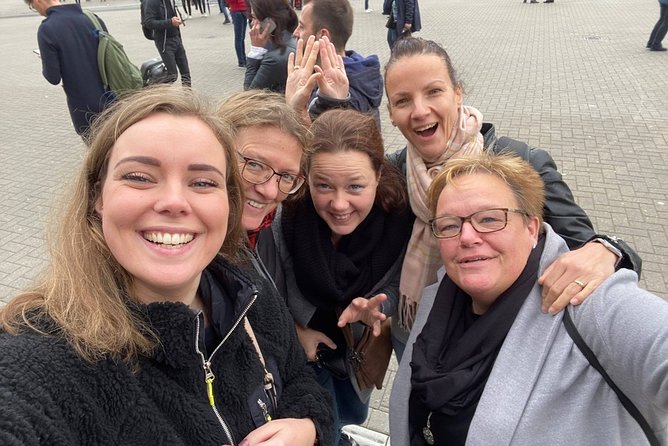
The experience is private, so only your own group takes part. You can play with up to six people under one booking, or divide into teams if you want a little competition. A group of three to six is probably the most comfortable size for discussing answers without slowing the walk too much.
You need a smartphone and data connection. Those are not supplied, so charge your phone before starting and make sure the person handling the app has reliable mobile service. Since the activity is offered in English, it is suited to English-speaking groups.
The app is generally easy to navigate, with interactive assignments and a scorecard at the end. The game format gives the walk purpose, especially for people who lose interest during ordinary sightseeing.
Still, the technology is not flawless. Some map pins have been reported as sitting far from the actual answer location. At times, hints can be unhelpful, and at least one answer has been flagged as incorrect. Questions can also feel unrelated to the place you are standing in.
My advice is simple: do not let one stubborn question spoil the afternoon. Check the surroundings carefully, use the available hint, and keep moving if the location marker seems wrong. If your group cares about a perfect score, these glitches may irritate you. If you mainly want an unusual route through Utrecht, they are easier to forgive.
The explanations also tend to be brief. The game teaches you something, but not always enough to satisfy a strong interest in the subject. Keep a note of the names that catch your attention and look them up afterward if you want more detail.
Price, timing, and who gets the best value
At $37.21 per group of up to six, the cost works out well for a full group. Six people pay roughly $6.20 each, before any currency or booking charges. Even a couple can find value in it if they want a private activity with a route, questions, and a final score rather than a free walk with no structure.
The price is less attractive if you expect admissions, a guide, or a full museum experience. None of those are included in the stated package. You are paying for the city trail and game, while food, drinks, attraction tickets, a smartphone, and data remain your responsibility.
The activity is listed as available every day, with operating hours shown from midnight to 11:59 p.m. That wide window gives you plenty of freedom, although daytime is the practical choice for seeing markets, buildings, and streets clearly.
Most people can participate, and service animals are allowed. It is also described as user-friendly for people with hearing impairments. Since the route is self-guided, you avoid the challenge of following spoken commentary in a noisy group.
Free cancellation is available if you cancel at least 24 hours before the start time. Cancellations within 24 hours are not refunded, and late changes are not accepted.
Should you book the Utrecht e-scavenger hunt?
I would book this for a small group that wants freedom, light competition, and a broad look at Utrecht. It suits friends, families with older children, and mixed-age groups who enjoy solving questions while walking. It is also a good choice if you already know the central sights and want the route to point you toward places you might otherwise miss.
I would choose a different activity if you want a guide to explain every building in depth, a polished historical narrative, or guaranteed precision from every map pin. The occasional app problem and thin answer explanations are real limitations.
For the best experience, start with a charged phone, allow more than two hours if you plan to stop, wear good walking shoes, and budget for a café or canal-side meal. Use the score as a bonus, not the main event. The real value is the route itself: Utrecht’s famous tower, old churches, flower market, canals, courtyards, workers’ streets, and civic buildings become one long, playful introduction to the city.
FAQ
Where does the e-scavenger hunt begin?
It begins at Domplein 20, 3512 JD Utrecht, Netherlands.
Where does the activity end?
The activity ends back at the meeting point.
How long does the hunt take?
The estimated duration is about two to four hours. Your group can take longer if you stop for food, drinks, or extra sightseeing.
How many people can join one booking?
One group can include up to six people.
Is a smartphone included?
No. You need to bring your own smartphone and mobile data.
What language is the activity offered in?
The activity is offered in English.
Is this a private activity?
Yes. Only your own group participates.
Can I cancel for a full refund?
Yes, if you cancel at least 24 hours before the scheduled start time. Cancellations within 24 hours are not refunded.
Just added in Utrecht
- Vecht River: Private Tour sightseeing Cruise with diner★ 5.0 · 5 reviews
- Utrecht Walking Tour with a local comedian as guide★ 4.8 · 5 reviews
- Utrecht Quiz Tour★ 3.2 · 31 reviews
- Utrecht: Museum Speelklok Entry Ticket★ 4.5 · 48 reviews
- Utrecht: Vegan Food Bike Tour – 6 Tastings (excl. bike)★ 5.0 · 7 reviews
- Utrecht or Amsterdam Sidecar Tour. City, rural or TAILORMADE★ 5.0 · 2 reviews
- Utrecht: Lofen Palace with Entry Ticket & Guide (Dutch)★ 4.4 · 41 reviews
- Utrecht: Ludwig’s Original Pub Crawl with VIP Club Entry★ 3.3 · 42 reviews
Scavenger Hunts & City Games, compared.

e-Scavenger hunt Maastricht: Explore the city at your own pace
Read our review →
e-Scavenger hunt Middelburg: Explore the city at your own pace
Read our review →
Rotterdam Highlights & Spies: Interactive City Game
Read our review →
Discover Utrecht with a self-guided Outside Escape city game tour
Read our review →
e-Scavenger hunt Den Bosch: Explore the city at your own pace
Read our review →
e-Scavenger hunt Deventer: Explore the city at your own pace
Read our review →
Discover Amerfoort’s city center in this Outside Escape game tour
Read our review →
Discover Delft with a self-guided Outside Escape city game tour!
Read our review →Browse the lists this tour appears in