
Review · ROTTERDAM TOURS
Rotterdam: Wilhelminapier, High-rise & floating architecture
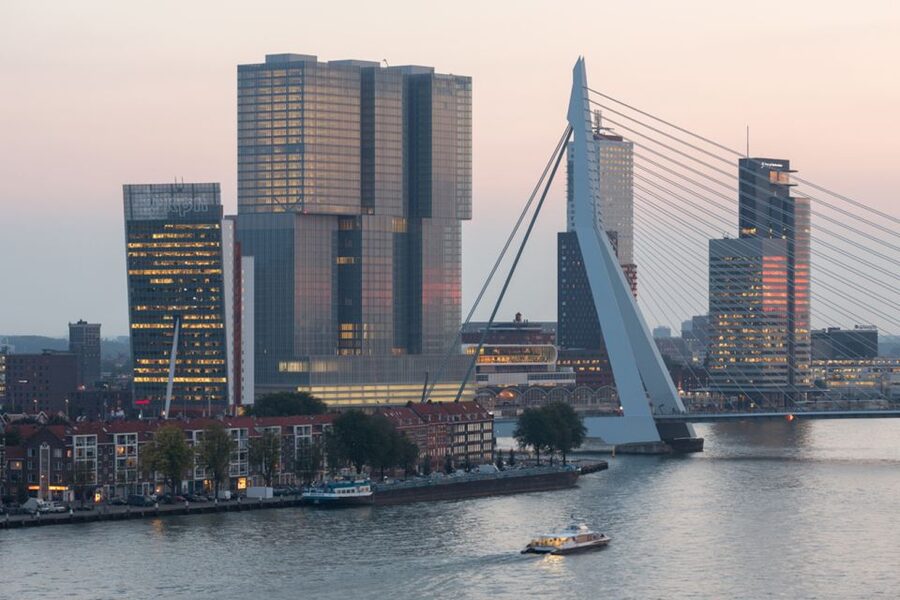
Rotterdam’s skyline tells a story. This private walking tour makes that story easy to read, taking you through the transformed Wilhelminapier, past bold high-rises, into a former harbor warehouse, and up to a rooftop view from Pakhuismeesteren. I especially like the mix of architecture and port history, along with the chance to see the area from street level and above. The floating hotel, park, and office add a modern engineering angle that gives the walk more substance than a simple photo stop.
I also like the small personal touches: a tasty Dutch treat and a postcard featuring Rotterdam architectural photography by Ossip van Duivenbode. The main drawback is the price. At $286 for a private group of up to six, it can be good value for a full group, but expensive for one or two people during a tour that lasts only one hour.
In This Review
- Key points to know before booking
- Starting outside Het Nieuwe Luxor Theater
- Why Wilhelminapier matters
- Reading De Rotterdam from the outside
- Inside Pakhuismeesteren and up to the roof
- Foodhallen: architecture with something to eat
- Rijnhaven’s floating hotel, park, and office
- Ending near the Fenix migration museum
- Is $286 good value for one hour?
- Who should book this architecture walk?
- Should you book the Wilhelminapier tour?
- FAQ
- Where does the tour meet?
- How long does the tour last?
- What is the price?
- Is the tour private?
- Which languages are available?
- Is rooftop access included?
- Is the tour wheelchair accessible?
- Where does the tour finish?
Key points to know before booking
- The tour begins outside Het Nieuwe Luxor Theater, the red building on the Wilhelminapier, making the meeting point easy to identify.
- Pakhuismeesteren is the main interior stop, with access to its rooftop and a view across Rotterdam’s famous architecture.
- The former Holland America Line connection gives the district context, helping you understand why the Wilhelminapier changed so dramatically.
- De Rotterdam is explained through its concept and design, rather than simply being treated as another tall building.
- Floating projects along Rijnhaven include a hotel, park, and office, showing Rotterdam’s interest in building on water.
- The private format works best for families or small groups, especially if you can share the $286 cost across six people.
Starting outside Het Nieuwe Luxor Theater
Your guide meets you outside Het Nieuwe Luxor Theater, the red building near the Wilhelminapier. That is a useful landmark in an area filled with large modern structures, and the meeting point puts you right in the middle of Rotterdam’s architectural story from the first minute.
The tour lasts one hour, so expect a brisk and focused walk rather than a slow neighborhood wander. You will hear about the history, design, and changing purpose of the pier while moving between the buildings. I would arrive a few minutes early, since a short tour benefits from getting started promptly.
The tour is private, with space for a group of up to six. That matters here. Architecture explanations often work better when you can ask direct questions, and a small group makes it easier to pause for photographs or clarify a detail about a building.
The guide can lead the tour in Dutch, English, German, Spanish, or French. This broad language choice is useful for mixed-language families and groups, though you should select the language you need when checking availability.
A few more options to weigh up in Rotterdam
- Rotterdam: Harbor Sightseeing Cruise
★ 4.3 · 7,599 reviews - Rotterdam: 1-Hour Sightseeing Splash Tour
★ 4.5 · 3,299 reviews - Rotterdam: Rotterdam Zoo Blijdorp Entry Ticket
★ 4.6 · 2,754 reviews
Why Wilhelminapier matters
The Wilhelminapier was once tied closely to Rotterdam’s port activity and the Holland America Line. Ships and passengers once passed through this part of the city, connecting Rotterdam with distant destinations. Today, the same area is known for high-rise architecture, hotels, restaurants, cultural venues, and views across the water.
That change is the central idea of the tour. You are not simply looking at attractive buildings. You are seeing how a former harbor district was given a new purpose through major architectural projects.
I find this useful because Rotterdam can look like a collection of unrelated towers if you explore it without context. A guide helps connect the pieces. The old port function explains the location, while the newer buildings show how the city chose to present itself in the modern era.
The Holland America Line connection also adds a human layer. The district was not just a work zone or a place for cargo. It was a departure point for people beginning new lives overseas. The tour’s final location near the Fenix migration museum reinforces that link between movement, migration, and Rotterdam’s waterfront.
Reading De Rotterdam from the outside
A major focus is De Rotterdam, one of the Wilhelminapier’s best-known high-rise complexes. The guide explains its concept and design, giving you a way to understand the building beyond its size.
The value here is interpretation. Modern architecture can be hard to read at first glance. A tower may look like stacked blocks, shifted volumes, or a wall of glass, but those shapes often reflect how the building is divided and used. A professional guide can point out the design choices and explain why De Rotterdam became such an important part of the city’s new identity.
You should expect the stop to focus on the building’s history, concept, and design rather than a long interior visit. That keeps the tour moving, but it also means the experience suits people who want a clear introduction rather than a technical architecture lecture.
For photographers, the high-rise setting offers plenty to work with. Look for the way separate forms appear to overlap as you change position. On a short tour, your guide will likely keep the group moving, so have your camera or phone ready before reaching the best viewpoints.
Inside Pakhuismeesteren and up to the roof
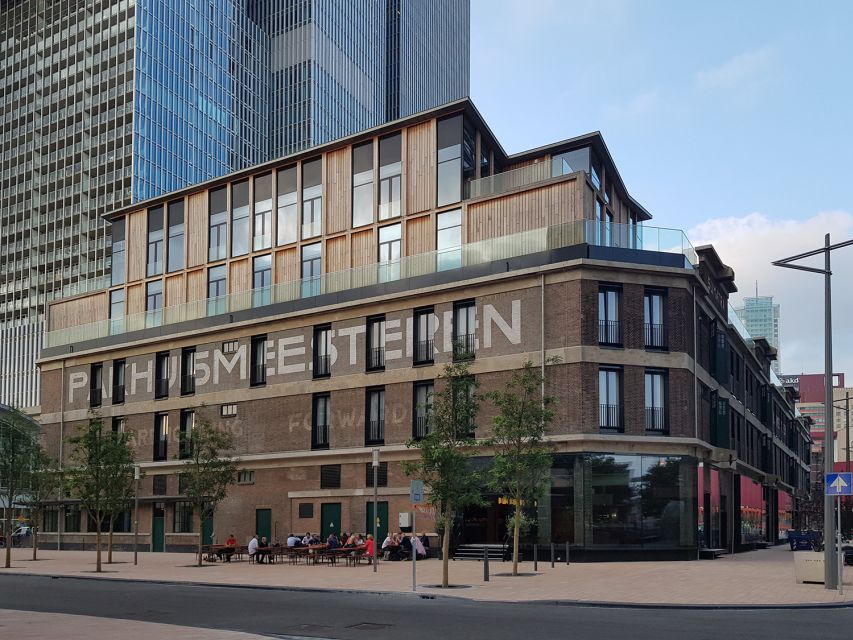
Pakhuismeesteren is one of the most appealing stops because it combines old port use with new city life. The building was formerly a harbor warehouse. It now contains a hotel and the Foodhallen, a food destination that gives the tour a more everyday feel.
The building is worth seeing from inside because its current use does not erase its earlier purpose. You get a sense of how Rotterdam has reused a working port structure rather than replacing every older building with something new.
The rooftop visit is included, and this is likely the visual high point of the hour. From above, you can take in Rotterdam’s skyline and see how the Wilhelminapier fits into the wider city. The view gives shape to the guide’s earlier explanations. Instead of hearing about a collection of buildings one at a time, you can see their relationship from a single position.
The rooftop is also where the tour offers its strongest photo opportunity. You can photograph the city’s high-rises, the water, and the layered architecture of the waterfront. Since rooftop access is part of the experience, check that the starting time suits your plans and that you are comfortable with a short walk between stops.
The tour includes a postcard featuring Rotterdam architectural photographer Ossip van Duivenbode. It is a small item, but it fits the theme well and gives you a tangible reminder of the city’s modern buildings.
A different kind of day out entirely:
- Rotterdam: Euromast Lookout Tower Ticket
★ 4.4 · 2,549 reviews - Rotterdam: Pancake Cruise
★ 4.4 · 1,986 reviews - Rotterdam: Kinderdijk UNESCO World Heritage Entry Ticket
★ 4.6 · 1,477 reviews - Rotterdam: Harbor Cruise with Live Guide
★ 4.0 · 1,270 reviews
Foodhallen: architecture with something to eat
Foodhallen is located in Pakhuismeesteren and is described as a must-see for food lovers. It brings a practical, social use into a tour that could otherwise feel focused only on towers and design concepts.
The experience includes a tasty Dutch treat. The information does not specify the exact snack, so do not book expecting a particular dish. Think of it as a small local touch during the architectural walk, not a full meal or food tour.
If you are hungry, Foodhallen may tempt you to stay longer than the schedule allows. The one-hour format is tight, so the included treat should not be confused with time for a full meal. You might want to return afterward if you would like to explore the food options at a slower pace.
This stop is especially useful for families and mixed-interest groups. Someone fascinated by architecture can focus on the building, while a food lover gets a glimpse of how the renovated warehouse is used today.
Rijnhaven’s floating hotel, park, and office
After the high-rise buildings and warehouse interior, the tour turns toward floating innovation along Rijnhaven. You will see a floating hotel, a floating park, and a floating office.
These projects show a different side of Rotterdam’s architectural thinking. The city is not only building upward with towers. It is also testing ways to make use of the water itself. That makes this section valuable because it expands the meaning of modern architecture from appearance to function.
The floating projects are viewed as part of the walk, rather than presented as long interior visits. You should expect an explanation of the concepts and a chance to look at the structures from the waterfront. If you enjoy practical design questions, this may be one of the most interesting sections: how can a city use limited land, support new functions, and work with water rather than treating it only as a barrier?
The tour description calls attention to a floating hotel, park, and office, but it does not promise access inside each one. Plan on seeing and discussing them from outside.
Ending near the Fenix migration museum
The walk ends near Fenix, Rotterdam’s newest icon and migration museum. The ending location is a smart fit with the Wilhelminapier’s past.
You begin near a former Holland America Line setting, learn how the harbor district changed, and finish close to a museum focused on migration. Even within one hour, the route links the waterfront’s old role as a departure point with its present role as a place for culture, design, and public life.
Because the tour ends near Fenix rather than returning to the theater, you should keep that in mind when planning the rest of your day. The final location may be convenient if you want to continue exploring the waterfront, but it is less convenient if you need to return immediately to the starting point.
Is $286 good value for one hour?
The cost is $286 per private group of up to six. Split six ways, that is about $47.67 per person. At that group size, the price can make sense for a family or group of friends that wants a private guide, a rooftop entrance, and a focused introduction to the Wilhelminapier.
For two people, the cost rises to $143 each. For a solo visitor, it is a very expensive way to spend one hour. The private format is the key value point, not the duration alone.
The included rooftop access, Dutch treat, and postcard add something, but they do not change the basic calculation. You are paying mainly for the guide’s interpretation, the private setting, and the organized route through several architectural highlights.
I would compare this tour with your own interests. If you already know Rotterdam’s architecture well, one hour may feel short for the price. If you are new to the city and want a clear explanation of the Wilhelminapier without arranging your own route, the cost is easier to justify.
The tour received a rating of 4 out of 5 from three verified bookings. The written feedback points to three consistent strengths: the walk is interesting, the interior of Pakhuismeesteren is worth seeing, and the background information adds value. One participant specifically enjoyed a fun walk with Willem and learned more about Rotterdam along the way. That suggests the guide’s personality can shape the experience, as it does with any private tour.
Who should book this architecture walk?
I would recommend it most strongly to people who enjoy cities through buildings, public spaces, and urban change. You do not need to be an architect. The tour is designed to explain the ideas behind the structures in plain terms.
It also suits:
- Families or groups of up to six who can share the private price
- First-time visitors who want a short introduction to Rotterdam’s waterfront
- Food lovers interested in seeing Foodhallen inside a former warehouse
- Photographers looking for rooftop and skyline views
- Visitors who appreciate modern architecture and floating design
- People who want a guided experience in Dutch, English, German, Spanish, or French
You may want to skip it if you prefer a long food experience, a museum visit, or a relaxed walk with plenty of free time. The hour moves quickly, and the tour is built around explanation and viewpoints rather than extended stops.
The route is wheelchair accessible, which makes the private format more practical for groups with different mobility needs. You should still confirm the current meeting details and starting time when booking.
Should you book the Wilhelminapier tour?
Book it if you want a short, organized look at Rotterdam’s modern waterfront and can share the private-group price. The rooftop at Pakhuismeesteren, the former Holland America Line setting, De Rotterdam, Foodhallen, and the floating projects give the hour a good range.
I would consider it particularly worthwhile at six people. The price then becomes much more reasonable, and the private guide can adjust explanations to your group. For one or two people, book only if Rotterdam’s architecture is a main reason for your visit and you value having a guide rather than exploring independently.
The best reason to choose this tour is its combination of old harbor function and new architectural ideas. It helps you see Rotterdam not as a pile of striking towers, but as a city that keeps changing the way it uses its waterfront.
FAQ
Where does the tour meet?
Meet your guide outside Het Nieuwe Luxor Theater, the red building on the Wilhelminapier.
How long does the tour last?
The tour lasts one hour.
What is the price?
The price is $286 per private group of up to six people.
Is the tour private?
Yes. The experience is offered as a private group tour.
Which languages are available?
The tour is available in Dutch, English, German, Spanish, and French.
Is rooftop access included?
Yes. Entrance to the rooftop of Pakhuismeesteren is included.
Is the tour wheelchair accessible?
Yes. The tour is listed as wheelchair accessible.
Where does the tour finish?
The tour ends near Fenix, Rotterdam’s migration museum.
Just added in Rotterdam
- e-Scavenger hunt Dordrecht: Explore the city at your own pace★ 4.5 · 24 reviews
- Escape the City – Interactive city walk in Dordrecht★ 5.0 · 1 review
- Discover the best spots in Dordrecht with Outside Escape★ 4.5 · 11 reviews
- Historical Dordrecht: Private Tour with Local Guide★ 5.0 · 1 review
- The Netherlands: WW2 Private Day Trip★ 5.0 · 4 reviews
- Rotterdam: Guided Food Tour★ 4.4 · 16 reviews
- Rotterdam: Trompenburg Botanical Gardens Entry Ticket★ 4.1 · 77 reviews
- Rotterdam: UNESCO Van Nelle Factory Guided Tour★ 4.5 · 94 reviews
Rotterdam Tours, compared.


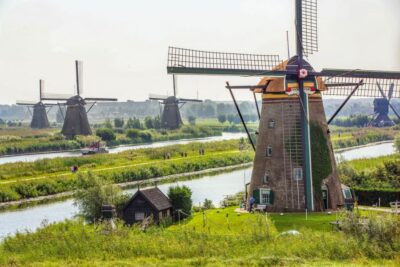
Kinderdijk UNESCO World Heritage Entry Ticket
Read our review →
Browse the lists this tour appears in