
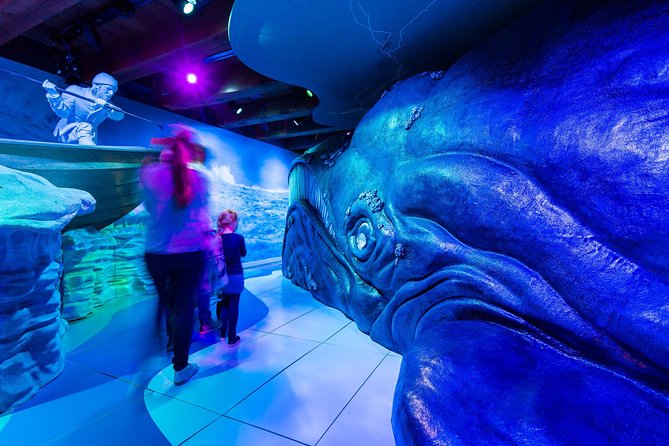
Review · MUSEUMS
Amsterdam: National Maritime Museum Skip-the-Line Ticket
Amsterdam’s sea story is bigger than canals. At the National Maritime Museum, you can board a full-size 1749 East Indiaman replica and then follow the ships, maps, battles, trade, and colonial choices that shaped the Netherlands. I especially like the hands-on displays and the clear audio tour, which turns a large collection into something you can follow. The main drawback is simple: there is enough here for several hours, and a quick visit can feel rushed.
I also like the museum’s covered inner courtyard, a striking 1656 space beneath a glass roof patterned after an old nautical map. The VR ride over Golden Age Amsterdam is a clever change of pace, especially for families. Still, the exhibits cover many subjects, and the links between them are not always obvious, so you may need to set your own route.
In This Review
- Key points to know before you go
- Inside the 1656 Admiralty storehouse
- How the Netherlands became a maritime power
- Boarding the Amsterdam replica
- The VR flight over Golden Age Amsterdam
- Displays that work for adults and children
- Making sense of the audio tour
- How long should you spend there?
- Is the $24 ticket good value?
- Who should book this experience?
- Should you book the National Maritime Museum ticket?
- FAQ
- Where is the National Maritime Museum located?
- How much does the ticket cost?
- How long is the ticket valid?
- Is the audio guide included?
- Which languages are available for the audio tour?
- Can I visit the replica ship Amsterdam?
- Is the museum wheelchair accessible?
- Can I cancel the booking?
Key points to know before you go
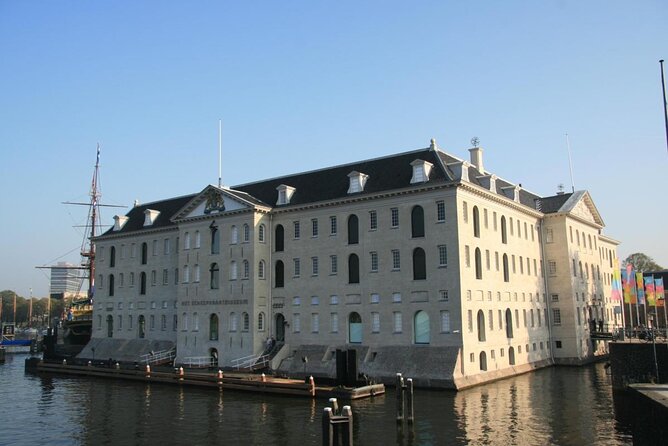
- The replica ship is the main event: Walk through the captain’s quarters, sailor’s hammocks, cargo areas, and lower decks of the Amsterdam.
- The collection reaches beyond ships: Expect sea charts, paintings, ship models, navigation tools, carvings, figureheads, royal objects, and naval material.
- The 60-minute audio tour is included: It is available in English, Spanish, Chinese, Dutch, French, German, Italian, Japanese, Korean, Portuguese, and Russian.
- The VR ride adds a vivid history lesson: See central Amsterdam as it looked during the Dutch Golden Age.
- Families have plenty to touch and try: Interactive displays include activities connected with shipboard life.
- The $24 ticket works best for a half-day: It is less useful if you only plan to spend an hour inside.
Inside the 1656 Admiralty storehouse
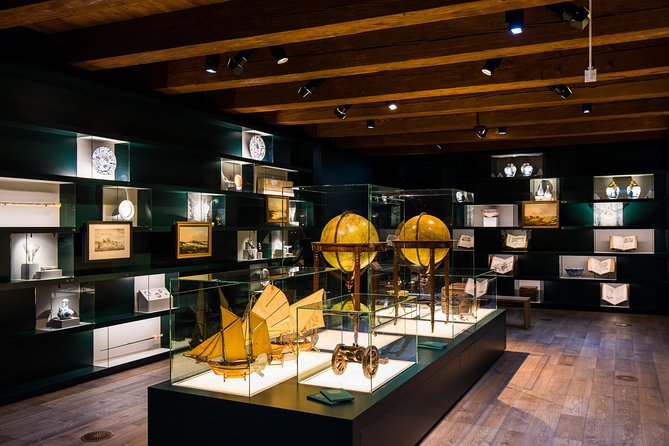
The museum occupies the Arsenal, built in 1656 as a storehouse for the Admiralty. That setting matters. You are not looking at Dutch maritime history in a plain modern box. The building itself belongs to the story, with its large scale and practical old-storehouse character.
Your first useful stop is the covered inner courtyard. Its glass roof contains 1,200 pieces arranged in a design based on an old nautical map. It gives the museum a calm central space and helps you get your bearings before tackling the galleries.
The courtyard is free to visit daily from 10:00 AM to 5:00 PM, while the ticket gives you access to the museum displays and the replica ship. If you are short on time, even the courtyard offers a worthwhile architectural pause, though the full ticket is what lets you understand Amsterdam’s connection to the sea.
I like the way the building gives the collection room to breathe. You are not squeezed from one object to the next. At the same time, the museum’s size can make your first ten minutes feel slightly unfocused. Pick up the audio guide early, or decide that you will follow one theme at a time.
More Museum Tours in Amsterdam
- Amsterdam: Van Gogh Museum Ticket
★ 4.7 · 52,054 reviews - Moco Museum Amsterdam Entrance Tickets with Banksy & More
★ 4.4 · 10,088 reviews - Amsterdam: The Upside Down Museum Entrance Ticket
★ 4.4 · 9,506 reviews
How the Netherlands became a maritime power
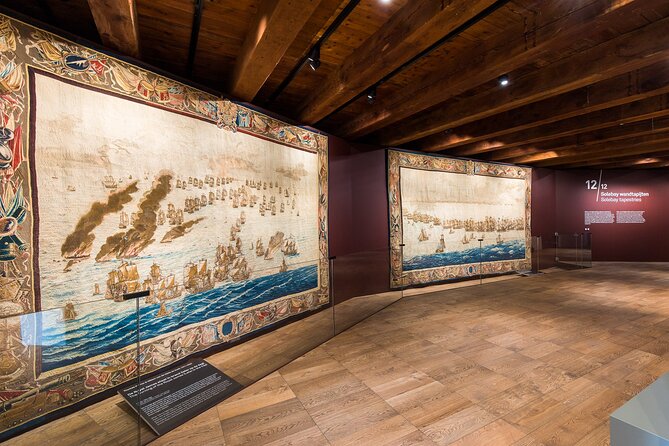
The museum explains Amsterdam’s growth as a major European harbor through objects rather than one long lecture. Ship models show how vessels were built and used. Navigation instruments hint at the skill and danger involved in long voyages. Sea charts reveal how sailors and mapmakers gradually made unfamiliar waters more understandable.
The maps are a particular strength. You can see that mapmaking was not only about drawing coastlines. It supported trade, military planning, exploration, and the control of distant territory. The displays also include paintings, ship decorations, carvings, and figureheads, which bring a human and artistic side to what could otherwise become a lesson in equipment.
The collection reaches into the Dutch navy and the Dutch East India Company, commonly known as the VOC. That means the museum deals with commerce, sea battles, exploration, and the machinery of empire. It also addresses Dutch involvement in colonization and the slave trade. I appreciate that these subjects are not brushed aside, since the wealth and power connected to Dutch shipping cannot be separated from their costs.
You should allow time for the captions and audio explanations here. The displays are informative, but this is not a quick photo stop. If you rush past the text, you may see beautiful objects without understanding why they mattered.
Boarding the Amsterdam replica
The replica of the 1749 VOC East Indiaman Amsterdam is the museum’s strongest draw. It sits beside the building and lets you walk through the kind of ship that carried goods, people, and power across the seas.
This is not just an object viewed from behind a barrier. You can move through the decks and cabins, look into the captain’s quarters, and see how cramped shipboard life could be. You can also try a cannon, spend a moment in a sailor’s hammock, and explore the bow and lower sections.
The ship works well because it turns abstract maritime history into a physical experience. A model tells you how a vessel looked. Walking through the replica gives you a better sense of its scale, layers, and limited living space. You can picture the difference between the captain’s area and the sailors’ quarters without needing much explanation.
Families should make this a priority. Children have interactive activities connected with the ship, including displays in the hold. Adults who enjoy naval history, design, or old trading routes will find plenty to inspect too. The ship is also a good reason to visit even if traditional museums are not your usual choice.
There are limits. A replica cannot reproduce the full noise, motion, smell, and danger of an 18th-century voyage. Some spaces may feel more like an educational set than an original historic interior. Still, the chance to walk around a Dutch East Indiaman is far more memorable than looking at another small ship model.
The VR flight over Golden Age Amsterdam

Near the ship’s bow, a virtual reality experience takes you over central Amsterdam during the Dutch Golden Age. The goal is to show the city as a working harbor at the beginning of the 17th century.
This is a smart addition because it connects the vessels in the museum to the city outside. You see Amsterdam not simply as today’s canal-lined destination, but as a place shaped by shipping, trade, warehouses, and waterborne movement.
The VR segment also breaks up the reading and object viewing. Children tend to appreciate the change in pace, while adults get a quick visual explanation of how the harbor fit into the city. It is not a substitute for the museum’s historical material, but it helps you picture the world that produced it.
Because the experience is one part of a much larger museum, do not expect a long standalone attraction. Treat it as a focused visual chapter. If you arrive during a busy period, you may need patience around the most popular interactive activities, though no specific waiting time is given.
A different kind of day out entirely:
- Amsterdam Classic Saloon Boat Cruise with Drinks and Cheese
★ 5.0 · 31,825 reviews - Amsterdam Luxury Canal Cruise + Unlimited Drinks & Bites option
★ 5.0 · 30,518 reviews - Amsterdam: Heineken Experience Ticket
★ 4.6 · 30,055 reviews - Amsterdam: Rijksmuseum Entry Ticket
★ 4.7 · 25,535 reviews
Displays that work for adults and children
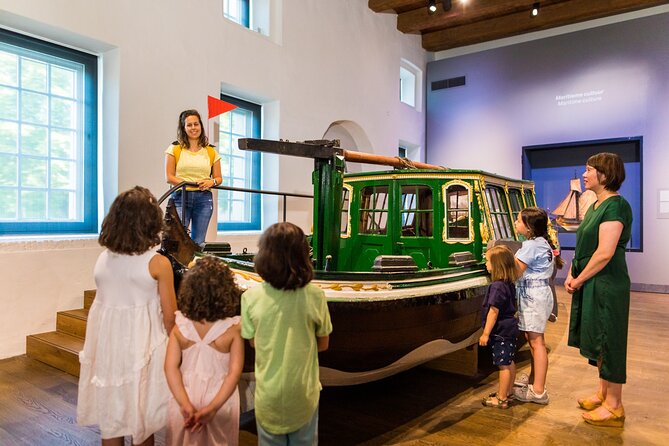
This museum is more active than a standard collection of paintings and cases. You can touch screens, watch videos, move objects, sit in displays, and try activities related to ships and seafaring.
The children’s sections are designed for younger visitors, which helps families stay longer. The ship itself offers some of the best hands-on material, with activities in the hold and life-like scenes that show how people traveled and worked at sea.
For adults, the strongest material includes the navigation instruments, historic maps, ship models, paintings, carvings, and figureheads. The royal barge is another highlight, especially if you are interested in ceremonial vessels and the way the sea has served both practical and royal purposes.
The museum also reaches into modern sea life. One section presents a solo voyage around the world, bringing the subject forward into an age that depends heavily on modern technology. That contrast is useful. It asks you to consider how much has changed in navigation and communication, and how much physical hardship remains in long-distance sailing.
I would not try to give every gallery equal time. Choose the ship, maps, and one or two historical themes that interest you most. The collection is broad, and the experience improves when you slow down for the pieces that catch your attention.
Making sense of the audio tour

The included audio tour lasts about 60 minutes and is available in 11 languages: English, Spanish, Chinese, Dutch, French, German, Italian, Japanese, Korean, Portuguese, and Russian.
I recommend using it, particularly if this is your first visit. The museum covers trade, naval power, exploration, colonization, and the slave trade. The audio gives those subjects a clearer order and adds context to objects that might otherwise look decorative.
The English version is useful for getting the main story, but you do not have to follow every stop. If you have children with you, listen to the sections that explain the ship and then let them explore the interactive areas. If you prefer a slower museum visit, use the audio as a framework and pause whenever a map, model, or piece of carving deserves more time.
There is no guided tour included. You explore independently, which gives you freedom but also puts the responsibility for pacing in your hands. The audio is a good middle ground between wandering without direction and joining a fixed group.
How long should you spend there?
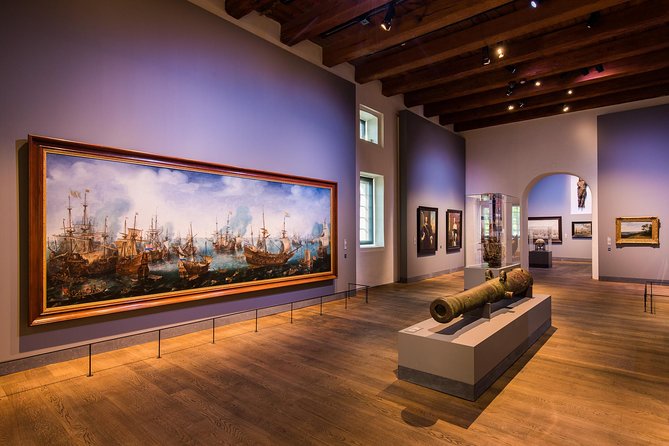
The ticket is valid for one day, and that flexibility is useful. Some people can get a solid impression in an hour or so, especially if they focus on the ship and the best-known galleries. I would allow at least three hours for a satisfying visit.
A half-day is better if you want the audio tour, the permanent displays, the VR ride, and the replica ship without hurrying. If maritime history is one of your main interests, you may want most of the day. One afternoon can still feel too short because the subjects range from mapmaking and naval warfare to colonial trade, art, royal vessels, and modern sailing.
The museum is open to wheelchair users, an important practical point for anyone planning a longer visit. The meeting address is Kattenburgerplein 1, 1018 KK Amsterdam, at the National Maritime Museum. The ticket is for entry, the Amsterdam replica, and the audio tour, not a private guide.
Is the $24 ticket good value?
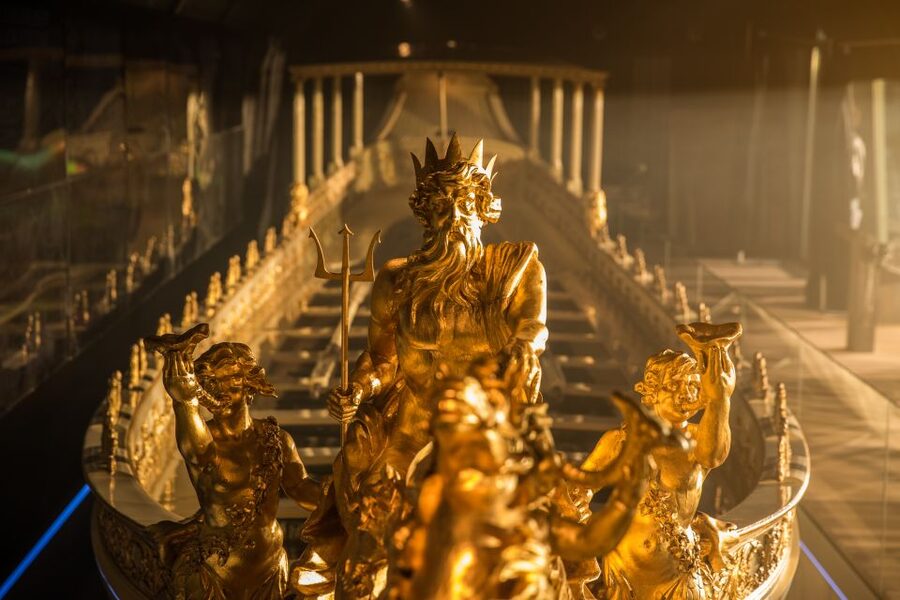
At $24 per person, the ticket offers good value if you use it as a substantial museum visit rather than a brief stop. The included ship, audio tour, VR experience, interactive displays, and large collection give you several different ways to spend your time.
The value is strongest for three groups. Families get activities beyond static exhibits. Adults interested in Dutch sea power get a serious collection with maps, art, instruments, and historical context. First-time Amsterdam visitors get a useful explanation of how the city’s identity grew from water, trade, and shipping.
The value is weaker if you only have an hour or if you dislike museums that cover many connected subjects. The displays are generally well explained, but the links between topics can sometimes feel loose. You may need to choose your own route instead of expecting one perfectly continuous story.
The ticket also includes skip-the-line entry, which can matter on a busy day. The precise time saved is not stated, so I would not buy it only for a guaranteed instant entrance. The bigger benefit is having a ready ticket for a major attraction with enough material to fill a half-day.
You can reserve now and pay later, and cancellation is free up to 24 hours before the visit for a full refund. That is useful when your Amsterdam plans are still shifting.
Who should book this experience?
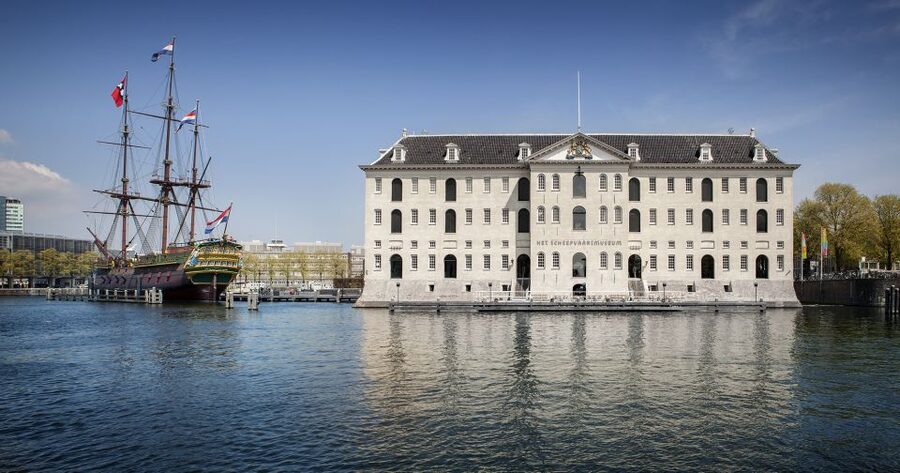
I would recommend it to families, history-minded visitors, anyone curious about ships, and people who want more context for Amsterdam than canals and old houses can provide. The replica Amsterdam is the key reason to go, but the maps, figureheads, royal barge, and audio material give the visit lasting value.
It is also a good rainy-day choice. The inner courtyard is covered, the galleries are indoors, and the ship provides a change from room after room of objects.
I would be more selective if you have only a few hours in Amsterdam and already plan several major museums. In that case, focus on the ship, courtyard, VR ride, and one gallery rather than trying to see everything.
Should you book the National Maritime Museum ticket?
Book it if you want to understand the forces that made Amsterdam a major port, and if walking through a full-size historic ship sounds better than simply viewing one. The combination of physical spaces, serious objects, family activities, and a useful audio tour makes the $24 price fair for a half-day visit.
Skip it only if your schedule allows no more than a quick hour or if maritime subjects do not interest you. For most visitors, the replica Amsterdam alone gives the museum a strong reason to visit, while the honest treatment of trade, slavery, colonization, and modern sea travel makes the wider experience much more worthwhile.
FAQ
Where is the National Maritime Museum located?
The museum is at Kattenburgerplein 1, 1018 KK Amsterdam, in North Holland, Netherlands.
How much does the ticket cost?
The listed price is $24 per person.
How long is the ticket valid?
The ticket is valid for one day.
Is the audio guide included?
Yes. A free audio tour of about 60 minutes is included with entry.
Which languages are available for the audio tour?
The audio tour is available in Spanish, Chinese, Dutch, English, French, German, Italian, Japanese, Korean, Portuguese, and Russian.
Can I visit the replica ship Amsterdam?
Yes. Entry includes a visit to the replica 18th-century ship Amsterdam, a replica of the 1749 VOC East Indiaman.
Is the museum wheelchair accessible?
Yes, the activity is listed as wheelchair accessible.
Can I cancel the booking?
Yes. You can cancel up to 24 hours in advance for a full refund. You can also reserve now and pay later.
Just added in Amsterdam
- Private Tour Zaanse Schans Windmills and Volendam in Jaguar★ 5.0 · 10 reviews
- Zaanse Schans and Giethoorn Unique Day Trip with Boat Cruise★ 4.5 · 17 reviews
- Windmills-Volendam-Giethoorn Private Tour in Jaguar★ 5.0 · 2 reviews
- Half-Day Private Guided Sightseeing Tour of Zaanse Schans★ 5.0 · 14 reviews
- Best of Netherlands: Zaanse Schans Mills, The Hague & Rotterdam★ 4.5 · 10 reviews
- Zaanse Schans Private Tour Windmills★ 5.0 · 18 reviews
- Zaanse Schans Windmills Edam Volendam and Marken from Amsterdam★ 5.0 · 1 review
- Zaanse Schans Edam Volendam Private Day Tour from Amsterdam★ 5.0 · 3 reviews
Museums, compared.

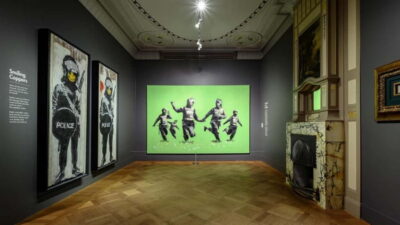
Moco Museum Amsterdam Entrance Tickets with Banksy & More
Read our review →


Amsterdam’s Weirdest Museum: Believe It or Not!
Read our review →
Browse the lists this tour appears in