
Review · WALKING TOURS
Groningen: Walking Tour with Local Guide
Groningen rewards a closer look. This 1.5-hour walk links the city’s medieval core, student energy, old churches, Jewish heritage, and modern Forum Groningen in a compact 1.5-kilometer route. I especially like the mix of major sights and small city stories, plus the chance to hear how Groningen’s past shapes its present.
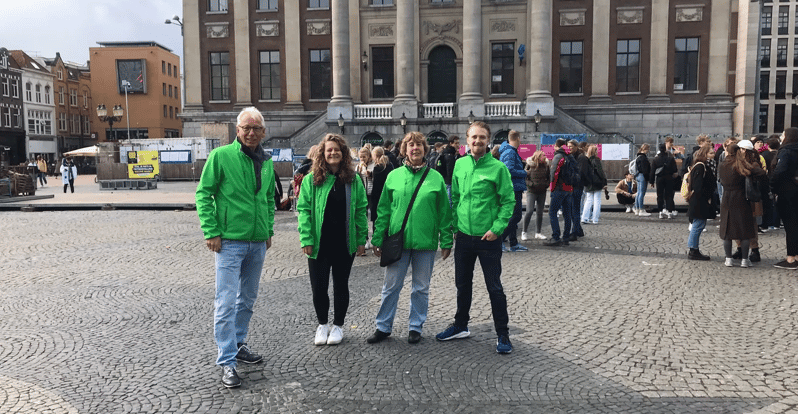
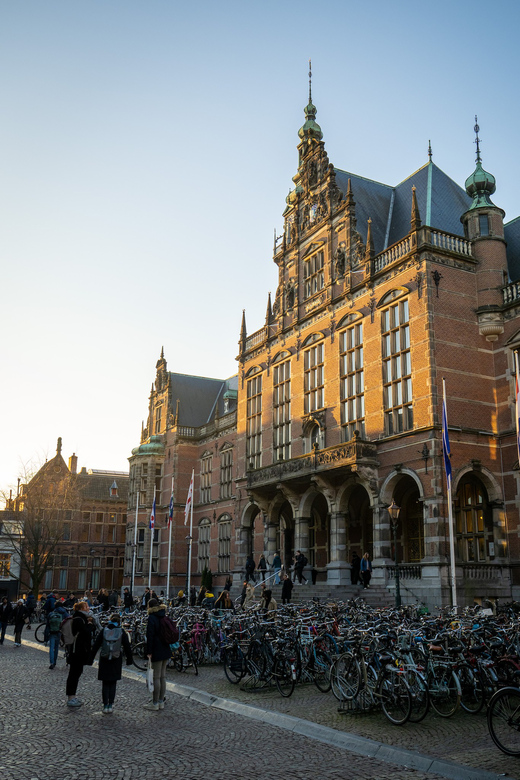
I also like the friendly, personal tone reported from guides such as Margret and Wessel, who bring both historical and everyday details into the walk. The main consideration is weather: one recent tour took place in cold, slippery conditions, so good shoes and a warm layer matter.
In This Review
- Key points at a glance
- Why this Groningen walk works so well
- Starting at Forum Groningen
- New Market Square and the Martini Tower
- Grote Markt and the city’s public face
- Regents, government, and Groningen’s changing power
- The Gold Office and Academic Building
- A Church and Groningen’s oldest harbor
- Folkingestraat and the Jewish story
- Getting the best experience from your guide
- Timing, access, and weather
- Who should book this walk
- Is the 22-dollar price good value?
- Should you book the Groningen walking tour?
- FAQ
- Where does the Groningen walking tour meet?
- How long is the walking tour?
- How far do you walk?
- What is the maximum group size?
- What languages are offered?
- Is the tour wheelchair accessible?
- What sights are included?
- Is the Pepergasthuis included every day?
- What happens at the end of the tour?
- Can I cancel the booking?
Key points at a glance
- A short 1.5-kilometer route: You see a great deal without committing to a long walking day.
- Martini Tower and Grote Markt: Groningen’s best-known tower and central square anchor the historical story.
- Old and new in one walk: The route begins and ends at Forum Groningen, then moves through Renaissance buildings, churches, harbors, and student streets.
- A city shaped by students: About 70,000 students live among Groningen’s 235,000 residents, giving the center a youthful feel.
- Several language choices: The experience is advertised in English, Dutch, and German, though the activity details specifically list Dutch and German, so confirm your preferred language before booking.
- A free view at the finish: After the tour, you can take the Forum’s electric stairs to its 45-meter-high platform.
Why this Groningen walk works so well
Groningen can be confusing at first. It is old, but not preserved in a sleepy museum bubble. It is a university city, yet its medieval streets, churches, squares, and former harbor still shape daily life. A local guide helps you connect those pieces instead of seeing them as unrelated buildings.
At $22 per person, the price is fair for a live 1.5-hour tour, especially if you are visiting Groningen for the first time. You are paying for a guide, not entry tickets, transport, or a long list of paid stops. The real value comes from getting a useful orientation early in your visit, then knowing which streets, squares, cafés, shops, and viewpoints deserve a second look.
The group can include up to 25 people. That is not a tiny private walk, but the compact route and central meeting point keep it manageable. If you prefer a very quiet, highly personal tour, a full group may feel less intimate. If you want a low-cost introduction without planning every street yourself, the format makes sense.
The walk covers about 1.5 kilometers, so the physical demand is modest. The bigger issue is the surface and weather. In winter, ice made one outing difficult, even though the guide kept it enjoyable. Wear shoes with a firm sole, and remember that this is an outdoor tour in an open city center.
More Walking Tours in Groningen:
- Pieterburen: Wadden Sea Mudflats Guided Walking Tour
★ 4.1 · 14 reviews - Exciting Murder Mystery – Interactive city walk in Groningen
★ 4.5 · 8 reviews - Anne Frank’s Story – Guided Walking Tour through Amsterdam
★ 5.0 · 11,619 reviews
Starting at Forum Groningen
The meeting point is inside Forum Groningen, in front of the VVV store at the yellow counter. This is a practical start because Forum is not simply a place to gather. It is also the city’s modern cultural and information center, and the guide uses it to set up the wider story of Groningen.
You begin with technical innovation, modern culture, and current life in the city. That opening matters. Instead of treating history as a sealed-off chapter, the tour presents Groningen as a place that keeps changing while its old center remains in daily use.
Forum Groningen also gives the walk a clear ending. After the tour, you can use the electric staircases to reach the 45-meter-high platform. The view is described as breathtaking, but the bigger benefit is practical: you see the city from above after learning its street plan from ground level.
Arrive with enough time to find the yellow counter. Forum is large enough that rushing in at the last moment could make the meeting point harder to locate.
New Market Square and the Martini Tower
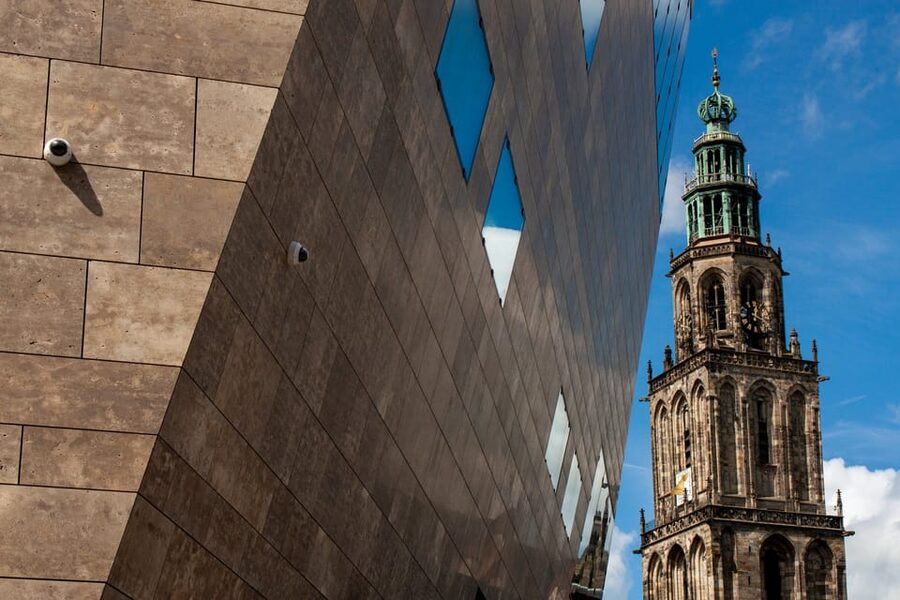
From Forum, the route heads toward the New Market Square and the Martini-toren. The gray tower is one of Groningen’s defining sights, and the guide uses it to open up the city’s long story.
The Martini Tower has witnessed many versions of Groningen. You are not simply looking at an old church tower. You are hearing how a major landmark connects to the city’s identity, its skyline, and the way people orient themselves in the center.
The New Market Square gives the tower room to breathe. It is also a useful place to notice the contrast between Groningen’s older stone buildings and the newer forms around Forum and the square. I like this part of the route because it gives you the classic postcard view while keeping the focus on how the city functions now.
You should not expect a tower-climbing visit as part of this walking tour. The tower is an exterior sight on the route, with the guide supplying the context.
Grote Markt and the city’s public face
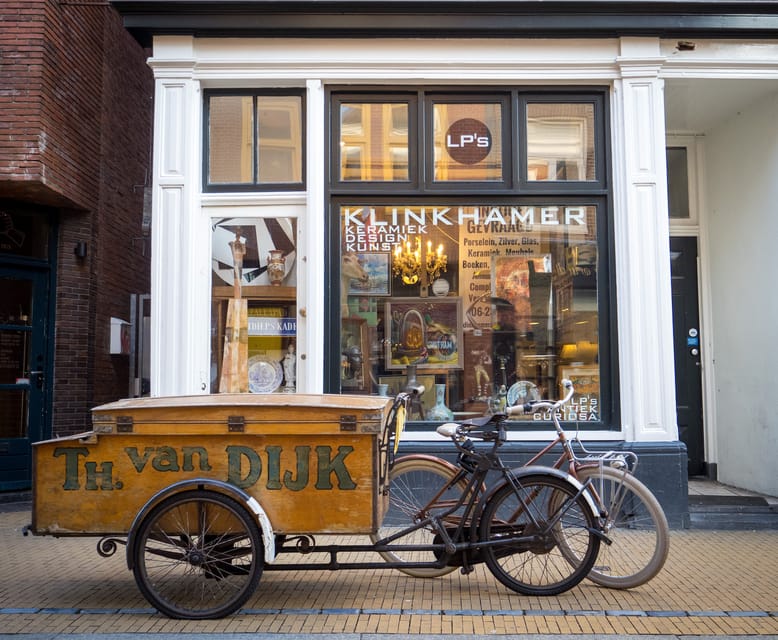
The walk continues through the Grote Markt, Groningen’s main square. Here you see the City Hall and hear about the city’s civic life, past and present.
The square also helps explain Groningen’s scale. This is a regional center with a population of about 235,000, including roughly 70,000 students. That student population is not a minor detail. It affects the shops, cafés, nightlife, cycling culture, and the general pace of the center.
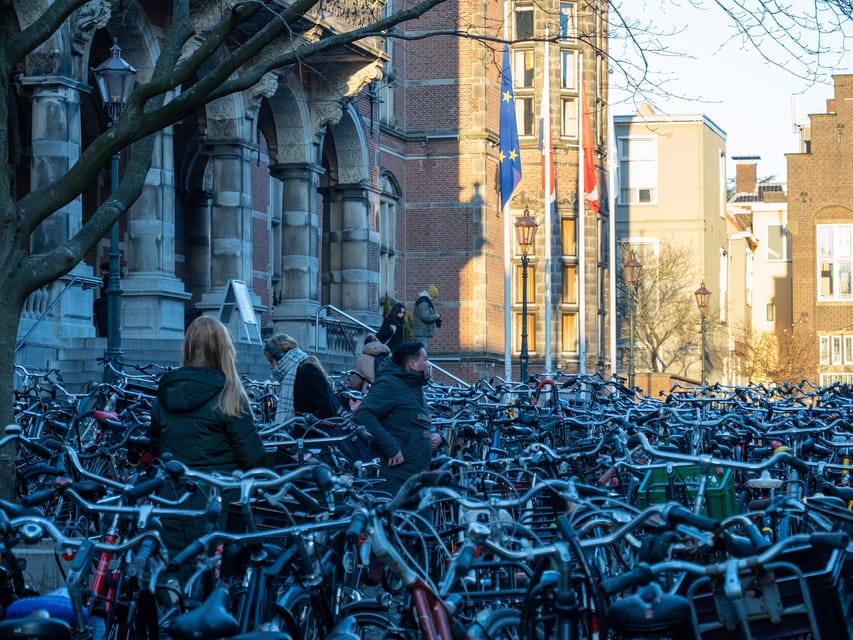
Groningen is famous for its bicycles, and you will notice them throughout the walk. The bikes are part of the city’s character, but they also require attention. Keep an eye on cycle routes and do not assume every quiet-looking strip is a pedestrian-only space. The city’s bicycle culture is fun to observe, but it is not decorative.
The guide also points out places where you can shop, drink a beer, or enjoy wine. That advice is useful because it turns a sightseeing route into a first-day orientation. You can return later to the areas that caught your eye instead of wandering without a plan.
A few more options to weigh up in Groningen
- Groningen: City Canal Cruise
★ 4.3 · 895 reviews - Groningen: Climb the Martinitower
★ 4.5 · 365 reviews - Groningen: Terrace Boat Experience with a Cozy Bar
★ 4.1 · 307 reviews - Groningen: Open Boat City Canal Cruise
★ 4.7 · 250 reviews
Regents, government, and Groningen’s changing power
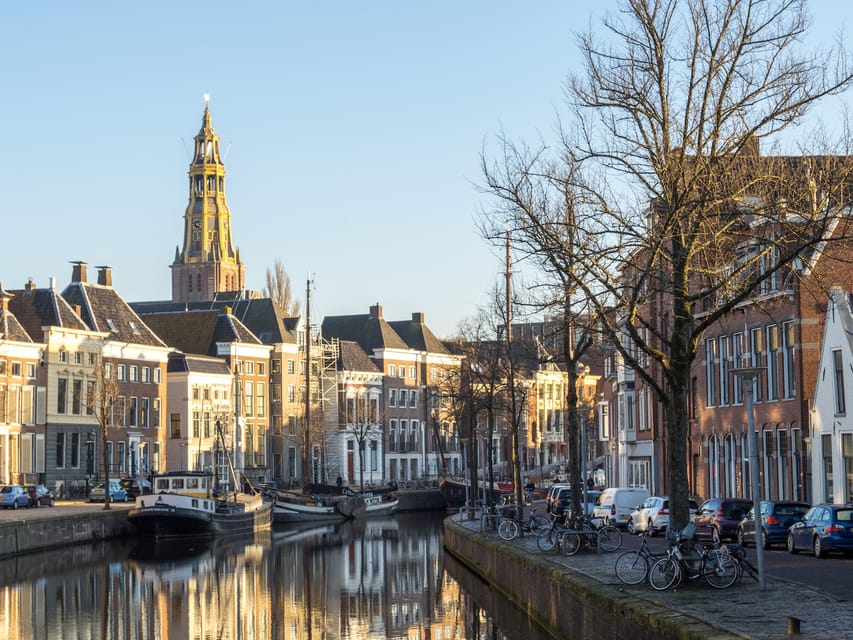
The route includes the office of the Commissioner of the King and the Palace of the 17th and 18th-century Regents. These stops add a political and social layer to the walk.
Buildings associated with government and wealthy regents show how power was organized in earlier Groningen. They also make the city’s history more human. Rather than hearing only dates and architectural labels, you get a sense of who controlled money, administration, and public decisions.
The exact level of detail will depend on your guide. That is one reason the guide matters so much on a short tour. There is not time for every story, so a good guide must choose details that make the buildings memorable. The praise for guides Margret and Wessel points to this personal approach. Wessel, in particular, was appreciated for combining historical and cultural information with modern and unusual facts.
This section may appeal most to you if you enjoy understanding how a city works, not just photographing its prettiest façades.
The Gold Office and Academic Building
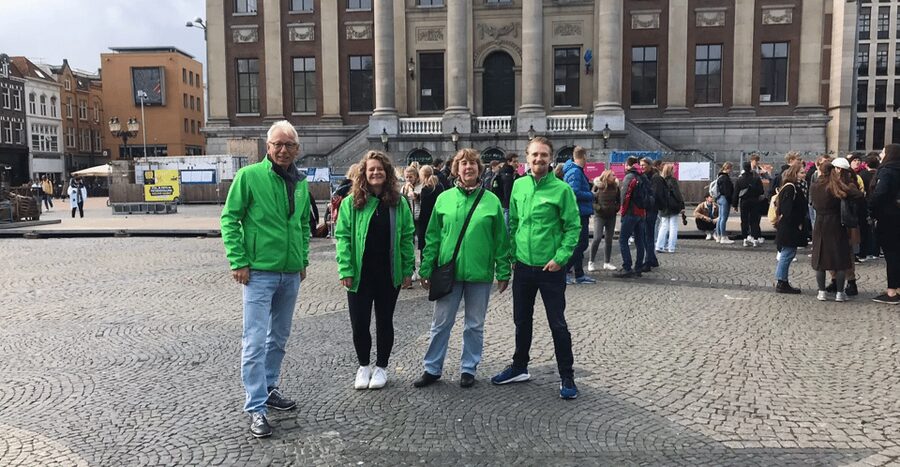
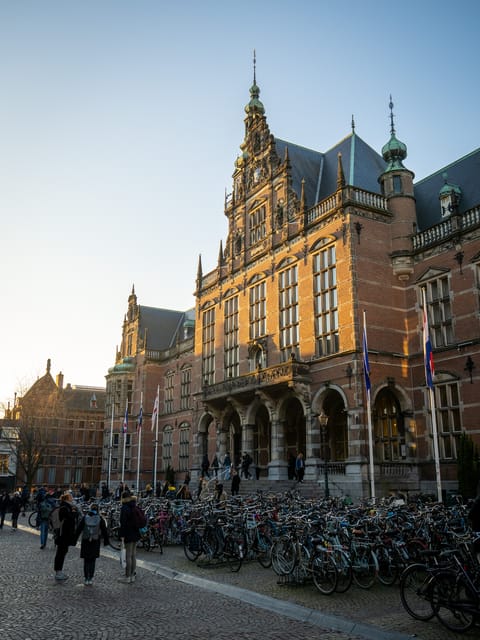
The Gold Office and the Academic Building continue the architectural and civic story. The route presents Renaissance elements beside more modern construction, so you get a visual lesson in how Groningen grew without becoming one uniform style.
The Academic Building is especially relevant in a student city. Groningen’s university life is not tucked away from the center. It helps shape the streets you walk, the businesses you see, and the city’s youthful mood.
I would pay attention here to the contrast between formal institutional buildings and the informal life around them. A historic university façade can look quiet, while the surrounding streets may be full of bikes, students, and ordinary errands. That mixture is more revealing than a single grand monument.
Because the tour is only 1.5 hours, you will not receive an exhaustive architectural lecture. The benefit is a readable overview, enough to recognize the main styles and understand why these buildings matter.
A Church and Groningen’s oldest harbor

The yellow tower of the A-church provides another strong visual marker. Its color makes it easy to remember, and the church adds a different mood from the gray Martini Tower.
The route then reaches Groningen’s oldest harbor. This is where the city’s age becomes easier to picture. A harbor is not just a pretty waterfront setting. It helps explain trade, movement, and why a settlement developed where it did.
The tour describes this part as a step back about 800 years. That does not mean the area has been frozen in time. Its value is that the old harbor lets you connect Groningen’s medieval role with the modern city around it.
I like this stop for travelers who want more than a procession of central squares. It gives the tour a sense of place, not just a collection of buildings.
Folkingestraat and the Jewish story
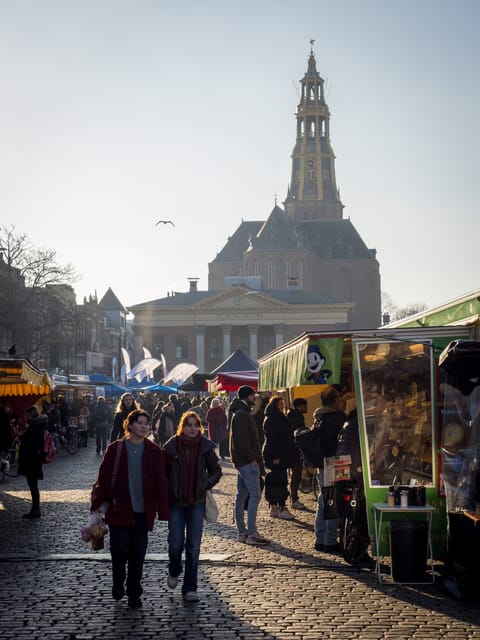
Folkingestraat is one of the most meaningful parts of the route. The street carries Groningen’s Jewish history, and the guide places that history within the city center rather than treating it as a separate subject.
This is a good reminder that historic streets hold more than architectural interest. They also hold the stories of communities, faith, work, migration, and loss. You may find this section more reflective than the lighter discussion of shopping, bikes, or student life.
The route also includes the Pepergasthuis, an old shelter for pilgrims who came to worship the relic of Saint John the Baptist. However, the Pepergasthuis is not part of the tour on Sundays. If this stop matters to you, check the day before booking.
That Sunday limitation is a small but important planning detail. The tour still covers plenty of ground without it, but the route is not identical every day.
Getting the best experience from your guide
The human element is central here. Guides have been praised for enthusiasm and for a strong personal connection to Groningen. One guide was described as deeply involved with her city, while another brought together historical, cultural, present-day, and unusual facts.
That is exactly what you want from a short city walk. You do not need a guide to recite every century. You need someone who can explain why a square matters, point out a building you would otherwise miss, and give you a reason to return later.
The available language information needs a little care. The tour is presented as available in Dutch, German, or English, while the activity details specifically name German and Dutch. If you need English, confirm it when checking the departure options.
The mood also seems friendly rather than formal. That suits Groningen. This is a walk for asking practical questions and getting a feel for the city, not a solemn procession from monument to monument.
Timing, access, and weather
The tour lasts 1.5 hours and covers about 1.5 kilometers. That makes it a good first activity after arriving in Groningen, especially if you want to learn the layout before choosing where to eat, shop, or spend the evening.
The tour is listed as wheelchair accessible. Since the route uses city streets and includes outdoor sights, it is still sensible to check the exact conditions for your date if you have specific mobility needs. The accessible listing is encouraging, but individual street conditions and crowd levels can affect comfort.
Weather deserves more attention than the low physical distance might suggest. A winter outing was cold and slippery, yet the guide’s enthusiasm kept it interesting. In other words, poor weather may affect comfort without ruining the experience, but you should prepare properly.
Bring a warm layer, wear stable shoes, and keep rain protection close. On a sunny day, the green squares and open market areas should make the route pleasant. On a wet or icy day, the same open spaces can feel less forgiving.
Who should book this walk
I would recommend it most strongly to first-time visitors, couples, solo sightseers, and anyone who wants a quick introduction before exploring independently. The route gives you major landmarks, local context, and practical ideas for the rest of your stay.
It also suits you if you like a balance of history and current city life. You see churches, towers, civic buildings, an old harbor, and Jewish heritage, but you also hear about student culture, modern design, bikes, shopping, and places for a drink.
Families may appreciate the short distance, though the historical content will appeal most when children are willing to listen. The 25-person maximum is reasonable for a public tour, but it is not designed for the privacy of a custom guide.
You may want something else if you dislike group walks, already know Groningen well, or want extended access inside every monument. This is a city introduction, not a specialist architectural tour or a full-day history course.
Is the 22-dollar price good value?
At $22 per person, I consider this good value if you use the tour as a city orientation. The walk is inexpensive compared with a private guide, and the compact route covers an unusually broad range of subjects.
You get the Martini Tower, Grote Markt, City Hall, regents’ buildings, the Gold Office, Academic Building, A-church, oldest harbor, Folkingestraat, and a view from Forum afterward if you choose to stay. Not every stop receives equal time, but the variety helps you understand Groningen as a whole.
The value is lower if you only want to see landmarks quickly and take your own photos. You can walk through the center without paying. The fee earns its keep through explanation, local perspective, and the connection between old buildings and present-day Groningen.
Free cancellation up to 24 hours before the start and reserve-now, pay-later booking add useful flexibility. The guide is included, while entry to separate attractions is not described as part of the price.
Should you book the Groningen walking tour?
Yes, if you want a friendly, efficient introduction to Groningen with a strong local voice. The short route covers the city’s key sights without tiring you out, and the blend of medieval streets, student life, Jewish history, modern culture, and harbor stories gives you more than a standard monument checklist.
Book it early in your stay so you can return to the places that interest you. Confirm the tour language, check whether the Pepergasthuis matters to your plans on a Sunday, and dress for the weather.
Skip it only if you prefer exploring entirely alone or need a tour built around long interior visits. For $22, this is a sensible way to get your bearings fast and see why Groningen feels both old and young at the same time.
FAQ
Where does the Groningen walking tour meet?
Meet inside Forum Groningen, in front of the VVV store at the yellow counter.
How long is the walking tour?
The tour lasts 1.5 hours.
How far do you walk?
The route covers about 1.5 kilometers.
What is the maximum group size?
The maximum group size is 25 people per tour.
What languages are offered?
The experience is presented as available in English, Dutch, and German. The activity details specifically list Dutch and German, so confirm your preferred language when checking availability.
Is the tour wheelchair accessible?
Yes, the activity is listed as wheelchair accessible.
What sights are included?
The route includes Forum Groningen, the New Market Square, Martini Tower, Grote Markt and City Hall, the Commissioner of the King’s office, the Palace of the Regents, the Gold Office, the Academic Building, the A-church, Groningen’s oldest harbor, and Folkingestraat.
Is the Pepergasthuis included every day?
No. The Pepergasthuis is not part of the tour on Sundays.
What happens at the end of the tour?
The tour ends at Forum Groningen. You can then use the electric staircases to visit the 45-meter-high platform and see the city from above.
Can I cancel the booking?
You can cancel up to 24 hours in advance for a full refund. Reserve-now, pay-later booking is also available.
Just added in Groningen
- Exciting Murder Mystery – Interactive city walk in Groningen★ 4.5 · 8 reviews
- e-Scavenger hunt Groningen: Explore the city at your own pace★ 4.5 · 28 reviews
- Historical Canal Tour★ 5.0 · 60 reviews
- Groningen: Terrace Boat Experience with a Cozy Bar: 1.5 Hours★ 5.0 · 29 reviews
- Groningen Scavenger Hunt and Sights Self-Guided Tour★ 5.0 · 1 review
- Discover Groningen in this Outside Escape city game tour!★ 4.5 · 12 reviews
- Groningen: Terrace Boat Experience with a Cozy Bar: 1 hour★ 4.5 · 35 reviews
- Private BBQ Cruise Tour at Lake Paterswoldsemeer With Drinks★ 5.0 · 1 review
Walking Tours, compared.
Anne Frank’s Story – Guided Walking Tour through Amsterdam
Read our review →
Life of Anne Frank and World War II Walking Tour
Read our review →
Absolutely Amsterdam – the Essential Introductory Walking Tour
Read our review →
Anne Frank Walking Tour – Guided in EN/DE/IT/ES
Read our review →
Anne Frank Walking Tour Amsterdam Including Jewish Cultural Quarter
Read our review →Browse the lists this tour appears in