
Review · WALKING TOURS
Maastricht Private Walking Tour With A Professional Guide
Maastricht rewards slow walking. This private two-hour tour brings its medieval churches, Roman beginnings, wartime past, and European importance into one clear route through the old center. I especially like the private format, which lets your group ask questions, and the chance to adjust the focus with your guide as you go. The main drawback is simple: two hours can only sketch a city with this much history.
I also like that the route connects famous sights with smaller local details, including Pieke oet de Stokstraot and the old city gate at Helpoort. A guide with more than 20 years of experience is part of the service, though one booking mix-up caused a guest to miss the tour entirely, so I would confirm the appointment before setting out.
In This Review
- Key points to know
- Why a Private Walk Works Well in Maastricht
- At Markt 52: City Hall and Maastricht’s Civic Heart
- Dominicans Church and the City’s Religious Layers
- Hendrik van Veldeke and the Vrijthof Area
- Helpoort and the Defenses of Medieval Maastricht
- Pieke oet de Stokstraot and Small Local Details
- Sint Servaasbrug and Maastricht’s Changing Fortunes
- War, Refuge, Occupation, and Recovery
- The Maastricht Treaty and the Birth of the Euro
- What the $275.65 Group Price Buys You
- Who Will Enjoy This Walk Most
- Should You Book the Maastricht Private Walking Tour?
- FAQ
- How long does the Maastricht private walking tour last?
- Where does the tour begin?
- Where does the tour end?
- Is the tour private?
- Are entrance fees included?
- Can the tour be customized?
- What is the cancellation policy?
Key points to know
- A private group of up to 15: You walk only with your own party, which makes questions and route changes easier.
- A compact two-hour introduction: The tour covers Maastricht’s main central sights without the cramped views of a bus.
- History from Rome to the euro: The story moves through Saint Servatius, religious conflict, Napoleon, both world wars, and the Maastricht Treaty.
- A mostly easy city-center route: You need to be comfortable walking, but the tour is designed around central streets and landmarks.
- Useful for first-time visitors: It gives you a map in your head before you explore Maastricht independently.
- Entrance fees are extra: The tour focuses on outdoor viewing and guided explanation, not included museum or church admission.
Why a Private Walk Works Well in Maastricht
Maastricht is old enough to feel confusing at first. Its streets bring together Roman origins, medieval churches, a former defensive wall, elegant civic buildings, and reminders of its modern role in European politics. A private guide helps turn those separate sights into one connected story.
I prefer this approach to a large group or bus tour here because the center is best seen at street level. You can stop in front of City Hall, look up at church towers, and hear an explanation without trying to follow a guide from the back of a vehicle. You also avoid the poor viewing angles and rushed stops that come with moving a large group through narrow streets.
The group limit is up to 15 people. That is still a fairly large private party, but it gives you much more control than a public tour. If your group wants more medieval architecture, more World War II context, or a clearer explanation of the European Union, you can ask for that emphasis.
The tour begins at Markt 52, near Maastricht’s City Hall and Street Market, then ends back at the same meeting point. That makes the start and finish easy to understand, especially if you are using public transportation nearby. You should plan to arrive on time, since the one serious complaint involved a guide misunderstanding a cancellation and not arriving. The provider accepted responsibility, but a quick confirmation is a sensible precaution.
More Walking Tours in Maastricht:
- Maastricht Privat Sightseeing City Walk
★ 5.0 · 76 reviews - Maastricht 2-Hour Walking Tour | Discover The City With A Local
★ 4.5 · 57 reviews - 2H Walking Tour Maastricht
★ 4.8 · 57 reviews
At Markt 52: City Hall and Maastricht’s Civic Heart
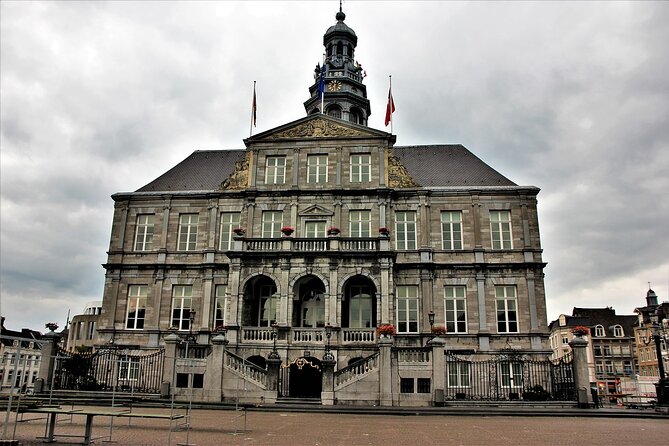
Starting at Markt 52 puts you beside the Stadhuis, or City Hall. This is a useful opening point because Maastricht’s story is not only about churches and fortifications. It is also about local government, trade, political pressure, and the city’s changing place within the Netherlands.
The nearby Street Market adds a practical sense of how this part of town functions. You are not simply looking at an old monument in isolation. You are beginning in a civic square where daily life and municipal history meet.
Your guide can set the timeline here, beginning with the city’s origins under the Romans and continuing through the Middle Ages. The route then reaches the Carolingian period, when Maastricht was part of a wider European power structure. This early section gives you useful bearings, but do not expect a full archaeological lecture in two hours. The value is the overview, not exhaustive detail.
This is one point where the private format helps. If Roman beginnings are your main interest, you can ask the guide to explain how that foundation shaped later Maastricht. If you are more interested in modern politics, you can move more quickly through the earliest centuries and save time for the Maastricht Treaty.
Dominicans Church and the City’s Religious Layers
The Dominicans Church, or Dominikanerkerk, is one of the route’s most striking reminders that old religious buildings can have new lives. The tour includes it as part of the historic center, alongside St. Servatius Church, St. John Church, and the Church of Our Lady.
The important point is not simply collecting four church names. Together, these sites show how much religious power shaped Maastricht. Your guide covers the legend of Saint Servatius, the religious wars of the 16th and 17th centuries, and the way confessional conflict affected the city.
You will also see Museum Aan Het Vrijthof, which adds an art and civic dimension to the route. The supplied price does not include entrance fees, so treat this as an exterior stop unless your guide and schedule make a visit practical. If you want to go inside museums or churches, ask about the timing before the walk begins. A two-hour route can lose time quickly when admission lines or interior visits enter the plan.
St. Servatius Church is especially important to the story of Maastricht. The Saint Servatius tradition gives the city a strong religious identity, while the church itself helps you understand why this was more than a small provincial town. St. John Church, with its distinctive presence near the same historic area, shows how several major religious institutions occupied a compact part of the city.
The Church of Our Lady brings another layer to the walk. Seeing these buildings in sequence helps you compare their roles and styles instead of treating each one as a disconnected photo stop.
Hendrik van Veldeke and the Vrijthof Area
The route includes Hendrik van Veldeke, a name tied to Maastricht’s literary and cultural past. This stop is a reminder that the city’s story is not limited to military events, rulers, and treaties. Language, poetry, and local identity also matter.
The Vrijthof area, with Museum Aan Het Vrijthof and the nearby churches, gives your guide a good place to connect culture with public life. You might find this part especially useful if you want more than a checklist of buildings. Ask how the square and its surrounding institutions changed over time, and what role they play in Maastricht today.
This is also a good section for photographs, since the concentration of historic architecture gives you several views in a short walk. The trade-off is that a central square can feel busy at times, and the tour does not promise a quiet visit or a dedicated photography stop. If you want time to frame pictures, say so early.
A few more options to weigh up in Maastricht
- Highlight Running Tour
★ 5.0 · 118 reviews - e-Scavenger hunt Maastricht: Explore the city at your own pace
★ 4.5 · 110 reviews - Maastricht: Museum of Illusions Entry Ticket
★ 4.2 · 82 reviews - Valkenburg: Municipal Cave Guided Tour
★ 4.5 · 47 reviews
Helpoort and the Defenses of Medieval Maastricht
Helpoort, the old city gate, shifts the focus from religion and civic life to defense. It helps explain why Maastricht mattered strategically and why walls and gates were such a major part of medieval urban life.
The gate is also a useful transition into later political history. The tour covers the Napoleonic era, the formation of the Kingdom of the Netherlands, and Maastricht’s difficult integration into that kingdom. Those subjects make more sense when you can see the physical defenses and compact old city around you.
I like this part of the route because it makes history tangible. A date in a guidebook can feel distant. A surviving gate gives you something solid to look at while the guide explains conflict, authority, and changing borders.
The tour does not include entrance fees, so you should not assume that every site can be entered. The strongest value comes from the guide’s explanation while you move among the landmarks. If a particular interior is essential to you, confirm whether it can fit the route and budget.
Pieke oet de Stokstraot and Small Local Details
Pieke oet de Stokstraot is a more personal stop than the major churches and city gate. Including a local character or neighborhood reference gives the walk a human scale. It shows that Maastricht is made up of stories tied to streets and residents, not only grand events.
This is the sort of detail that can disappear on a standard sightseeing circuit. A bus cannot give you the same feel for a small street or local figure. A private walking guide can pause, explain the reference, and answer the question that naturally follows: who was Pieke, and why does this place remember him?
The available information does not provide a full explanation of the figure, so I would treat this as a prompt to ask your guide for more context. That is one of the tour’s strengths. You are not locked into a recorded script, and you can ask about the small details that catch your eye.
Sint Servaasbrug and Maastricht’s Changing Fortunes
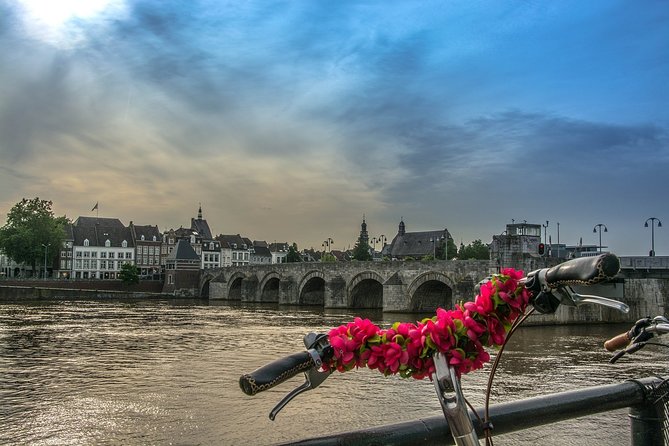
Sint Servaasbrug, the old bridge over the Meuse, brings the route back to movement, trade, and the city’s position between regions. Bridges are rarely just scenic crossings in an old European city. They explain how people, goods, armies, and ideas moved through the place.
From the city’s early Roman origins, the tour moves through the Middle Ages and the Carolingian Empire, then into religious wars and the industrial revolution. The industrial period is important because it explains Maastricht’s economic turnaround. The city was not frozen in its medieval past. It adapted to new industries and new forms of work.
The bridge also helps prepare you for the tour’s modern chapters: World War I, World War II, the post-war period, and the Maastricht Treaty. The route’s strength is this long arc. You are not only seeing old stones. You are learning how the city kept changing when borders, industries, and political systems changed around it.
War, Refuge, Occupation, and Recovery
The first half of the 20th century receives a meaningful place in the story. During World War I, Maastricht served as a haven for refugees. That detail adds social context to the city’s position near national borders and shows how international conflict affected ordinary urban life.
The tour then covers the German occupation during World War II. You should expect a concise explanation rather than a full war museum visit, but the subject gives weight to the streets you are walking through. Maastricht’s past is not only decorative or medieval. It includes fear, displacement, occupation, and recovery.
The post-war section shows how the city moved forward after those years. If modern European history interests you, this is an area where I would use the private format to ask questions. The guide can help connect local events with the wider changes in the Netherlands and Europe.
Because the tour lasts about two hours, the balance between ancient and modern subjects depends partly on your questions. You can ask for more war history, but doing so may mean less time at the churches or medieval sites.
The Maastricht Treaty and the Birth of the Euro
The final major theme is the Maastricht Treaty and the foundation of the European Union and the euro. This is one of the tour’s most useful features because it explains why a relatively compact Dutch city appears so often in modern European politics.
The treaty is not presented as an abstract classroom topic. It belongs to Maastricht, which means your guide can place this major political milestone within the city you are seeing. The route therefore ends with a strong connection between local streets and international decisions.
If you already know the basics of the European Union, ask how the treaty affected Maastricht itself. If the subject is new to you, ask the guide to explain the city’s role in plain language. A private tour is especially helpful here because you can spend a few extra minutes on the points you find confusing.
This modern ending also keeps the tour from becoming a parade of medieval buildings. You finish with a clearer idea of how Maastricht fits into Europe today.
What the $275.65 Group Price Buys You
The listed price is $275.65 for a group of up to 15 people. For one or two people, that is a costly two-hour walk. For a larger family or group of friends, the arithmetic looks much better because the price is shared rather than charged per person.
At the full group limit, the cost works out to roughly $18 per person. At six people, it is about $46 per person, and for two people it is nearly $138 each. That makes this tour most attractive when you have several people who want the same private guide.
You are paying for attention, flexibility, and a route designed for your group. You are not paying for admission to attractions, and entrance fees are extra. If you mainly want a short orientation before exploring alone, this can be worthwhile. If you want extended interior visits, a longer tour, or a museum-focused experience, the two-hour format may feel limited.
The strongest value comes from the city overview. You get Roman beginnings, medieval power, religious conflict, industrial change, war, and European integration in one walk. That is a lot of ground, but it is also the reason the tour works best as an introduction rather than a final word on Maastricht.
Who Will Enjoy This Walk Most
I would recommend this tour to first-time visitors who want to understand Maastricht quickly. It suits families, couples, and private groups who prefer asking their own questions instead of keeping pace with strangers.
It is also a good choice if you are interested in several periods at once. The route does not force you to choose between medieval architecture and 20th-century politics. You can see City Hall, the churches, Helpoort, the bridge, and other central sights while following one continuous story.
You should be comfortable walking for about two hours. The tour is not designed for people who want to stay seated, and it is better suited to mobile visitors who enjoy seeing a city at street level.
The activity is near public transportation, service animals are allowed, and most people can participate. The private arrangement means only your group joins the activity. Free cancellation is available up to 24 hours before the start time. Cancellations or changes inside that window are not accepted for a refund.
Should You Book the Maastricht Private Walking Tour?
Book it if you want a well-rounded first look at Maastricht, especially with a group large enough to share the $275.65 cost. The praised qualities are clear: an easy walk, a friendly guide, broad historical coverage, and the ability to see the main sights plus smaller local details.
I would hesitate if you are a solo visitor or a couple watching every euro. I would also hesitate if you want long interior visits, since admissions are not included and the entire route lasts only about two hours.
Before you go, confirm the meeting details and tell your guide which subjects matter most. Ask for more time on Saint Servatius, the wars, World War II, or the Maastricht Treaty as needed. Used this way, the tour gives you something valuable: a working map of Maastricht and a story that makes the city easier to understand on your own.
FAQ
How long does the Maastricht private walking tour last?
The tour lasts approximately two hours.
Where does the tour begin?
It begins at Markt 52, 6211 CK Maastricht, Netherlands.
Where does the tour end?
The activity ends back at the meeting point.
Is the tour private?
Yes. Only your group participates, with up to 15 people included in the group price.
Are entrance fees included?
No. Entrance fees are not included in the tour price.
Can the tour be customized?
Yes. You can discuss possible adjustments with your local guide during the tour.
What is the cancellation policy?
You can cancel up to 24 hours before the experience start time for a full refund. Cancellations or changes made less than 24 hours before the start are not accepted for a refund.
Just added in Maastricht
- Maastricht 2-Hour Walking Tour | Discover The City With A Local★ 4.5 · 57 reviews
- Discover Maastricht with a self-guided Outside Escape city game★ 5.0 · 29 reviews
- Maastricht Heritage and Nature Tour★ 5.0 · 6 reviews
- e-Scavenger hunt Valkenburg: Explore the city at your own pace★ 4.5 · 20 reviews
- Maastricht Highlights, Architecture & Heritage Tour★ 5.0 · 7 reviews
- Maastricht Medieval Mystery: Interactive City Game & Tour★ 4.0 · 25 reviews
- Maastricht Evening Sightseeing Tour★ 4.5 · 7 reviews
- Discover Maastricht with a Smile! Culture, History and People★ 5.0 · 16 reviews
Walking Tours, compared.

Anne Frank’s Story – Guided Walking Tour through Amsterdam
Read our review →
Life of Anne Frank and World War II Walking Tour
Read our review →
Absolutely Amsterdam – the Essential Introductory Walking Tour
Read our review →
Anne Frank Walking Tour – Guided in EN/DE/IT/ES
Read our review →


Anne Frank Walking Tour Amsterdam Including Jewish Cultural Quarter
Read our review →Browse the lists this tour appears in