
Review · CITY TOURS
The Haag and Rotterdam two city for one day
Two Dutch cities, two very different moods. This private tour puts The Hague’s royal buildings, courts, churches, and paintings beside Rotterdam’s ships, markets, bridges, and bold modern design. I like the contrast, and I like that your group can move at a comfortable pace instead of following a large crowd.
The tour also includes a licensed guide, a traditional Dutch lunch, and a Gouda cheese tasting at a farm shop. The main drawback is time. The day is advertised as roughly five hours in one place and seven hours in the longer description, so you should confirm the exact schedule before booking. You also pay separately for the train, about 10 euros per person for a round trip.
In This Review
- Key points to know before booking
- Why these two cities work well together
- The Hague begins with old stories and small details
- Binnenhof shows The Hague at the center of power
- Panorama Mesdag gives you a 19th-century seaside view
- The Peace Palace represents international law
- Royal The Hague continues along Noordeinde
- Churches and national memory fill out the route
- The 30-minute transfer changes the subject
- Rotterdam’s Maritime Museum opens the port story
- Markthal puts daily life under a huge artwork
- Cube Houses explain Rotterdam’s playful design
- The cathedral and river bring different sides of Rotterdam together
- Who gets the best value from this private tour
- Should you book The Hague and Rotterdam in one day?
- FAQ
- How long does the tour last?
- What is the price?
- Is the train ticket included?
- Where does the tour start?
- Where does the tour end?
- Is this a private tour?
- What is included in the tour?
Key points to know before booking

- The Hague and Rotterdam in one outing: See the Netherlands’ political and royal center, then switch to its modern port city.
- A private group of up to seven: Your party travels together, with a guide and no unrelated group members.
- The Hague has the fuller historical program: Expect the Binnenhof, Peace Palace, Noordeinde Palace, churches, an old prison tower, and Panorama Mesdag.
- Rotterdam focuses on architecture and the port: The Maritime Museum area, Markthal, Cube Houses, Erasmus Bridge, and Nieuwe Maas shape this part of the day.
- Transport is partly separate: A train connection between the cities takes about 30 minutes, but the ticket is not included.
- The schedule needs checking: The information gives both approximately five hours and approximately seven hours, while the end point is listed as Delft rather than Rotterdam.
Why these two cities work well together

The Hague and Rotterdam sit close together, but they tell very different stories. The Hague is associated with government, diplomacy, monarchy, grand avenues, and older buildings. Rotterdam is tied to shipping, rebuilding, engineering, and experimental architecture.
That contrast gives the tour a clear purpose. You are not simply collecting city sights. You are seeing how two nearby Dutch cities took different paths. The Hague retained much of its ceremonial and political identity, while Rotterdam became known for its port and its striking postwar design.
The tour is private, so the pace can be adjusted for your group. That matters because the itinerary contains many short stops. You will get a broad introduction rather than long museum visits. If you want to inspect every painting or spend an hour inside each church, this schedule will feel tight.
The listed price is $686.26 for a group of up to seven. That is a serious price for a half-day or one-day outing, but the calculation changes if you fill the vehicle or travel as a family or group of friends. At the maximum size, the base cost is about $98 per person, before train tickets and any other personal purchases. For one or two people, the value is much harder to defend unless private guiding is your main priority.
A few more options to weigh up in The Hague
- The Hague: Mauritshuis Entrance Ticket
★ 4.7 · 2,706 reviews - The Hague: City Canal Cruise
★ 4.6 · 2,024 reviews - The Hague: Madurodam Miniature Park Entry Ticket
★ 4.6 · 1,559 reviews
The Hague begins with old stories and small details
The first stop is an old monastery with a garden and lanterns made from Delft porcelain. The location is presented as an important place in the story of the modern Netherlands, and the guide uses it to discuss betrayal, political incidents, and a tragic murder.
That combination should appeal to you if you prefer local stories to a quick parade of famous facades. The garden and porcelain lanterns also add a visual touch that is easy to miss on a standard city walk.
There is a shop here filled with nostalgic toys, retro candy canes, kerosene lamps, and other old-fashioned objects. It may sound minor beside the major monuments, but this is the sort of stop that gives a tour some personality. You are not only looking at official buildings. You are also seeing how Dutch memory and everyday objects are presented.
The supplied details do not identify the monastery by name, so ask the guide to clarify it when you meet. That is useful if you want to mark the location on a map or return later.
Binnenhof shows The Hague at the center of power
The Binnenhof is the essential political stop in The Hague. This group of buildings in the city center has housed the States General and the residence of the Prime Minister, and it sits close to the Mauritshuis art gallery and other monuments.
You will get a sense of why The Hague became the country’s political capital. The buildings are not presented as isolated sights. They form a working and historic center, where government, royal life, and museums sit close together.
The itinerary does not promise admission to the Mauritshuis, so do not plan on a full art museum visit during this tour. The same point applies to several other locations. The guide can explain what you are seeing, but the day is built mainly around exterior views and short visits.
This is one of the places where a private guide helps. A cluster of government buildings can look confusing if you arrive without context. With limited time, you want someone to explain which structure matters and why.
Panorama Mesdag gives you a 19th-century seaside view

Panorama Mesdag is one of the more unusual stops. The painting is 14 meters high and 120 meters long, showing the fishing village of Scheveningen in the 19th century.
The work was begun in 1880 by Hendrik Willem Mesdag, a marine painter associated with the Hague School. His wife and many students helped with the project. It is displayed in a purpose-built cylindrical building, where the curved shape creates the illusion that you are standing on high dunes above the village.
This is not a standard framed painting that you glance at and leave. The building and the shape of the canvas are part of the experience. You can look around the scene and notice how the curved surface changes your sense of distance.
The short schedule may limit how long you spend here, but the stop adds depth to The Hague portion. It connects the city to Scheveningen, the sea, and the 19th-century Dutch art world.
A different kind of day out entirely:
- The Hague: The Pier SkyView Ticket with Drink and Snack
★ 4.4 · 1,398 reviews - The Hague: Hop-on Hop-off Old-Fashioned Heritage Tram Tour
★ 4.4 · 1,083 reviews - The Hague: Escher in The Palace Museum Ticket
★ 4.6 · 896 reviews - Oranjehotel World War II Prison Entrance Ticket
★ 4.6 · 708 reviews
The Peace Palace represents international law
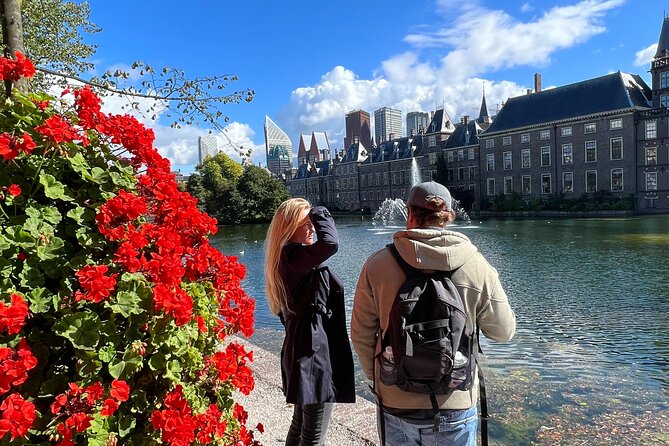
The Peace Palace is included with admission, with about 15 minutes allotted for the stop. It is the official home of the International Court of Justice and the Permanent Court of Arbitration.
The building was constructed from 1907 to 1913 for the Permanent Court of Arbitration, using funds donated by American industrialist and philanthropist Andrew Carnegie. It sits in a seven-hectare park in central The Hague.
You should think of this as a photo and explanation stop, not a full institutional visit. Fifteen minutes is enough to see the setting and understand the building’s role, but it is not enough for a detailed tour of international law.
Still, the Peace Palace is a strong fit for the city. The Hague is often called a world center for law and diplomacy, and this stop gives that reputation a physical place.
Royal The Hague continues along Noordeinde
Noordeinde is one of three palaces still used by the Dutch royal family. Since 2013, it has served as the working palace of King Willem-Alexander.
The stop is useful because it shows the monarchy as part of the modern city rather than something locked away behind museum doors. You can see the setting of the working palace and connect it with The Hague’s royal identity.
The tour also passes an old prison tower with gates. The details do not specify the tower’s name or admission arrangement, so expect a brief historical look rather than assume you will enter. The same practical rule applies to several sights on this route: the guide may explain and point out more than the schedule allows you to enter.
Churches and national memory fill out the route
The Great Church, also called St. James Church, is one of The Hague’s oldest buildings. It sits on Torenstraat, named for its tall tower, and is closely associated with the Binnenhof and the House of Orange-Nassau. Members of the royal family were baptized and married here.
That royal connection makes the church more than a religious building. It helps explain how civic power, monarchy, and Protestant tradition overlap in The Hague.
The route also includes a monument dedicated to the father of the nation. The supplied information does not give the monument’s name, so ask the guide for the exact reference. This is a small but worthwhile question, especially if you want to understand which figure the city presents as central to Dutch national identity.
Taken together, these stops give The Hague a strong historical shape. The possible weakness is that the list is long. You will see many locations, but several may be quick exterior stops.
The 30-minute transfer changes the subject
The trip between The Hague and Rotterdam takes about 30 minutes by train or car. The train ticket is not included and costs approximately 10 euros per person for a two-way trip.
The train option can be practical, but you should clarify who handles the tickets and where you meet after the transfer. The published meeting point is Den Haag Centraal at Koningin Julianalaan 10. The listed end point is Delft, at Delft Market Square, which does not match a simple Rotterdam finish.
That mismatch is worth sorting out before you pay. The experience is described as a two-city day centered on The Hague and Rotterdam, yet the end point information names Delft. It may reflect the provider’s wider routing, but you should ask for the exact final drop-off point and transport plan.
This transfer is also a useful break. The Hague’s formal buildings and royal associations give way to Rotterdam’s port, engineering, and modern architecture.
Rotterdam’s Maritime Museum opens the port story
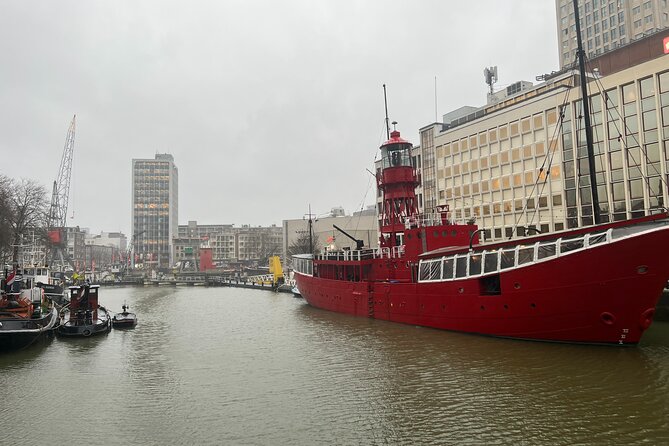
The Rotterdam portion begins around the open section of the Maritime Museum. The museum was founded in 1874 and is described as the oldest maritime museum in the Netherlands.
You will see ships, an old port train, cranes, and other working pieces of port life. The guide explains the history of Rotterdam as the largest port in Europe, at least in the wording supplied for the tour.
The visit includes about 15 minutes and admission is included. That is enough for a strong introduction, but not a full museum visit. If maritime history is your main interest, you may want to return separately with more time.
For a first look, this stop works well. Rotterdam makes more sense when you understand that its unusual buildings and broad river are tied to trade, shipping, and industrial movement.
Markthal puts daily life under a huge artwork
The Markthal is one of Rotterdam’s most recognizable modern buildings. Apartments curve over an indoor market, creating a horseshoe-shaped structure that combines homes with food stalls.
Inside are about 100 fresh produce units, around 15 food shops, restaurants, a supermarket, and a four-level parking garage. Look up from the market and you will see Horn of Plenty, a large artwork by Arno Coenen and Iris Roskam. Its size has led to comparisons with the Dutch version of the Sistine Chapel.
The tour allows about 15 minutes here, with admission included. That is enough to enter, look up, take in the building’s shape, and perhaps decide what you would like to eat later. It is not enough for a relaxed market lunch, so keep your expectations realistic.
A traditional Dutch lunch is included in the tour description, but the exact restaurant and timing are not specified. Ask whether the lunch takes place at the Markthal or elsewhere, especially if you have dietary needs.
Cube Houses explain Rotterdam’s playful design
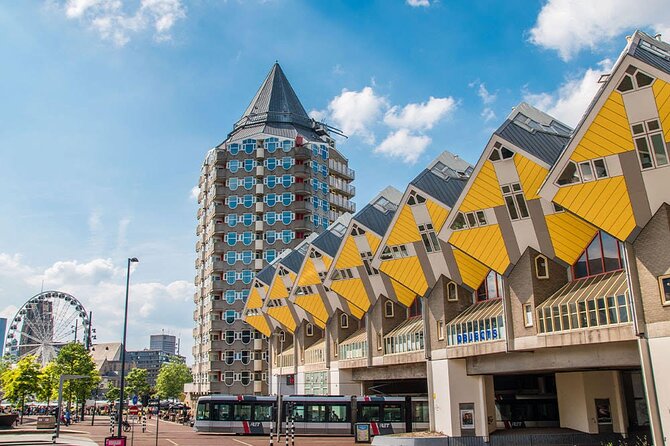
The Cube Houses were designed by Piet Blom and built in Rotterdam and Helmond in 1984. In Rotterdam, 38 houses and two larger super-cubes form a single structure along Overblaak Street.
Their tilted forms are the point. These are not ordinary houses with unusual paint. The design changes the way walls, windows, and rooms meet, creating a memorable example of Rotterdam’s willingness to test new ideas.
You will likely view the houses from the outside during this fast-moving tour. The information does not promise entry into a show house, so do not count on seeing a typical interior. Even from the street, the cluster is easy to understand and makes a sharp contrast with The Hague’s older stone buildings.
The cathedral and river bring different sides of Rotterdam together
The Cathedral of Saints Lawrence and Elizabeth is the Catholic cathedral of the Diocese of Rotterdam. Its address is Mathenesserlaan 305, 3021 HK Rotterdam.
This stop adds a religious and civic layer to a city program otherwise focused on ports and modern design. Since the schedule is short, ask if the visit is an exterior viewing or includes time inside.
The final major sights are the Erasmus Bridge and the Nieuwe Maas. The Erasmus Bridge crosses the Nieuwe Maas and is known for its asymmetric pylon and cable-stayed design. The bridge is 802 meters long, with a pylon 139 meters high, and has become one of Rotterdam’s symbols.
The Nieuwe Maas is a branch of the Rhine and Meuse delta. It divides Rotterdam into northern and southern sections and flows through the city toward the west. These two sights help you read Rotterdam geographically. The bridge is not only a landmark. It is part of the city’s connection across the river and its wider port system.
Who gets the best value from this private tour
I would recommend this experience most strongly to a group of four to seven people that wants a guide and prefers a broad overview to long museum visits. Families may like the short visual stops, the old toy shop, the market hall, the ships, and the bold Cube Houses.
It also suits first-time visitors who have only one day available and want both historic and modern Holland. The private format means your group can ask questions and keep a comfortable pace.
I would be more cautious if you are a serious art, architecture, or maritime enthusiast. The tour touches all three subjects, but the 15-minute stops at the Peace Palace and Maritime Museum area leave little room for detailed study. You may prefer separate full-day visits.
The price makes the most sense when shared. Add about 10 euros per person for the train, and confirm whether lunch is fully covered or simply arranged as part of the tour. Gouda tasting and snacks are included, which adds a pleasant local food element, but personal purchases at the market or shops cost extra.
Confirmation arrives within 48 hours, subject to availability. The tour is near public transport, most people can participate, and only your group takes part. Free cancellation is available up to 24 hours before the start time. Poor weather or failure to reach the minimum number of participants can lead to a new date or a full refund.
Should you book The Hague and Rotterdam in one day?
Book it if your priority is contrast, convenience, and private guiding. The Hague gives you courts, palaces, churches, political buildings, and Panorama Mesdag. Rotterdam gives you ships, cranes, modern housing, a food hall, a famous bridge, and a major river.
Do not book without first confirming the exact duration and finish. The details give both five and seven hours, and the stated end point is Delft even though Rotterdam is the second city. Once those points are clear, this can be a useful way to cover two very different Dutch cities without planning every connection yourself.
FAQ
How long does the tour last?
The experience is described as approximately five hours in the tour summary and approximately seven hours in the longer description. Confirm the exact schedule before booking.
What is the price?
The listed price is $686.26 per group of up to seven people.
Is the train ticket included?
No. The train ticket between the cities is separate and costs approximately 10 euros per person for a two-way trip.
Where does the tour start?
The listed starting point is Den Haag Centraal, Koningin Julianalaan 10, 2595 AA Den Haag, Netherlands.
Where does the tour end?
The listed end point is Delft Market Square in Delft. Confirm this with the provider because the experience also includes Rotterdam.
Is this a private tour?
Yes. Only your group participates, with a maximum group size of seven.
What is included in the tour?
The tour includes excursions in both cities with a licensed guide, snacks, a traditional Dutch lunch, Gouda cheese tasting at a farm shop, and admission to the Peace Palace and the open section of the Maritime Museum.
Just added in The Hague
- Delft: City Walk with Audio Guide in 7 Languages on your Phone★ 5.0 · 4 reviews
- Best Highlights of The Hague with a local★ 5.0 · 1 review
- 3 Course Walking Dinner in Delft with Guided Tours in Between★ 5.0 · 3 reviews
- Your Own Hague. Behind The Scenes of The Royal City★ 4.5 · 5 reviews
- The Hague Must-See attractions Private Walking Tour With A Guide★ 5.0 · 5 reviews
- e-Scavenger hunt The Hague: Explore the city at your own pace★ 3.5 · 10 reviews
- The Hague: City Walk Audio Guide in 7 Languages on your Phone★ 3.5 · 5 reviews
- The Hague Private Walking Tour with a Local★ 4.0 · 29 reviews
City Tours, compared.
75 Minute City Canal Cruise with Audio Guide
Read our review →
City Canal Cruise and Heineken Experience Ticket
Read our review →
Browse the lists this tour appears in