
Review · MUSEUMS
The Hague: Escher in The Palace Museum Ticket
Impossible stairs, royal rooms, and a seven-meter artwork. Escher in Het Paleis brings M.C. Escher’s mind-bending prints together inside the former Winter Palace of Queen Mother Emma. I like the way the museum shows both the famous optical tricks and the artist’s less familiar work. I also like that the upper-floor activities give children and adults something to do beyond reading wall labels. The main thing to consider is that the palace rooms can feel compact and, at busy times, somewhat stuffy.
At $15 per person, this is a fair-priced museum stop, especially if Escher’s repeating patterns, impossible buildings, and mathematical ideas appeal to you. Plan on about an hour for a quick visit, or closer to two hours if you want to read carefully, use the audio guide, and spend time with the hands-on exhibits. Your ticket is valid for 365 days, so you have useful flexibility when arranging a day in The Hague.
In This Review
- Key points to know before you go
- Why Escher in The Hague works so well
- Entering the former Winter Palace of Queen Mother Emma
- The main collection, from nature to impossible worlds
- Metamorphosis III and the seven-meter display
- Looking as Escher Does on the upper floor
- The audio guide and the palace details
- How long to stay and how to plan the visit
- Reaching Lange Voorhout from The Hague Central Station
- The café, shop, and small practical comforts
- Who will enjoy this museum most
- Is the $15 ticket worth it?
- FAQ
- Where is Escher in Het Paleis located?
- How do I reach the museum from The Hague Central Station?
- How much does admission cost?
- How long is the ticket valid?
- Is an audio guide included?
- What major artwork can I see?
- Are children allowed in for free?
- Is there anything for children to do?
- Can I bring luggage or a large bag?
- Is the museum open on public holidays?
Key points to know before you go
- Metamorphosis III is the visual centerpiece: The seven-meter woodcut is displayed in an unusual way so you can follow Escher’s changing forms through time and space.
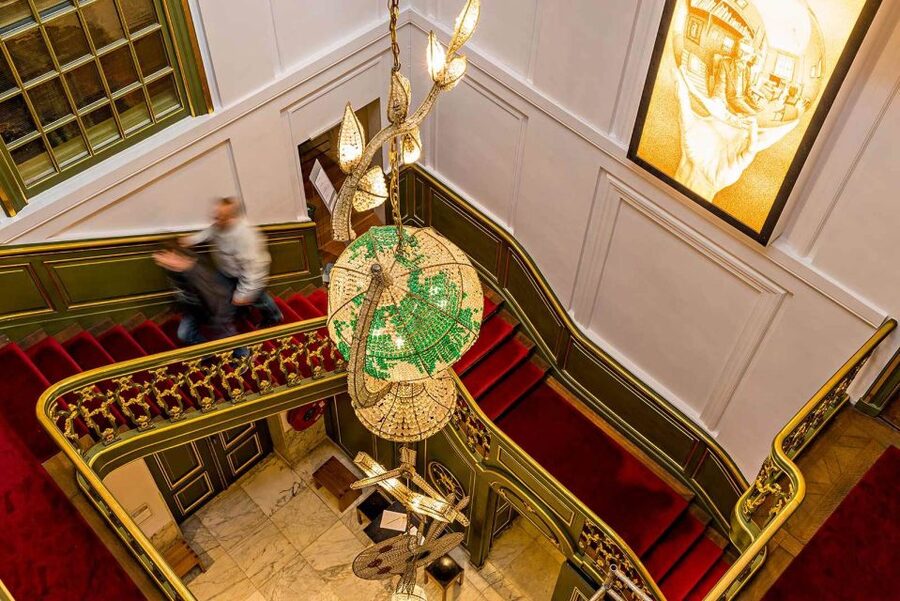
- The palace is part of the experience: Original royal details remain in the former Winter Palace, including decorative ceilings, chandeliers, and rooms that once served the Dutch royal household.
- More than 130 prints are on display: You will see famous works such as Day and Night and Climbing and Descending, along with designs that receive less attention elsewhere.
- The upper floor is hands-on: Looking as Escher Does uses optical puzzles and physical activities to explain how Escher played with perception.
- Families get extra help: Children up to age six enter free with a paying adult, and a free treasure hunt gives younger visitors a reason to keep looking.
- The location fits neatly into a city day: From The Hague Central Station, take tram 9 to Korte Voorhout or tram 17 to Kneuterdijk.
Why Escher in The Hague works so well
Escher is easy to recognize, but harder to fully understand. You may know the endless staircase or birds that turn into fields. The museum helps you see how those ideas developed rather than presenting only a greatest-hits display.
The collection includes almost all of Escher’s work, with more than 130 prints. That range matters. You can trace his movement from detailed natural scenes and architectural studies toward the looping forms, tessellations, reflections, and impossible structures that made him famous.
I especially like this approach for first-time visitors. You do not need a background in art or mathematics. The pictures catch your eye first, then the explanations give you a way to think about what you are seeing.
The museum also helps correct a common misconception. Escher was not simply an artist who drew tricks. His work grew from close observation, pattern, geometry, travel, and a lifelong interest in how the eye makes sense of the world. The exhibition gives that development room.
More Museum Tours in The Hague
- Royal Delft: Delftblue Factory and Museum Admission Ticket
★ 4.5 · 145 reviews - The Hague: Panorama Mesdag Museum Entry Ticket
★ 4.8 · 143 reviews - The Hague: Prison Gate Museum
★ 4.5 · 58 reviews
Entering the former Winter Palace of Queen Mother Emma
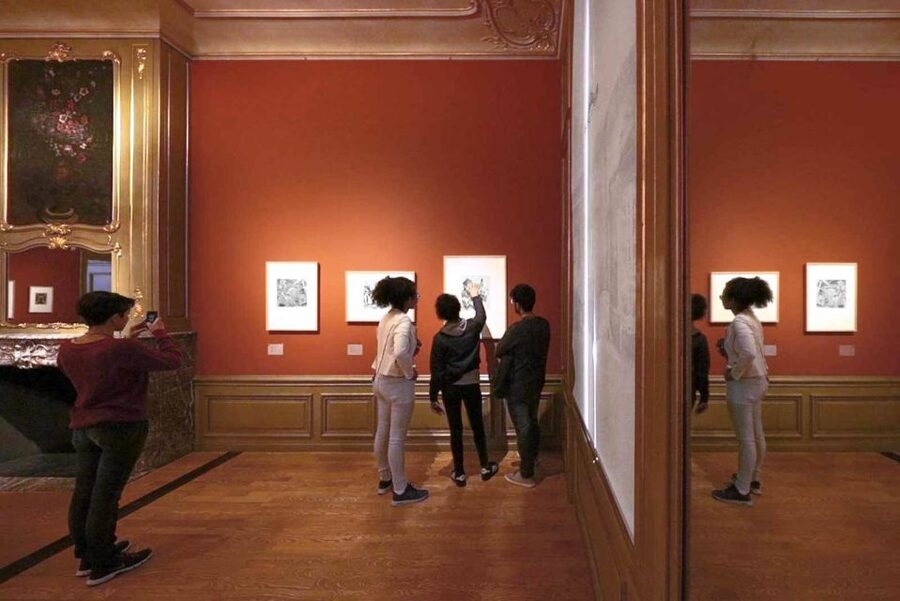
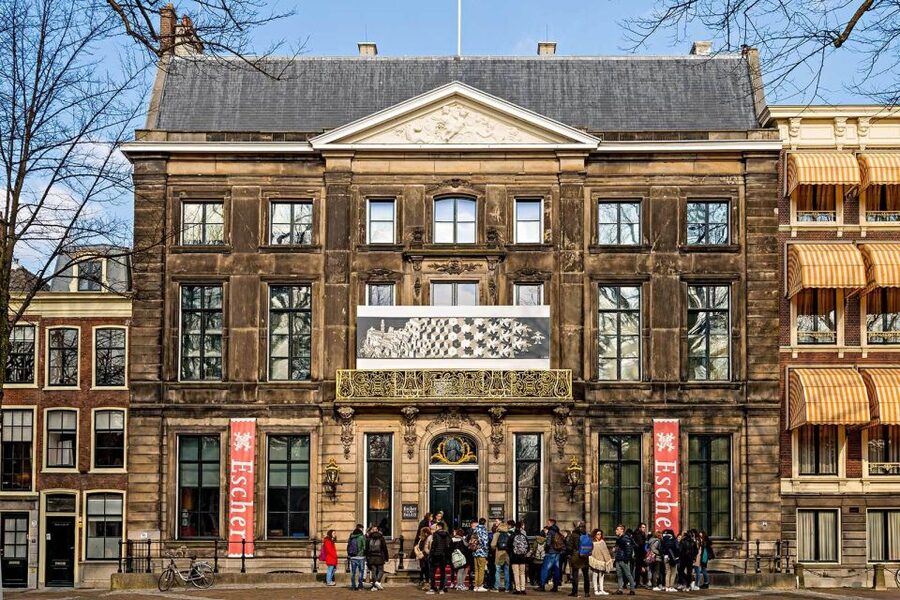
Het Paleis, at Lange Voorhout 74, is not a plain gallery box. It occupies the former Winter Palace of Queen Mother Emma of the Netherlands, and the original royal atmosphere remains visible throughout the building.
That setting gives the visit two subjects instead of one. You come for Escher, but you also get a glimpse of a royal residence. Look up as you move through the rooms. Chandeliers and ceiling details reward the visitors who remember to study the building, not just the framed prints.
The palace atmosphere also changes the mood of the collection. Escher’s precise black-and-white work can feel severe in a modern gallery. Here, it shares space with historic rooms and decorative features. The contrast is useful because it shows how unusual the art remains, even when placed in an elegant old interior.
Some rooms are relatively small. If the museum is busy, you may need patience around the most famous pieces. One practical choice is to move at your own pace rather than stopping for long periods in the first gallery. You can return to a favorite print later.
The main collection, from nature to impossible worlds
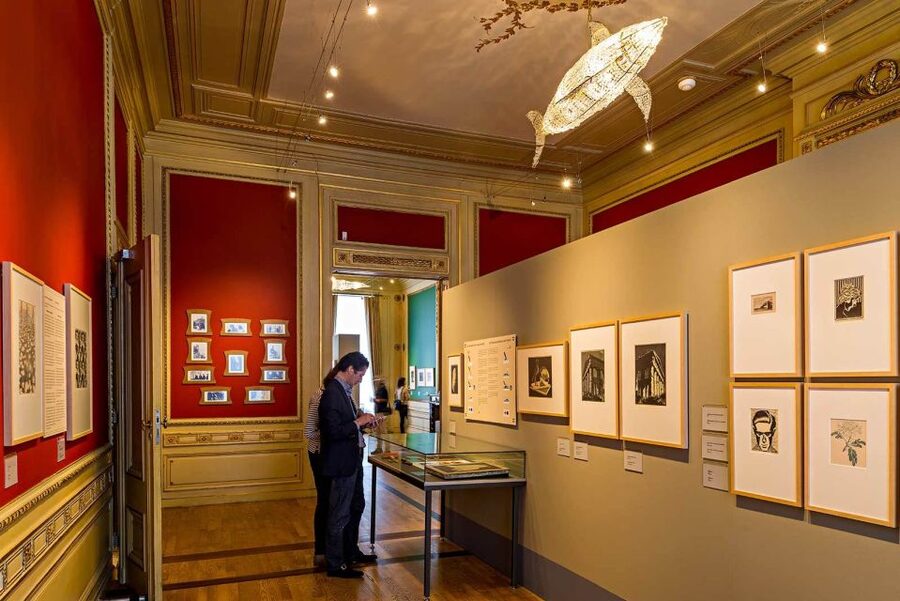
The exhibition is strongest when you follow Escher’s artistic progress. Early and less famous works help explain how he learned to control line, detail, contrast, and repeating forms.
You will find intricate designs and tessellations, but you will also see work beyond the perspective images most often reproduced in books. That broader view makes the visit more rewarding. It reveals an artist who kept returning to certain ideas while finding new ways to reshape them.
Day and Night is one of the essential stops. In this print, a Dutch field pattern gradually changes into a flock of birds. The image feels simple at first, then becomes more difficult to follow as the forms exchange roles.
Climbing and Descending offers a different kind of puzzle. Rows of figures appear to walk endlessly upward and downward on a staircase, creating a loop that cannot work in ordinary physical space. The pleasure comes from spotting the contradiction and then trying to work out how Escher made it look convincing.
Give yourself time with the smaller prints too. The famous works draw the crowd, but the less familiar pieces help you understand his process and recurring interests. If you enjoy graphic design, illustration, architecture, or mathematics, you may find these quieter works just as useful as the headline images.
Metamorphosis III and the seven-meter display
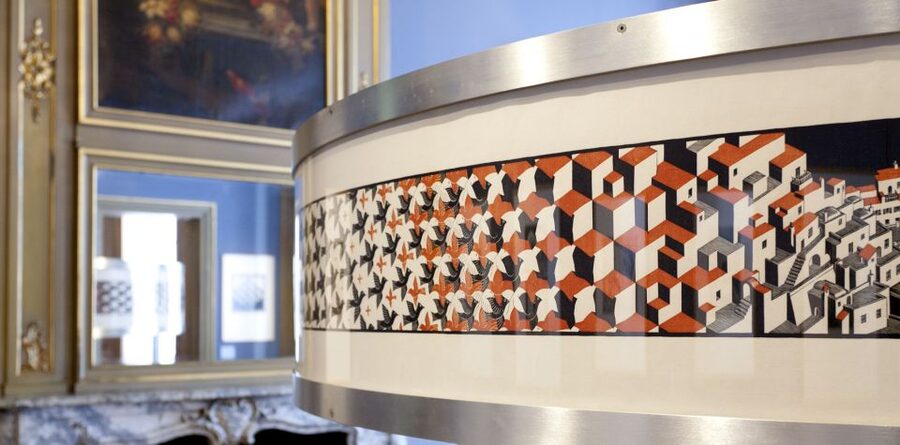
Metamorphosis III is the museum’s major physical spectacle. This enormous woodcut stretches for seven meters and is displayed in a nontraditional arrangement.
The format matters. Instead of seeing the print as a single flat image, you can follow the gradual changes as one form becomes another. Time and space seem to operate together, with patterns shifting through a long visual chain.
It is worth slowing down here. Walk along the work and let your eye adjust. Escher’s transitions are not meant to be understood in one quick glance. The appeal is in noticing how a familiar shape becomes something else without a clear break.
This is also where the museum’s scale helps. A seven-meter work needs room, and the long presentation gives it a physical presence that a reproduction cannot match. If Escher has been a bucket-list artist for you, this is likely the moment that makes the admission worthwhile.
A different kind of day out entirely:
- The Hague: Mauritshuis Entrance Ticket
★ 4.7 · 2,706 reviews - The Hague: City Canal Cruise
★ 4.6 · 2,024 reviews - The Hague: Madurodam Miniature Park Entry Ticket
★ 4.6 · 1,559 reviews - The Hague: The Pier SkyView Ticket with Drink and Snack
★ 4.4 · 1,398 reviews
Looking as Escher Does on the upper floor
The interactive section, Looking as Escher Does, is the best part of the museum for families and anyone who likes to test an idea rather than simply read about it.
Here you can work through puzzles with your eyes and use your hands to explore some of Escher’s visual problems. The activities explain perception in a direct way. Instead of telling you that the eye can be fooled, they let you feel the confusion for yourself.
Children have a free treasure hunt, which adds structure to the visit. Younger children may not spend long with every print, but a hunt gives them specific details to find. Children up to age six enter free when accompanied by a paying adult.
The interactive floor is also useful for adults. You may understand an optical illusion in theory and still be surprised when the image behaves differently from what you expect. Leave enough time for this level rather than treating it as a quick final stop.
The upper floor was repeatedly praised for its fun, family-friendly character, but keep the museum’s closing time in mind. A late arrival can leave you rushing through the hands-on area, which is exactly the section that benefits from unhurried attention.
The audio guide and the palace details
An audio guide is included in English, Dutch, German, French, Chinese, Japanese, Ukrainian, and Korean. That makes the collection easier to approach if you want more context than the printed labels provide.
You do not have to use it to enjoy the museum. The works have explanatory information, including English and Dutch text, and the collection can be browsed at a comfortable pace. Still, the audio option is useful if Escher’s methods are new to you or if you want a clearer account of his life and artistic development.
A short introductory video helps set the tone for the visit. It gives you a quick sense of Escher’s career before you move into the main rooms. If you enjoy knowing what to look for, watch it near the beginning.
Keep looking at the building as well. The chandeliers have received special attention for good reason. The palace’s ceilings and floors can contain as much visual interest as the prints, and the setting gives you a small glimpse of how the royal family lived.
How long to stay and how to plan the visit
You can see the museum in about an hour if you focus on the main works. That is enough for a compact visit, but it will not leave much time for detailed labels, the video, or the interactive displays.
I would allow around two hours for a relaxed visit. That gives you time to follow Escher’s development, study Metamorphosis III, look at the palace features, and spend proper time upstairs.
The ticket is listed at $15 per person and remains valid for 365 days. The long validity is unusual for a single museum admission, but availability and starting times still need to be checked when you book. The flexible cancellation policy allows cancellation up to 24 hours in advance for a full refund, and you can reserve now and pay later.
Large bags and luggage are not allowed. Plan to arrive without bulky belongings, since a crowded museum room is even harder to manage with a large bag. A past visitor found the cloakroom and free lockers useful, but the current instructions specifically warn against luggage or large bags, so pack light.
The museum is closed on Christmas Day and January 1. It remains open on Easter, King’s Day, Ascension Thursday, Whitsun, and Whit Monday. Check the opening details before setting out, particularly around holidays.
Reaching Lange Voorhout from The Hague Central Station
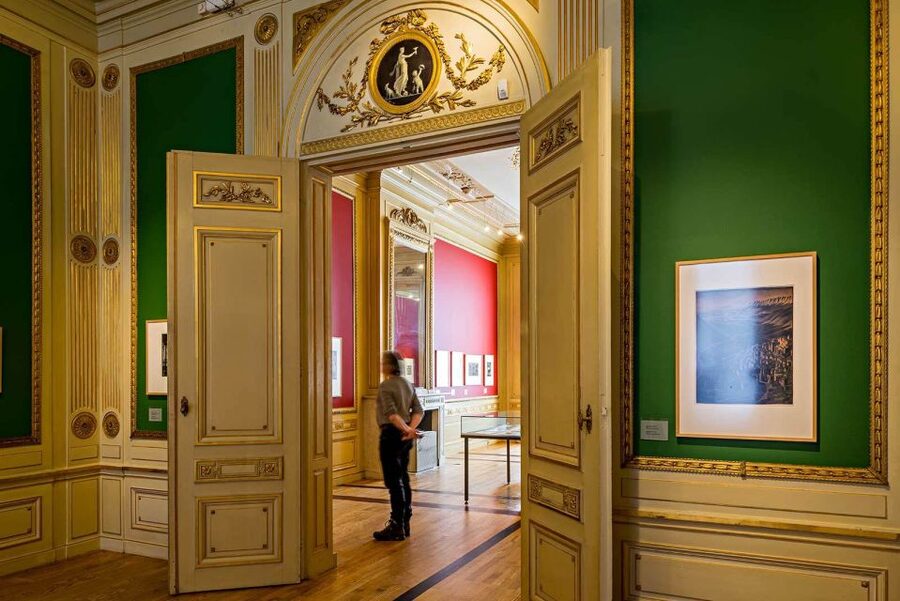
The museum is easy to add to a day in central The Hague. From The Hague Central Station, take tram 9 and get off at Korte Voorhout, or take tram 17 to Kneuterdijk.
The surrounding area gives you good options before or after your museum visit. You can walk toward the nearby park, see the Parliament buildings, and find lunch spots in the area. One practical plan is to visit Escher in the morning, eat nearby, and then continue through central The Hague.
Because the museum is in a central historic area, it works well as a short stop rather than a full-day attraction. You do not need to build your entire schedule around it, but you should avoid squeezing it into the last few minutes before another timed activity.
The café, shop, and small practical comforts
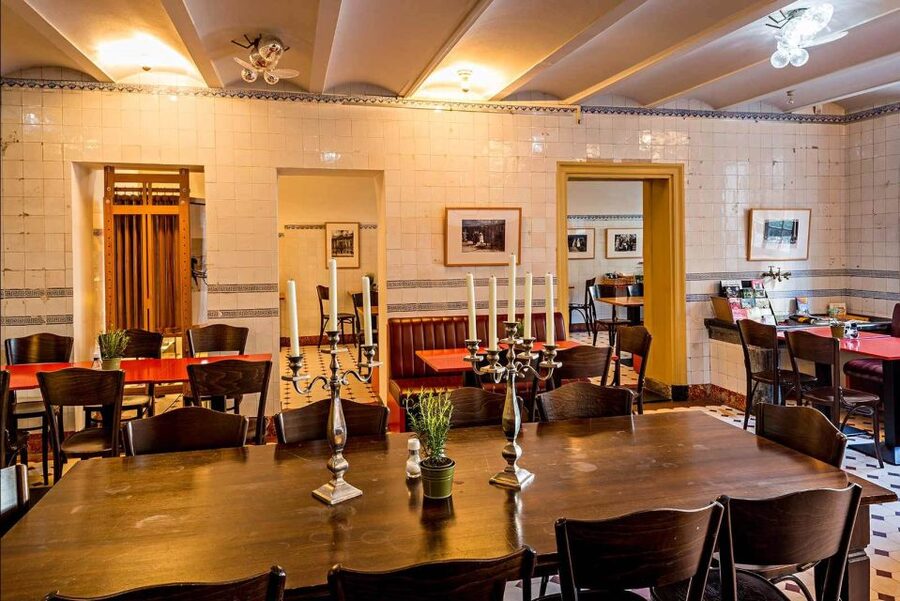
The museum café occupies the former palace kitchen. It gives you a pleasant place to pause after the galleries, and the setting continues the palace story rather than feeling like an unrelated modern concession.
There is also a souvenir shop. It is reasonably priced according to the supplied information, which is helpful if you want an Escher print, puzzle, or small reminder without treating the shop as a luxury stop.
The museum’s size is both an advantage and a limitation. I like that you can cover the main collection without tiring yourself out. On the other hand, the compact rooms can feel crowded, and air circulation may not be ideal when several people gather around a video or popular print.
If you are sensitive to warm or stuffy rooms, visit at a quieter time and keep your pace flexible. The video area is small, with room for only a limited number of people at once, so you may need to wait.
Who will enjoy this museum most
This is an easy recommendation for Escher fans. You get original works, the seven-meter Metamorphosis III, famous impossible scenes, and less familiar pieces that show how his art changed over time.
It also suits people who think they do not know much about Escher. The introduction, labels, and interactive exhibits make the subject approachable without requiring an art-history lesson.
Families should allow extra time for the treasure hunt and upper-floor puzzles. The activities give children a reason to examine the pictures, while the palace rooms and chandeliers offer adults something beyond the games.
Graphic designers, illustrators, architects, mathematicians, and anyone interested in visual perception will find plenty to study. The museum explains how pattern and geometry shaped Escher’s work, but it still leaves room for your own sense of wonder.
You may want to skip it if you dislike optical illusions, detailed black-and-white prints, or museums that ask you to look closely. It is not a palace tour with a few Escher pictures added. Escher is the central subject, and the visit works best when you are ready to spend time examining images.
Is the $15 ticket worth it?
At $15, the admission offers solid value. You receive access to more than 130 prints, the royal interior, the long Metamorphosis III display, the interactive upper floor, and an audio guide in several languages.
The museum is not huge, so do not expect a full day of galleries. That is part of its appeal. You can enjoy the collection in one or two hours and still have time for The Hague’s nearby sights.
I would book this experience if Escher interests you even a little, especially if you are visiting with children or want a museum that mixes art with puzzles. Buy with more caution if your schedule is tight, you are carrying luggage, or you dislike compact rooms. For most people, the combination of original art, an intact royal setting, and hands-on exhibits makes this one of The Hague’s most satisfying short museum visits.
FAQ
Where is Escher in Het Paleis located?
The museum is at Het Paleis, Lange Voorhout 74, The Hague, in South Holland, Netherlands.
How do I reach the museum from The Hague Central Station?
Take tram 9 to Korte Voorhout or tram 17 to Kneuterdijk.
How much does admission cost?
The listed price is $15 per person.
How long is the ticket valid?
The ticket is valid for 365 days. Check availability for the relevant starting times.
Is an audio guide included?
Yes. Audio guide languages include English, Dutch, German, French, Chinese, Japanese, Ukrainian, and Korean.
What major artwork can I see?
The collection includes Metamorphosis III, a seven-meter woodcut, as well as Day and Night and Climbing and Descending.
Are children allowed in for free?
Children up to six years old enter free when accompanied by a paying adult.
Is there anything for children to do?
Yes. The museum offers a free treasure hunt, and the upper floor has interactive puzzles and activities.
Can I bring luggage or a large bag?
No. Luggage and large bags are not allowed.
Is the museum open on public holidays?
The museum is closed on Christmas Day and January 1. It is open on Easter, King’s Day, Ascension Thursday, Whitsun, and Whit Monday.
Just added in The Hague
- The Hague Walking Tour★ 4.5 · 16 reviews
- The Hague: Powerboat Tour Scheveningen★ 4.5 · 15 reviews
- The Hague Tower Guided Tour★ 4.5 · 45 reviews
- The Hague: Private Boattour up to 10 persons★ 4.9 · 37 reviews
- The Hague: Private Custom Walking Tour With A Local Guide★ 4.5 · 13 reviews
- The Hague: Ping Pong Table Rental at a Secret Ping Pong Bar★ 4.5 · 7 reviews
- The Hague: Prison Gate Museum★ 4.5 · 58 reviews
- The Hague: One Way Boat Ticket to or from Delft★ 4.5 · 52 reviews
Museums, compared.
Moco Museum Amsterdam Entrance Tickets with Banksy & More
Read our review →


Amsterdam’s Weirdest Museum: Believe It or Not!
Read our review →
Browse the lists this tour appears in