
Review · HISTORICAL TOURS
Amsterdam: Private Pedicab Historical Sightseeing Tour
Amsterdam looks different from a pedicab. You glide through narrow streets, see the canals without a long walk, and hear the city’s story from a local guide. I especially like the private two-person format and the way the route links major sights with lesser-seen corners. The main drawback is the price: at $230 for two people, it is a splurge unless comfort, personal attention, or limited walking matters to you.
Guide Bram de Haan earns strong praise for his preparation, clear explanations, and warm manner. He uses photographs and maps to explain how Amsterdam grew, and he provides a blanket in cold weather. Still, bring warm clothing, because a two-hour open-air ride can feel chilly even when the forecast looks mild.
In This Review
- Key points at a glance
- Why a pedicab works well in Amsterdam
- Starting at Dam Square, Amsterdam’s birthplace
- Zeedijk and a glimpse of Chinatown
- New Market and the old city gate
- Montelbaanstoren and the houseboats of Oude Waal
- The Jewish quarter and Amsterdam’s wartime memory
- The Hermitage and the Amstel River
- Through the 17th-century canal district
- Museumplein and the Rijksmuseum tunnel
- Bram de Haan’s guiding style
- Comfort, weather, and mobility
- Is $230 good value for two people?
- Who should book this Amsterdam pedicab tour?
- FAQ
- How long is the Amsterdam private pedicab tour?
- How many people can join the private pedicab?
- What is included in the price?
- Are food and drinks included?
- Which languages are available?
- Where does the tour begin and end?
- Are there passenger weight restrictions?
- Should you book it?
Key points at a glance

- A city tour without the long walks: Hotel pickup and pedicab transport make this a useful choice for seniors and people with limited mobility.
- A private ride for up to two people: You get a personal guide rather than a large group, with room to ask questions and request photo stops.
- A broad historic route: The two hours cover Dam Square, Chinatown, the Jewish quarter, the Amstel River, the canal district, and Museumplein.
- Bram de Haan’s visual storytelling: Maps and photographs help explain Amsterdam’s growth, monuments, wartime past, and canal houses.
- A strong comfort check is needed: The combined passenger limit is 200 kilograms, and the activity is listed as unsuitable for anyone over 100 kilograms or 220 pounds.
- Good flexibility at the finish: You can arrange a preferred drop-off location before the ride.
Why a pedicab works well in Amsterdam
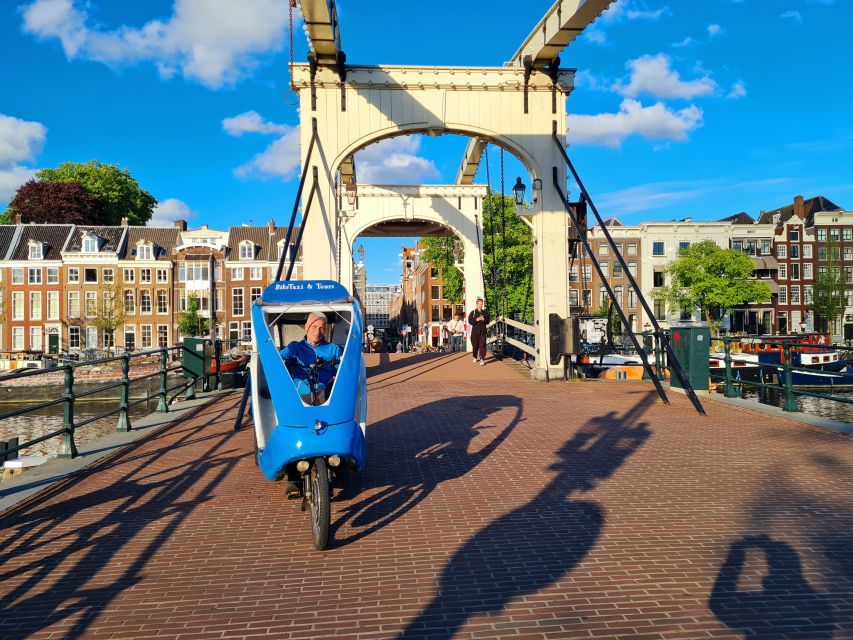
Amsterdam’s old center is compact on a map but tiring on foot. Streets twist around canals, bicycles come from every direction, and the most interesting details often appear several blocks apart. A pedicab gives you a moving seat, a guide, and a clear view at street level.
I like this more than a standard motor vehicle for the old center. The pedicab can use small streets that cars cannot easily reach, and you remain close to the canal houses, bridges, and street life. At the same time, it is easier than walking from one end of the historic center to another.
The private setup matters. You book the whole pedicab for up to two people, so you can ask about a building, pause for a photograph, or request more explanation without worrying about a group schedule. The ride lasts two hours, which is long enough for a broad introduction but not so long that the seat or weather becomes a serious test.
You should think of this as a sightseeing and orientation tour, not a museum visit. You will see the Rijksmuseum and Van Gogh Museum from outside, but admission is not part of the experience. The value comes from connecting the city’s districts and understanding how they fit together.
More History Tours in Amsterdam
- Amsterdam Food and Cultural Tour with Tastings
★ 5.0 · 2,442 reviews - Amsterdam: Haunted History and Ghost Walking Tour
★ 4.5 · 488 reviews - Amsterdam High-End Dutch Food & History Tour – Up to 8 guests
★ 5.0 · 482 reviews
Starting at Dam Square, Amsterdam’s birthplace
The tour begins at Dam Square, the central public space of the old city. This is where Amsterdam began to grow, and the square still gathers several of the city’s most important buildings.
You will see the Royal Palace, the New Church, and the National Monument. The guide explains how the square developed and why it remains the symbolic heart of Amsterdam. For a first visit, this is a sensible opening because it places you right at the starting point of the city’s story.
Dam Square can be crowded and noisy, so the pedicab is especially useful here. You do not need to spend your first minutes studying a map or finding your way through the old center. Instead, you get a quick explanation and then move on to quieter streets.
Zeedijk and a glimpse of Chinatown

Next comes Zeedijk, a street that was once part of the dike protecting the old city. That simple fact gives you a useful lesson in Amsterdam’s past: the city has always had to manage water, land, trade, and defense at the same time.
The route includes Amsterdam’s oldest surviving cafe with its original interior. The tour does not include food or drinks, so you should treat this as a visual stop rather than a cafe break. A little farther along, you get a glimpse of Chinatown, adding another layer to the old center’s story.
I like this part because it shows Amsterdam as a working city rather than a series of famous monuments. You see how an old defensive street, a traditional cafe, and an international neighborhood sit close together. The stop is brief, so if Chinatown is a main interest, you may want extra time there after the tour.
New Market and the old city gate
The ride continues to New Market Square, where the 15th-century city gate is the main landmark. The building sits in the middle of the square and gives the place a strong sense of its earlier purpose.
This is one of the stops where a guide adds real value. Without context, an old gate can look like an attractive stone building. With an explanation of its role in Amsterdam’s defenses and city growth, you can read the square more clearly.
The pedicab lets you arrive without navigating the busy center on foot. You also get a short stop for orientation and photographs. The tour covers a lot of ground, though, so this is not a slow architectural study. If you want to examine every detail, make a note of the location and return independently.
A different kind of day out entirely:
- Amsterdam: Van Gogh Museum Ticket
★ 4.7 · 52,054 reviews - Amsterdam Classic Saloon Boat Cruise with Drinks and Cheese
★ 5.0 · 31,825 reviews - Amsterdam Luxury Canal Cruise + Unlimited Drinks & Bites option
★ 5.0 · 30,518 reviews - Amsterdam: Heineken Experience Ticket
★ 4.6 · 30,055 reviews
Montelbaanstoren and the houseboats of Oude Waal
At Montelbaanstoren, you see an old watch and defense tower connected with Amsterdam’s expanded defense line in the early 16th century. The tower is more than a picturesque object. It points to a period when the growing city needed stronger protection beyond its first defensive boundary.
The view toward Oude Waal is one of the more memorable parts of the ride. Houseboats line the water, with 17th-century canal houses behind them. That combination gives you a compact picture of Amsterdam across time: old merchant homes, modern floating residences, and waterways still shaping daily life.
This is also a good place for photographs. Since the tour is private, you can ask for a moment to take pictures, though it is wise to say so clearly. One useful lesson from the ride’s format is that quiet requests work better than assuming every stop includes time outside the pedicab.
The Jewish quarter and Amsterdam’s wartime memory
The Jewish quarter brings the most serious historical part of the tour. You see the Great Synagogue, one of the first synagogues Jewish people were permitted to build in Western Europe more than 350 years ago. Across the street is the Portuguese Synagogue.
Nearby, the Holocaust Names Monument lists the names of Dutch Jewish victims of the Second World War on 102,000 bricks. The number is difficult to absorb in the abstract, but a names monument makes the loss personal and visible. The route also points out a row of 17th-century canal houses once occupied by successful Sephardic Jewish immigrants involved in the diamond trade.
This section gives the tour more weight than a simple highlights circuit. Amsterdam’s story includes trade and prosperity, but also persecution, occupation, and loss. The guide’s photographs and maps help connect the older Jewish community with the city’s wartime history.
You should expect the tone to change here. It is not a light sightseeing stop, and that is appropriate. If you want a detailed visit inside the synagogues or a longer study of the Holocaust Names Monument, you will need separate time. The pedicab tour offers context and a view of the area rather than a full museum visit.
The Hermitage and the Amstel River
The next landmark is the Hermitage, housed in a large 17th-century former home for widows. The building shows how Amsterdam reused grand historic structures for new purposes. It also gives you another look at the city’s charitable and religious institutions.
Then comes the Magere Brug, or Skinny Bridge, one of Amsterdam’s best-known bridges. Its slim design is particularly attractive at night, when hundreds of light bulbs outline the structure. During a daytime tour, the bridge still provides a fine view, but you will not see its evening lighting unless you arrange a later visit.
From here, you look over the Amstel River, the city’s main and widest canalized waterway. This is a natural place to take photographs because the water, bridges, and canal buildings come together in one broad view. The ride gives you a pause from the tight streets of the old center and shows how Amsterdam opens around its waterways.
Through the 17th-century canal district
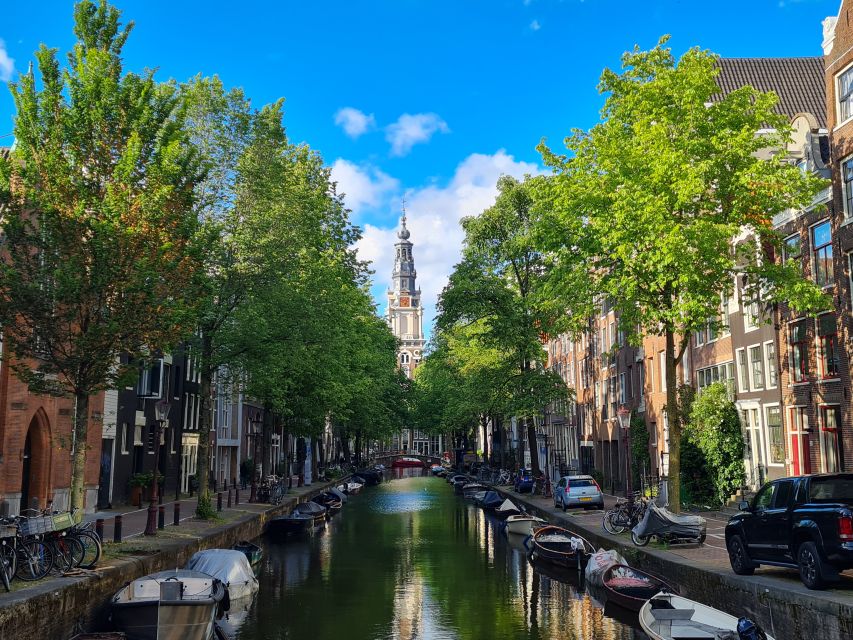
The route then enters the canal district, the half-circle of 17th-century waterways around the old center. On a map, these canals make Amsterdam’s historic shape easy to see. From the pedicab, you experience that plan at street level, passing rows of narrow canal houses that once belonged to successful merchants.
The guide points out how the houses differ and what their similarities reveal about their building periods. That is useful because Amsterdam’s facades can look alike at first glance. The details become more interesting when you know to look for changes in width, design, and period.
I enjoy this part as a bridge between history and everyday observation. You are not simply ticking off canals. You are learning why the buildings are narrow, why the facades vary, and how the canal district developed as Amsterdam grew wealthy.
The drawback is that two hours moves quickly. You will see several parts of the canal ring, but you will not stop at every bridge or street. If canals are your main reason for visiting Amsterdam, combine this ride with a separate canal boat trip or a relaxed walk later.
Museumplein and the Rijksmuseum tunnel
The final major stop is Museumplein, a large 19th-century green square surrounded by the country’s most important museums. The route includes the Rijksmuseum and the Van Gogh Museum, then passes through the Rijksmuseum tunnel before stopping in the middle of the square.
This is a smart ending for a first introduction. You finish with a clear sense of where Amsterdam’s museum district is located, even though museum entry is not included. If you plan to visit either museum, the tour helps you understand the area before you return for a longer visit.
Museumplein also gives you more open space after the narrow old streets and canals. It is a useful place to finish, especially if you want to continue to a museum, rest in the square, or make your way elsewhere.
You can arrange a preferred finishing location in advance. That flexibility is helpful, but make the request before the ride begins so the guide can plan the route sensibly.
Bram de Haan’s guiding style
Bram de Haan is the guide most closely associated with this experience, and his strengths are clear. He explains Amsterdam’s development from its beginnings through the Second World War, uses visual aids such as maps and photographs, and adds personal insight into the neighborhoods.
I value that approach because Amsterdam’s history can otherwise feel scattered. A tower here, a synagogue there, a canal house somewhere else: the city offers plenty of pieces, but you need someone to connect them. Bram’s explanations help turn those pieces into a story.
He also receives praise for being accommodating and professional. That matters in a private tour, especially if you have mobility limits or want to pause for photographs. Tours are available in English, Dutch, or German.
The experience is not designed as a theatrical performance. It is a practical city lesson delivered while you move. If you prefer a guide who answers questions and explains what you are seeing, it should suit you well.
Comfort, weather, and mobility
The pedicab is a strong option for seniors and anyone who cannot manage a long walking tour. Several people with limited walking ability found the format especially useful, and hotel pickup removes the need to reach a meeting point across the city.
A blanket is provided in cold weather, but you should still wear warm clothing. One ride took place on a cool, rainy day, and the blanket helped keep the passengers comfortable. Even so, open-air transport exposes you to wind and rain more than a car or museum does.
The supplied limits need careful attention. The maximum combined passenger weight is 200 kilograms, while the activity is listed as unsuitable for anyone over 100 kilograms or 220 pounds. If one passenger is close to that individual limit, contact the provider before booking rather than relying only on the combined figure.
The pedicab holds a private group of up to two people. That makes it best for a couple, two friends, or a parent and adult child. It is not a practical choice for a larger family unless each pair books separately.
Is $230 good value for two people?
At $230 per group, the cost works out to $115 per person when two people share the pedicab. That is expensive compared with a self-guided walk, but the comparison is not quite fair. You are paying for a private vehicle, hotel pickup and drop-off, a live guide, a tailored pace, and transport between districts.
I think the price makes the most sense in three cases. First, you have limited walking ability and want to see a lot without tiring yourself. Second, this is your first day in Amsterdam and you want a personal orientation. Third, you value a private guide who can explain the city in detail rather than a basic ride around the center.
The value is weaker if you are a confident walker, already know Amsterdam, or mainly want entry to museums. Food, drinks, and museum admission are not included. You may get more from a cheaper walking tour plus a museum ticket if indoor sights are your priority.
The option to reserve now and pay later, along with free cancellation up to 24 hours before departure, makes planning less risky. Still, the real question is not simply cost. Ask yourself if two hours of comfort and personal explanation will improve your visit enough to justify the splurge.
Who should book this Amsterdam pedicab tour?
I would recommend it for first-time visitors who want to get their bearings quickly. The route touches the old center, Chinatown, the Jewish quarter, the canal ring, the Amstel, and Museumplein, so you gain a useful city overview in one sitting.
It is also a sensible choice for older adults and people with limited walking ability. You can see major monuments without crossing the city on foot, and the hotel pickup keeps the day simple.
History-minded visitors should appreciate the range. The tour covers Amsterdam’s beginnings, medieval defenses, 17th-century trade, Jewish life, the Holocaust, and the city’s canal expansion. It does not treat the old center as a collection of pretty facades.
I would hesitate if you dislike open-air transport, are visiting in cold or wet weather, or want extensive time inside museums. I would also check the weight restriction carefully before paying.
FAQ
How long is the Amsterdam private pedicab tour?
The tour lasts two hours.
How many people can join the private pedicab?
The private group is for up to two people.
What is included in the price?
Hotel pickup and drop-off, a blanket in cold weather, and detailed explanations of the sights are included.
Are food and drinks included?
No. Food and drinks are not included.
Which languages are available?
The live guide is available in English, Dutch, and German.
Where does the tour begin and end?
The tour begins at Dam Square, with hotel pickup included. You can arrange a preferred finishing location in advance, and the guide also provides drop-off.
Are there passenger weight restrictions?
Yes. The maximum combined passenger weight is 200 kilograms. The activity is also listed as unsuitable for anyone over 100 kilograms, or 220 pounds, so confirm the details with the provider if needed.
Should you book it?
Book this tour if you want a comfortable, private introduction to Amsterdam with strong historical context. Bram de Haan’s careful explanations, visual aids, and personal approach add much more than simple transport, while the route gives you a useful look at districts you might not reach on foot.
Skip it if your budget is tight or you mainly want museum admission and independent exploration. For two people with limited walking ability, however, the $230 price can be reasonable. Add warm clothing, allow time for photographs, and tell the guide what matters most to you. That is how you get the best value from this short but wide-ranging ride.
Just added in Amsterdam
- Private Tour Zaanse Schans Windmills and Volendam in Jaguar★ 5.0 · 10 reviews
- Half-Day Private Guided Sightseeing Tour of Zaanse Schans★ 5.0 · 14 reviews
- Zaanse Schans and Giethoorn Unique Day Trip with Boat Cruise★ 4.5 · 17 reviews
- Windmills-Volendam-Giethoorn Private Tour in Jaguar★ 5.0 · 2 reviews
- Best of Netherlands: Zaanse Schans Mills, The Hague & Rotterdam★ 4.5 · 10 reviews
- Zaanse Schans Private Tour Windmills★ 5.0 · 18 reviews
- Zaanse Schans Windmills Edam Volendam and Marken from Amsterdam★ 5.0 · 1 review
- Zaanse Schans Edam Volendam Private Day Tour from Amsterdam★ 5.0 · 3 reviews
Historical Tours, compared.
Amsterdam Food and Cultural Tour with Tastings
Read our review →
Kinderdijk UNESCO World Heritage Entry Ticket
Read our review →
Hop-on Hop-off Old-Fashioned Heritage Tram Tour
Read our review →


Amsterdam High-End Dutch Food & History Tour – Up to 8 guests
Read our review →
Cruise through the Historic City Center with Guide
Read our review →
Browse the lists this tour appears in