
Review · WALKING TOURS
Private Walking Tour in Utrecht
Utrecht rewards slow walking. This private 90-minute tour brings you to canal wharf cellars and quiet courtyards, while a personal guide explains the city’s past in a relaxed way. I like the flexible route, and I like the small group size, which lets you ask questions or linger over a market stall. The main drawback is the short running time: Utrecht has enough history for a much longer walk.
The tour costs $184.05 per group of up to eight people, so it offers good value for a family or group of friends, but less value for a solo visitor. You will also need to decide if a guide-led overview is worth more to you than exploring Utrecht at your own pace.
In This Review
- Key details before you book
- Why Utrecht makes a fine change from Amsterdam
- Starting at Vredenburgplein and its market stalls
- Oudegracht, where Utrecht’s trade still shows
- Maartensbrug and the Roman-era crossing
- Pandhof, a quiet garden beside the Dom
- The square built on swampy ground
- The Dom Tower and Utrecht’s broken cathedral
- Ending at Vredenburgplein, or continuing to Oudaen
- What the $184.05 group price really buys
- Who will enjoy this Utrecht walk?
- Should you book this private Utrecht tour?
- FAQ
- How long does the private Utrecht walking tour last?
- Where does the tour begin?
- Where does the tour end?
- How many people can join the private tour?
- Are children under 12 charged?
- Is the beer tasting at Oudaen included?
Key details before you book
- The route begins at Vredenburgplein: Meet at Manneken Pis, a central and easy-to-reach starting point.
- The canal story is the star: Oudegracht combines medieval trade, old wharf cellars, waterside restaurants, and attractive evening light.
- You can shape the walk: Tell your guide if you want extra time at the market, more architecture, or a slower look at specific sights.
- Headsets make the tour practical: You can hear the commentary clearly while taking photos or walking a little apart from the group.
- The tour is private: Up to eight people can join, with children under 12 included free.
- Beer can extend the outing: The walk usually ends where it begins, but you can continue to Oudaen for an optional tasting.
Why Utrecht makes a fine change from Amsterdam
Utrecht sits in the middle of the Netherlands and works well as a day trip or a base for exploring the country. Direct trains take about 30 minutes from Amsterdam, 45 minutes from Rotterdam, and 15 minutes from Amersfoort.
I like Utrecht because it gives you a Dutch city experience without making you fight through a major sightseeing crowd. Its center has canals, churches, markets, cafés, and student energy, yet the pace feels calmer than Amsterdam. That slower mood is one of the pleasures of this walk.
A private guide is especially useful here because Utrecht’s best details are easy to pass without context. The canal may look like a pleasant photo stop, but its lower wharfs reveal how the city traded, stored goods, and adapted when transport changed. A garden tucked beside the Dom Church may seem like a simple courtyard until you learn how it served a monastery, soldiers, traders, and townspeople over the centuries.
The tour lasts about 1 hour 30 minutes, including normal stops and any unexpected pauses. That makes it easy to fit into a day of sightseeing, though you should not expect a complete survey of the city.
More Walking Tours in Utrecht
- Utrecht 2-Hour Walking Tour | Discover The City With A Local
★ 5.0 · 138 reviews - Utrecht: Guided Highlights Walking Tour
★ 4.7 · 80 reviews - Utrecht Old Town: Medieval Monster Hunt & Walking Tour
★ 4.0 · 62 reviews
Starting at Vredenburgplein and its market stalls
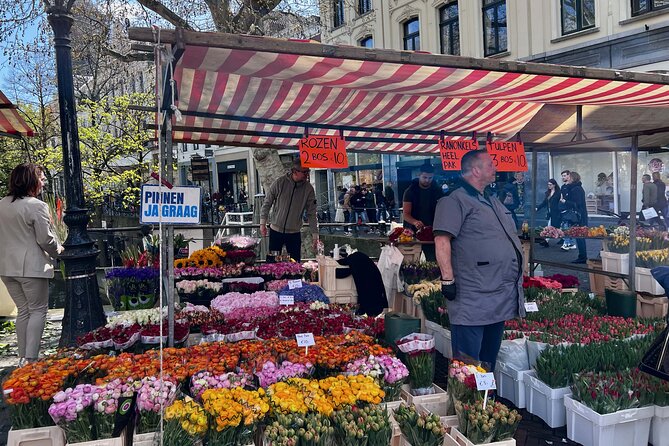
The meeting point is Vredenburgplein, at Manneken Pis, Vredenburg 154. This is in the city center, near public transportation, and it gives you a useful first look at everyday Utrecht before the historic sights begin.
On Wednesdays, Fridays, and Sundays, the square hosts a market. You might find fish stands, food stalls, and stroopwafels cooked right in front of you. If fresh waffles are high on your Utrecht wish list, tell your guide at the start and ask to spend a little time here.
That flexibility is one of the tour’s best features. A fixed group walk may hurry past the market to keep on schedule. Here, your guide can adapt the opening minutes to your interests. You can ask for food, local life, architecture, or a basic introduction to Utrecht’s past.
The practical catch is timing. The market is not present every day, so you should not book this walk expecting market scenes outside Wednesday, Friday, or Sunday. The tour can still begin at the same square, but the character of the stop will differ.
Oudegracht, where Utrecht’s trade still shows
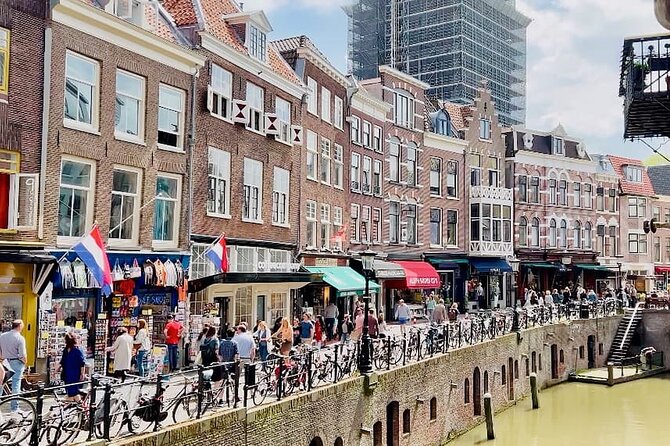
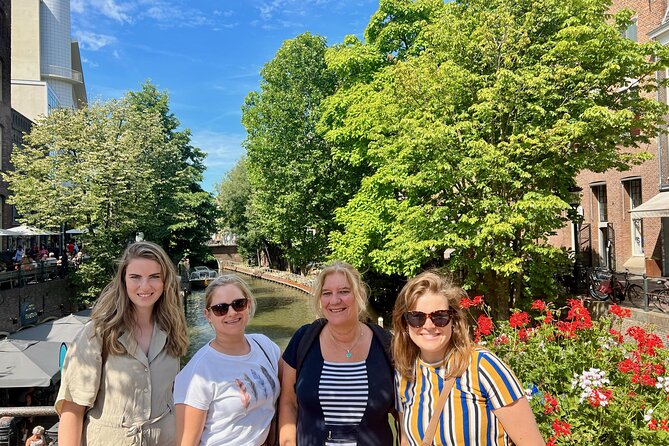
Oudegracht is the main visual treat of the walk. The canal runs about two kilometers from north to south through the city, following the old moat. Its most unusual feature is the lower-level wharf system, with cellars opening directly onto the water.
There are more than 730 wharf cellars along Utrecht’s canals. Their purpose was practical: goods unloaded from boats could move straight into storage without being hauled up to street level. The arrangement helped merchants work efficiently, and it created a street beside the water that feels distinct from the road above.
The oldest known wharf dates from around 1150. A merchant had dug a passage from a house basement toward the canal bank, creating an early link between building and water. Later, the cellars served as breweries and marketplaces.
This is the kind of detail that gives the canal its meaning. Without a guide, you may notice the restaurants and terraces but miss the reason so many doorways sit below the main street. With a guide, the canal becomes a working part of medieval Utrecht rather than just a pretty backdrop.
The system suffered after road freight grew. By about 1900, many wharf cellars had fallen into poor condition. Restoration began after World War II and continued to preserve the cellars, quays, and canal walls.
Today, restaurants occupy many of these spaces, with terraces on the wharfs beside the water. The atmosphere is particularly appealing in the evening, when the lights reflect along the canal. Your 90-minute walk may not include dinner, but you can note a few places to return to later.
The canal route can involve uneven walking surfaces and time spent on busy urban streets, though the supplied information does not specify a special accessibility route. If you have mobility concerns, ask the operator about the exact path before booking.
Maartensbrug and the Roman-era crossing
Near the Dom Tower, Maartensbrug crosses a section of Oudegracht that existed in Roman times. The present bridge dates from 1404, making it the oldest surviving bridge in Utrecht.
That combination of Roman beginnings and a medieval structure packs a great deal into one stop. You are not simply looking at an old bridge. You are standing near the place where Utrecht’s waterways, roads, and early settlement came together.
The stop also helps explain why the Dom area matters so much. Utrecht grew from this central point nearly 2,000 years ago, and the city’s later religious and commercial life developed around it.
A guide can give you the dates and connections without turning the walk into a lecture. The strongest comments about this experience praise the guides for making history clear, friendly, and enjoyable. Lucy, in particular, has been praised for her warmth, strong knowledge of Utrecht and Dutch history, and easy manner. If she is assigned to your tour, expect a personal presentation rather than a formal recital.
A different kind of day out entirely:
- Utrecht: City Canal Cruise
★ 4.3 · 2,895 reviews - Utrecht: De Haar Castle & Park Entry Ticket
★ 4.7 · 1,350 reviews - Utrecht: DOMunder Entry Ticket with Guide
★ 4.4 · 706 reviews - Utrecht: Dom Tower Entry Ticket and Guided Tour
★ 4.6 · 513 reviews
Pandhof, a quiet garden beside the Dom
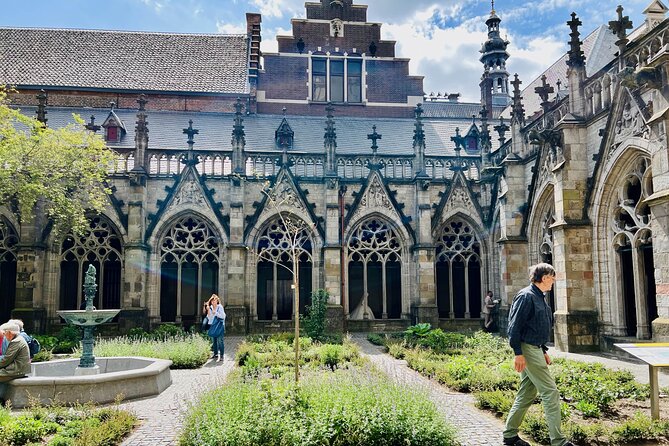
Pandhof offers a welcome pause from the canal and city streets. This was originally a 15th-century monastery garden, and today it remains a public courtyard with ornamental planting and a sense of calm.
The garden includes culinary herbs, dye plants, and medicinal plants. These are not random decorative choices. They recall the useful role monastery gardens played in daily life, when plants supplied kitchens, workshops, and basic medicine.
You can also see authentic garden elements and a statue of a reading canon, a clergyman. The combination creates a small, peaceful scene that rewards a slower look.
Pandhof also had less peaceful uses in earlier centuries. It served as a fairground, a guard room for soldiers, and a meat market. Those changes show how one modest urban space could shift with the needs of the city.
I would pay attention to this stop if you prefer places with atmosphere over grand scale. It is not a huge garden or a major museum. Its value comes from being easy to miss and from the guide’s explanation of what you are seeing.
Because the tour is private, you can ask for a moment to take pictures or simply enjoy the quiet. The headsets help here, too. You can move a short distance away and still hear the guide instead of crowding around one person.
The square built on swampy ground
Another stop is a central square whose name translates as swampy ground. Until the end of the 15th century, this area was marshy. To create usable land, people reinforced and raised it with sand, stones, and debris.
From the 15th through the 19th centuries, the square served as a market area. Executions also took place here, a reminder that public squares once had far harsher roles than today’s cafés and festivals.
Until the 1990s, the space functioned as a parking lot. It has since become a festival square lined with cafés. This change gives you a quick lesson in modern urban planning: Utrecht reclaimed a former swamp, used it for trade and punishment, filled it with cars, and then returned it to public life.
The stop may not impress you through architecture alone. Its value is the story beneath the pavement. I like these brief urban-history moments because they make a familiar square easier to remember.
The Dom Tower and Utrecht’s broken cathedral
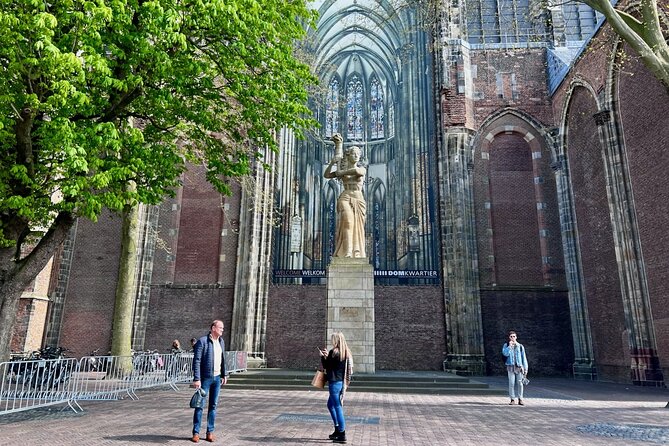
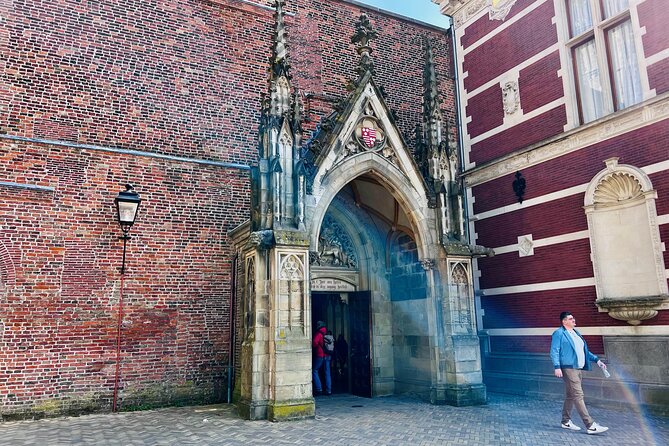
The Dom Tower is the tallest church tower in the Netherlands and Utrecht’s clearest landmark. It originally formed part of the Cathedral of Saint Martin, also called the Dom Church.
The cathedral was never fully completed because money ran short. In 1674, the unfinished nave collapsed, leaving the tower detached from the rest of the church. That accident created the unusual arrangement you see today: a free-standing tower beside the remaining cathedral structure.
The tower occupies the spot where Utrecht began nearly 2,000 years ago. Its importance is therefore religious, architectural, and civic all at once.
This tour provides historical context from ground level. The supplied information does not include tower admission or a climb, so you should not assume that going up is part of the experience. If you want a tower visit, ask separately about access and timing.
The Dom is a natural place to ask questions. You might want to know why the cathedral ran out of money, how the nave collapsed, or how the tower became a symbol of Utrecht. A private format gives you room to guide that conversation.
Ending at Vredenburgplein, or continuing to Oudaen
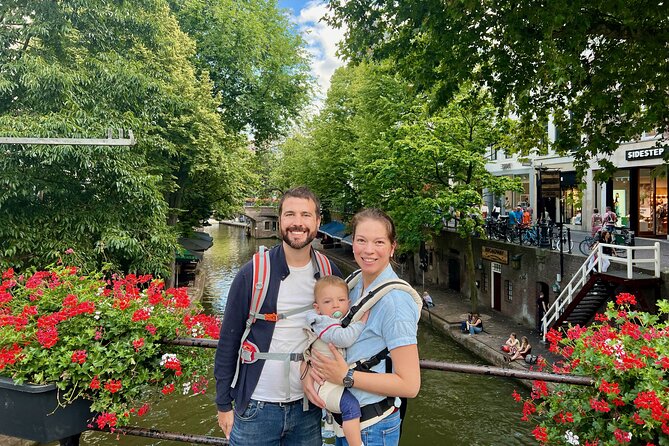
The standard walk returns to Vredenburgplein, making the tour easy to combine with a meal, shopping, or train travel afterward. The total walking time is about 90 minutes, so you can treat it as an introduction rather than an all-day commitment.
You can also continue with your guide to Oudaen, a city castle built in 1276. The optional beer tasting includes three beers and costs extra. The tasting is not included in the tour price, but it offers a pleasant way to continue the conversation in a historic building.
Oudaen is one of Utrecht’s important monuments, and you can remain there after the guide leaves. This option suits adults who want to turn a short city walk into a longer food and drink stop. Families or anyone avoiding alcohol can simply finish at Vredenburgplein.
What the $184.05 group price really buys
At $184.05 for up to eight people, the price works out to about $23 per person if your group is full. For two people, it is about $92 each, and for a solo visitor the full group rate is a significant expense.
The value comes from privacy and flexibility rather than a long list of included attractions. You get a private guide, 1.5 hours of walking, headsets, and the ability to adjust the route. There are no separate entry tickets included, and the beer tasting at Oudaen costs extra.
For a family, the deal improves because children under 12 join free. It also makes sense for friends who want to ask plenty of questions, take photos without holding up strangers, or focus on a particular interest.
Solo visitors should compare it with the operator’s public Utrecht walk, which has a maximum group size of six. The private option is best when you value control over the pace and route, not when you are simply seeking the lowest cost.
Who will enjoy this Utrecht walk?
I would recommend this experience to first-time visitors who want an organized introduction without spending half a day on a tour. It also suits families, couples, and small groups who want a guide to themselves.
It is a good choice if you enjoy:
- Urban history explained through ordinary streets and buildings
- Canals, bridges, old storage spaces, and historic churches
- Quiet courtyards and small details
- Market food and local city life
- Asking questions and changing the pace
I would be more cautious if you want extensive interior visits, a long museum stop, or a major tower climb. The walk is primarily an outdoor orientation tour, and 90 minutes passes quickly.
The operator has received several tourism and city-tour awards between 2020 and 2022, including recognition for sustainable travel experiences and city walking tours. Awards do not guarantee that every guide will suit every person, but they provide some useful background when choosing among private tour companies.
You receive confirmation when booking, and the confirmation itself is your tour ticket. Meet at the scheduled time at Manneken Pis on Vredenburgplein. Service animals are allowed, most people can participate, and the meeting point is near public transportation.
Free cancellation is available up to 24 hours before the start time. Changes or cancellations inside that window are not accepted for a refund, so check the local start time carefully.
Should you book this private Utrecht tour?
Book it if you want a friendly, flexible introduction to Utrecht and have at least two or three people to share the cost. The canal wharf cellars, Pandhof garden, Maartensbrug, and Dom Tower form a strong route, and the guide adds the context that makes each place matter.
If you are traveling alone, compare the private price with a public walk. If you want to climb the Dom Tower or spend time inside museums, plan those separately.
For most small groups, this is a smart first look at Utrecht. Ask for the market on a Wednesday, Friday, or Sunday, request extra canal time if that interests you, and consider finishing at Oudaen if the optional beer tasting fits your plans.
FAQ
How long does the private Utrecht walking tour last?
The tour lasts approximately 1 hour 30 minutes, including expected and unexpected stops.
Where does the tour begin?
The meeting point is Manneken Pis at Vredenburgplein, Vredenburg 154, 3511 BG Utrecht, Netherlands.
Where does the tour end?
The standard tour ends back at Vredenburgplein, where it begins.
How many people can join the private tour?
The maximum group size is eight travelers, excluding children under 12. Larger groups may be accommodated on request.
Are children under 12 charged?
Children under 12 join for free.
Is the beer tasting at Oudaen included?
No. The beer tasting is optional and costs extra. It includes three different beers, and you can stay at Oudaen after the guide leaves.
Just added in Utrecht
- Vecht River: Private Tour sightseeing Cruise with diner★ 5.0 · 5 reviews
- Utrecht Walking Tour with a local comedian as guide★ 4.8 · 5 reviews
- Utrecht Quiz Tour★ 3.2 · 31 reviews
- Utrecht: Museum Speelklok Entry Ticket★ 4.5 · 48 reviews
- Utrecht: Vegan Food Bike Tour – 6 Tastings (excl. bike)★ 5.0 · 7 reviews
- Utrecht or Amsterdam Sidecar Tour. City, rural or TAILORMADE★ 5.0 · 2 reviews
- Utrecht: Lofen Palace with Entry Ticket & Guide (Dutch)★ 4.4 · 41 reviews
- Utrecht: Ludwig’s Original Pub Crawl with VIP Club Entry★ 3.3 · 42 reviews
Walking Tours, compared.

Anne Frank’s Story – Guided Walking Tour through Amsterdam
Read our review →
Life of Anne Frank and World War II Walking Tour
Read our review →
Absolutely Amsterdam – the Essential Introductory Walking Tour
Read our review →
Anne Frank Walking Tour – Guided in EN/DE/IT/ES
Read our review →


Anne Frank Walking Tour Amsterdam Including Jewish Cultural Quarter
Read our review →Browse the lists this tour appears in