
Review · CRUISES & BOAT TOURS
Rotterdam and Kinderdijk Daily Walking and Boat Tour
Two Dutch worlds meet in one day. This seven-hour experience pairs Rotterdam’s daring architecture with the old polder windmills of Kinderdijk, giving you a useful look at how the Netherlands balances modern city life with centuries of water management. I like the small group of up to four and the chance to travel between the two places by boat rather than spending the whole day in a vehicle. I also like the personal approach from guide Alex, who explains how Holland, Amsterdam, and Rotterdam changed over the centuries.
The main consideration is cost: $553 per group, before the separate Kinderdijk admission fee, is a serious price for one or two people. It becomes much better value when shared by four, especially since the guide, Cube Houses entry, return boat tickets, and local snacks are included.
In This Review
- Key points to know before booking
- Rotterdam begins at a railway station built like a gateway
- Old Rotterdam survives beside the modern city
- The Cube Houses are Rotterdam at its most playful
- Bridges, ships, and the low point of Rotterdam
- Erasmus Bridge provides the city’s signature view
- The boat to Kinderdijk changes the pace
- Kinderdijk explains why the Netherlands stays dry
- What the extra Kinderdijk ticket includes
- Is $553 good value for four people?
- Who will enjoy this day most?
- Should you book Rotterdam and Kinderdijk together?
- FAQ
- Where does the tour begin?
- Where does the tour end?
- How long does the experience last?
- How many people can join the group?
- Is boat transportation included?
- Is admission to Kinderdijk included?
- Which languages are available?
Key points to know before booking
- Rotterdam’s architecture changes block by block, from a 17th-century water board headquarters to the Cube Houses and Erasmus Bridge.
- The 45-minute boat ride to Kinderdijk makes the transfer part of the sightseeing rather than dead travel time.
- Kinderdijk has 19 authentic polder windmills, most dating from the first half of the 18th century.
- The tour includes Cube Houses admission, but Kinderdijk’s main visitor facilities cost extra.
- Alex leads a highly personal tour, with English, Czech, Slovak, Serbian, Croatian, Bosnian, and related language options.
- Pack a real raincoat, not just an umbrella. Wind and rain are common in this part of the Netherlands.
Rotterdam begins at a railway station built like a gateway
The usual meeting points are Rotterdam Centraal or Erasmusbrug. Hotel pickup may also be arranged, which helps if you are carrying luggage or staying outside the central area.
Rotterdam Centraal is a fitting place to begin. This is not just a railway station where you wait for a train. It is one of the city’s major architectural sights, handling an average of 170,000 passengers each day. Its modern form gives you an immediate sense of Rotterdam’s forward-looking character.
From here, the walking route moves into the city’s older layers. That contrast is the point. Rotterdam is often associated with experimental buildings and broad postwar streets, but it also has a few surviving pieces of its earlier story.
One important stop is Schieland House, a 17th-century building that once served as the headquarters of Waterschap Schieland. This institution managed water policy in the area, a reminder that Dutch civic life has long depended on controlling canals, rivers, drainage, and low-lying land. The building also once provided temporary accommodation for Napoleon Bonaparte, giving the stop an unusual personal connection to European history.
More Boat Tours in Rotterdam
- Rotterdam: Harbor Sightseeing Cruise
★ 4.3 · 7,599 reviews - Rotterdam: Pancake Cruise
★ 4.4 · 1,986 reviews - Rotterdam: Harbor Cruise with Live Guide
★ 4.0 · 1,270 reviews
Old Rotterdam survives beside the modern city
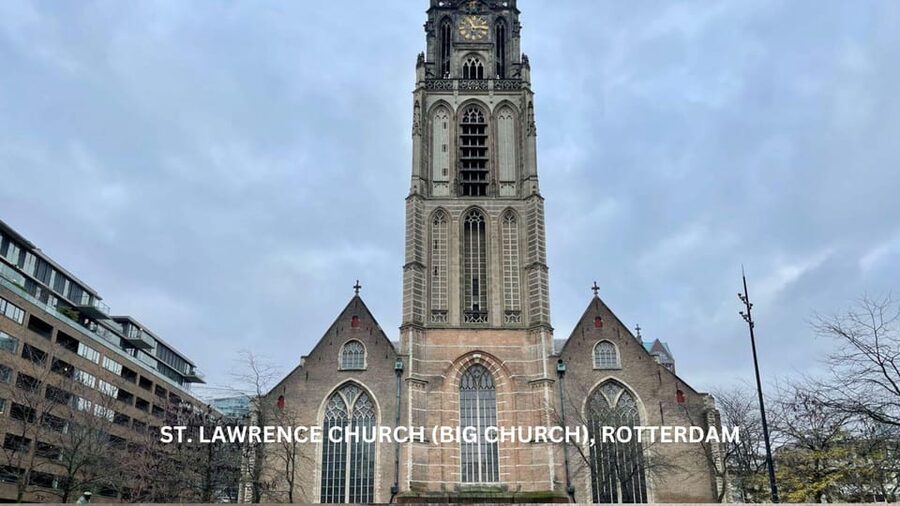
The Big Church, or St. Lawrence Church, is Rotterdam’s oldest building. This late Gothic church dates from 1525 and is one of the few structures that survived the Nazi bombing of May 15, 1940.
That survival matters because Rotterdam’s center was heavily reshaped after the bombing. The church gives you a physical link to the city that existed before the modern rebuilding. I would pay close attention here, since the building makes the city’s architectural clash easier to understand. You are not simply looking at old and new styles. You are seeing what remained, what disappeared, and what Rotterdam chose to build afterward.
Nearby, the monument to Desiderius Erasmus honors the 16th-century philosopher, theologian, scholar, and priest associated with the city. Erasmus is one of Rotterdam’s most famous historical figures, and his name appears on public buildings, institutions, and the city’s major bridge.
The route then shifts toward Markthal, one of Rotterdam’s most recognizable modern buildings. Its horseshoe shape combines a covered market with apartments and other facilities. The interior artwork has earned it the nickname the Sistine Chapel of Rotterdam. The market is also a practical place to notice how the city uses architecture for daily life, not just for postcard views.
The Cube Houses are Rotterdam at its most playful
The Kijk-Kubus, or Cube Houses, is included in the tour. These unusual homes look like trees, with cube-shaped apartments tilted above supporting columns.
The design is clever, but it comes with an obvious compromise. Because of the angled walls, only about three quarters of the interior space is suitable for ordinary living. That makes the included entrance worthwhile. From the outside, you see an eye-catching form. Inside, you understand what it means to live in one.
I like this stop because it turns an architecture photo into a practical question: could you actually live here? The answer is not as simple as the striking exterior suggests. You get a better sense of the design’s strengths and limitations than you would from a quick pass through the neighborhood.
The nearby Old Harbor adds another change of mood. It is one of medieval Rotterdam’s oldest ports, though not the oldest, and marks the former mouth of the River Rotte flowing toward the Nieuwe Maas. Today, the area is lined with coffee bars, restaurants, taverns, and nightlife spots. It is a good place to see how Rotterdam’s old working waterfront has become part of everyday city life.
Bridges, ships, and the low point of Rotterdam
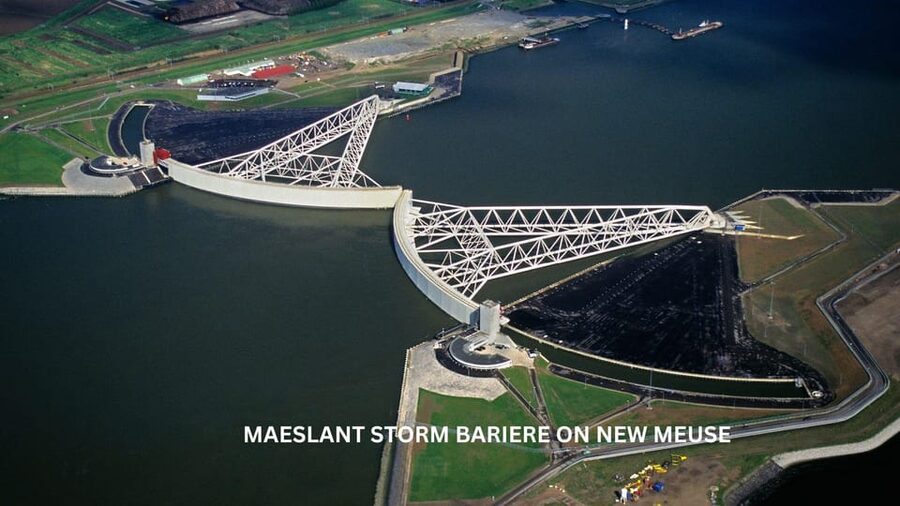
The walk continues through a series of places that show Rotterdam’s connection to trade, transport, and water.
The White House, or De Witt Huis, was once Europe’s tallest skyscraper. Built in the late 19th century, it reaches 42 meters, or 141 feet. By modern standards, that height is modest, but its former status helps you picture the ambition of the young commercial city.
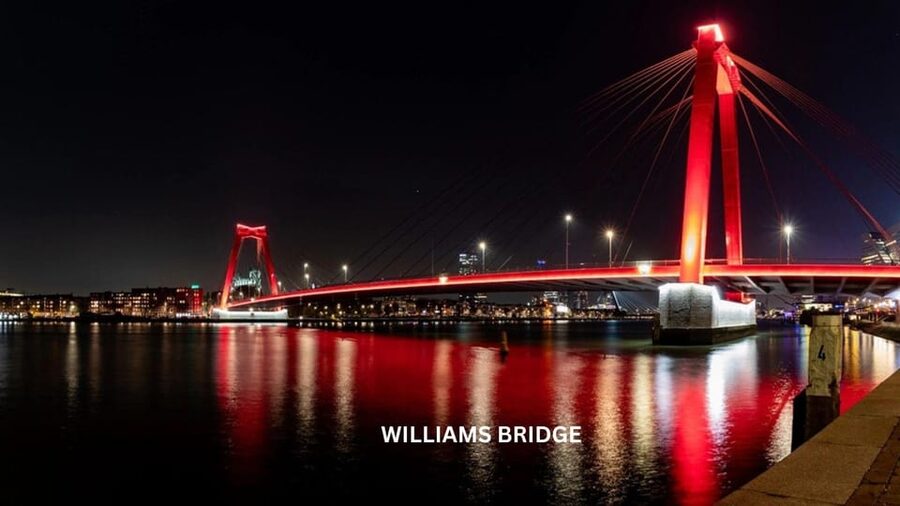
You will also see Willemsbrug, known as the Red Bridge, which connects Rotterdam’s central and northern areas with the southern districts. The bridge is dedicated to Willem III and is one of three important crossings in this part of the city.
De Hef is another striking piece of infrastructure. This huge steel structure once served as a rotating and lifting railway bridge across the Nieuwe Maas. Even if you are not a bridge enthusiast, it is a good example of Rotterdam’s habit of turning practical engineering into a major visual feature.
At De Boeg, the focus shifts from construction to loss. This war memorial commemorates the 3,500 people aboard Dutch merchant ships who died during World War II. It is a quiet counterpoint to the busy port and bold buildings.
Leuwhaven Maritime Museum adds more working detail. This open-air collection includes steamships, cargo-handling machinery, ship engines, and other maritime equipment. The stop helps connect Rotterdam’s architecture to the port economy that made the city important.
One of the tour’s more unusual claims is a coffee stop at the lowest Dutch point, 7.67 meters below sea level. The exact experience depends on the day’s timing and arrangements, but the idea fits the tour well: water management is not an abstract topic here. It shapes where people build, work, walk, and drink coffee.
The tour also points out a very different kind of Red Light District. This is not presented as Amsterdam’s famous canal-side version. Rotterdam’s district has its own setting and character, and the stop is useful if you want a broader view of the city beyond landmarks and museums.
More Walking Tours in Rotterdam
- Rotterdam: Architectural Highlights Guided Walking Tour
★ 4.8 · 215 reviews - Rotterdam Walk: Hilights, Gems, Architecture & WWII | 2 or 3hrs
★ 5.0 · 149 reviews - Rotterdam: Highlights & Gems Walking Tour with Dutch Local
★ 5.0 · 133 reviews - Rotterdam 2-Hour Walking Tour | Discover The City With A Local
★ 4.5 · 111 reviews
Erasmus Bridge provides the city’s signature view
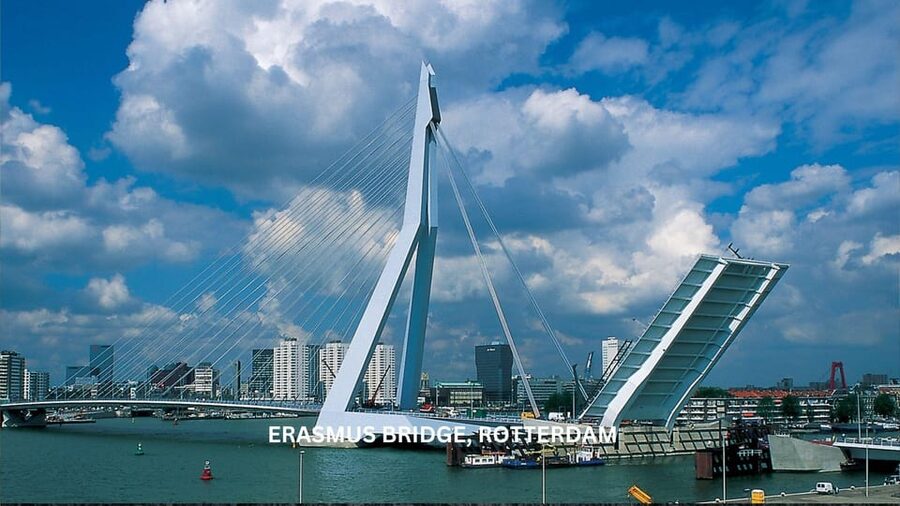
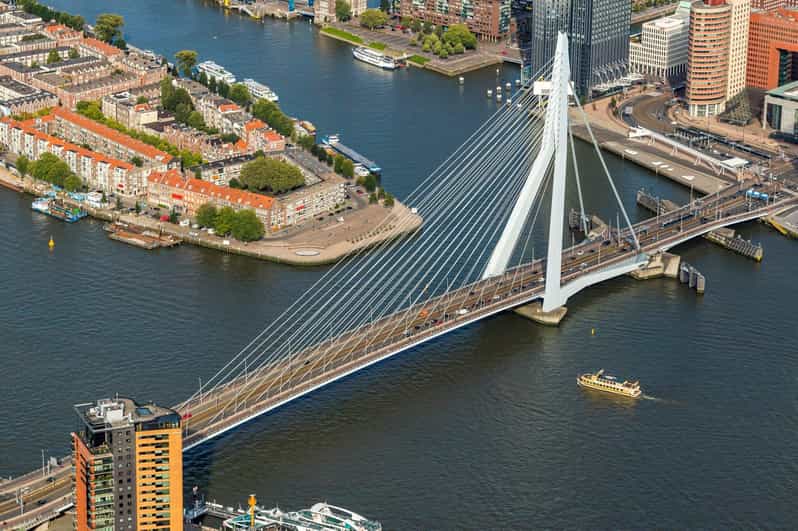
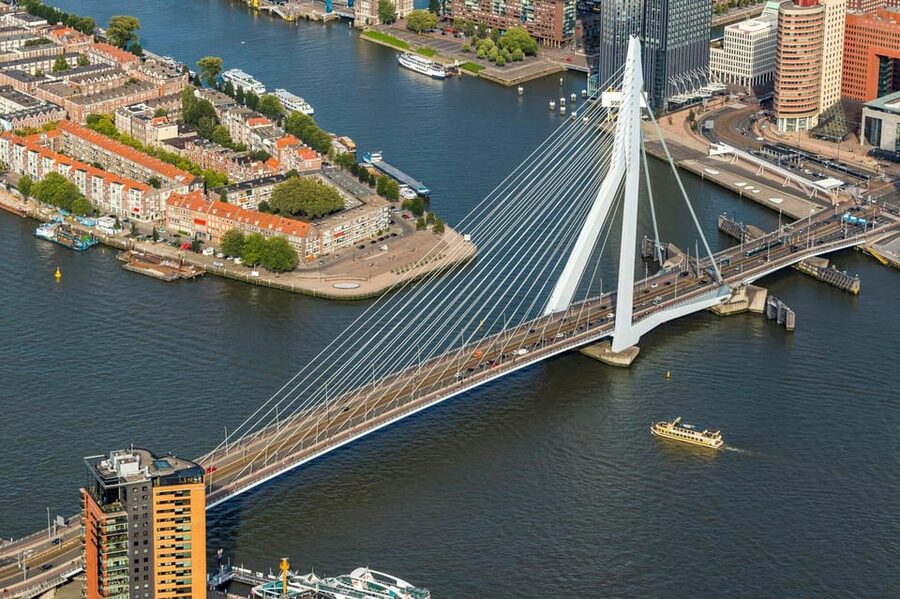
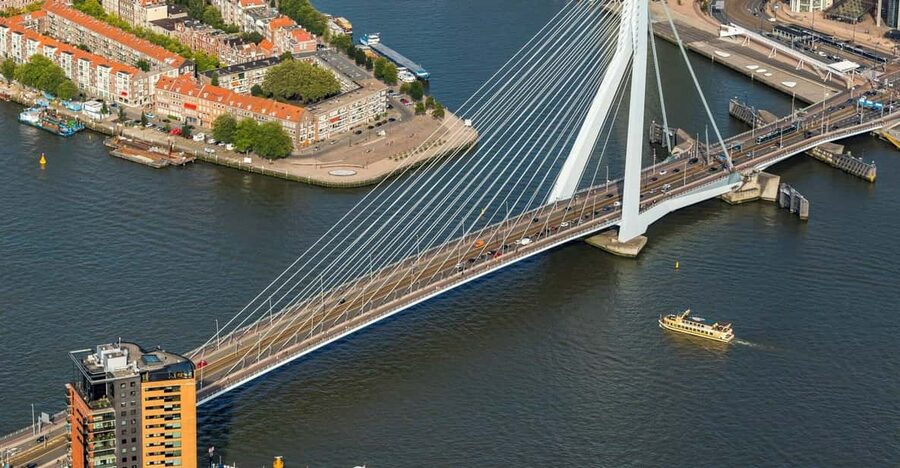
The Erasmus Bridge is Rotterdam’s most famous symbol. Its white pylon has earned the nicknames the Swan and the Harp, and the bridge rises 139 meters above the city. Its opening section is 80 meters long and is described as the largest and heaviest opening bridge section in Europe.
The bridge is more than a photo stop. It shows how Rotterdam’s modern identity is tied to the Nieuwe Maas and to movement between the central city and southern districts. If you begin at Erasmusbrug, you may see it early. If you begin at Rotterdam Centraal, it becomes a natural high point before the boat departure.
The two pickup and drop-off choices make the tour easier to fit into a city visit. You can begin and finish at Rotterdam Centraal, or use Erasmusbrug as your start and end point. Confirm the exact meeting arrangement in advance, particularly if you request hotel pickup or a departure from another city.
The boat to Kinderdijk changes the pace
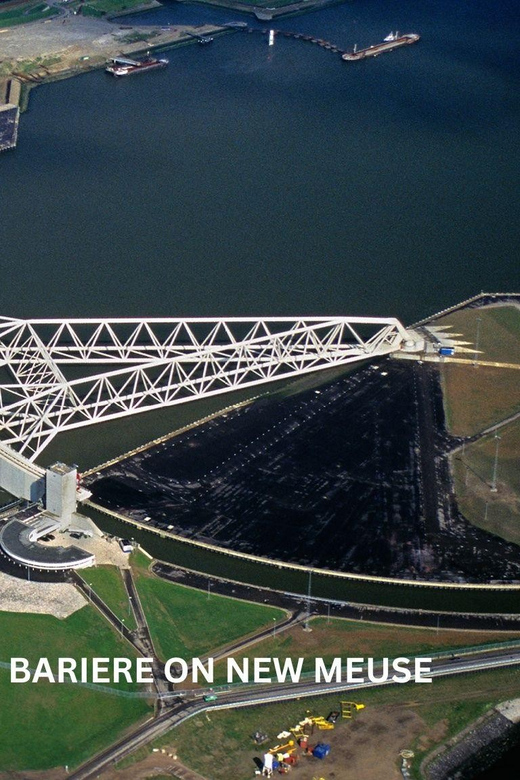
The boat ride from Rotterdam to Kinderdijk takes about 45 minutes. This is one of the strongest parts of the day because it gives you a break from walking while keeping you connected to the water system that defines the region.
You are not being driven past the countryside in a sealed vehicle. The boat makes the relationship between Rotterdam’s port, the rivers, and the reclaimed land easier to understand. It also creates a clean transition from a dense, modern city to an open polder setting.
Return boat tickets for up to four people are included. That adds real value, since the transfer is both transport and part of the experience. Still, check the schedule carefully when booking. A seven-hour tour has a fixed rhythm, and a late start or long stop could reduce the time available at Kinderdijk.
Kinderdijk explains why the Netherlands stays dry
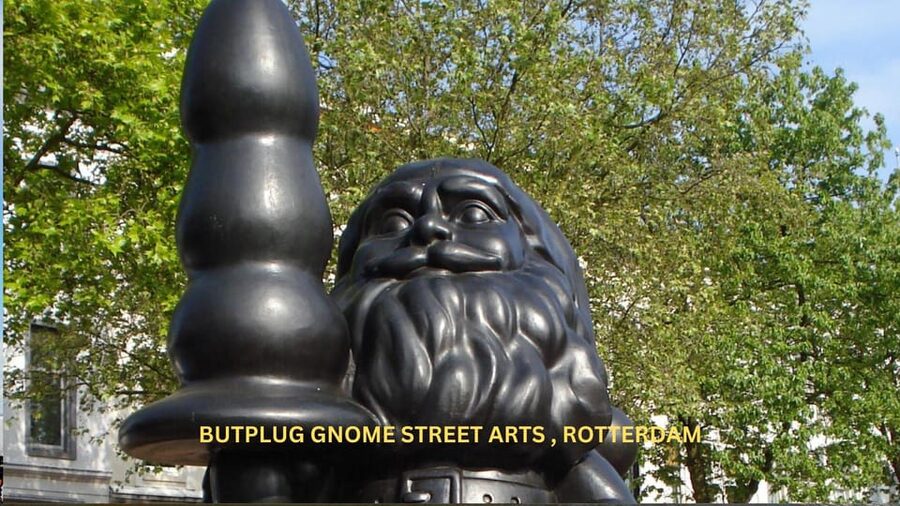
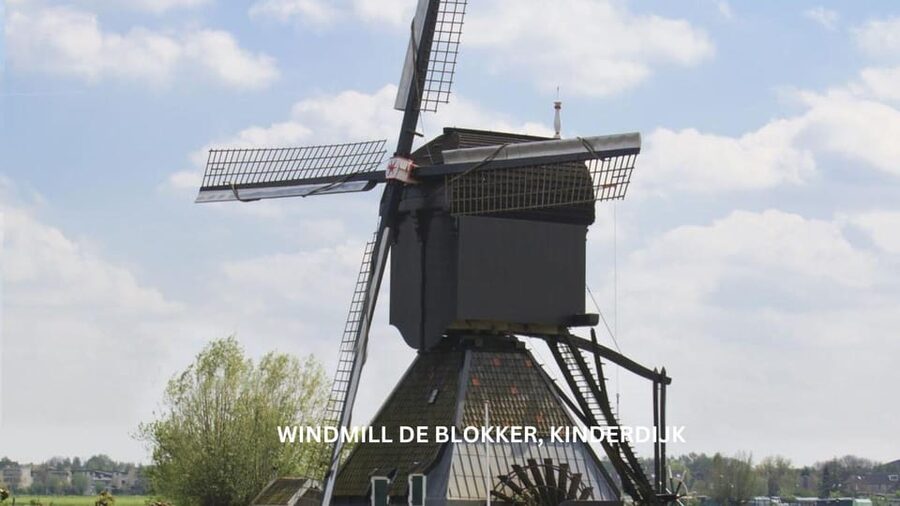
Kinderdijk is the day’s main lesson in Dutch water management. The area contains 19 authentic polder windmills, most dating from the first half of the 18th century. They are not decorative replicas placed for tourists. They are the same type of working structures that helped drain and maintain low-lying land centuries ago.
A polder is land reclaimed or protected through a managed system of dikes, drainage channels, pumps, and water controls. Windmills moved water from one level to another, allowing people to live and farm in places that would otherwise remain wet. The system required planning, shared responsibility, regular maintenance, and constant attention.
That is why Kinderdijk is more than a scenic stop. It explains a basic fact of Dutch life: the country’s relationship with water is practical, organized, and never finished. The landscape can feel peaceful, with green spaces and unusual birdlife, but the calm appearance rests on a great deal of engineering and upkeep.
The walking portion lets you see the windmills at close range. You can also enjoy coffee, tea, local snacks, beer, street food, or food tasting as part of the day’s flexible stops. Exact food arrangements may depend on timing and the guide’s plan, so treat these as useful additions rather than a full meal program.
What the extra Kinderdijk ticket includes
The standard tour price does not cover Kinderdijk’s main facility admission. The separate ticket costs €18 for adults and €6.50 for children ages 4 to 12.
That admission includes:
- Entry to two historic windmills, windmill number 2 and De Blokker
- Approximately half a boat tour along the windmills
- Entry to the former Wisboomgemaal pumping station
You can buy the ticket online in advance or at the ticket counter at Kinderdijk. I would consider booking ahead if you want to make the most of the limited seven-hour schedule. The extra cost is not trivial, especially for a family, but it adds the inside view that turns the windmills from scenery into working machines.
The listed return boat transport from Rotterdam is separate from this Kinderdijk facility ticket. Make sure you understand that distinction before you compare the price with other outings.
Is $553 good value for four people?
At $553 per group of up to four, the price works best for a family or a small party that wants a private-feeling day. Split four ways, the guide service and transport cost much less per person than they do for a solo visitor. For one or two people, the price is harder to justify unless you place a high value on flexibility and direct guiding.
The package includes the guide, local drinks and snacks during or after the tour, Cube Houses entrance, and return boat tickets to Kinderdijk. The separate Kinderdijk admission is the main extra expense.
The strongest value comes from the range covered in one day. You get Rotterdam architecture, old buildings, bridges, maritime equipment, water-management context, a boat journey, and the windmills. The drawback is that seven hours is a tight frame for such a wide subject. You should expect a well-packed day, not a slow exploration of every site.
Who will enjoy this day most?
I would recommend this tour to first-time visitors who want Rotterdam explained rather than simply photographed. It suits people who enjoy architecture, engineering, urban history, and practical stories about how cities work.
It is also a good choice if Kinderdijk is high on your list but you want more than a simple visit to the windmills. The Rotterdam portion gives the windmills context, while the boat ride links the two destinations.
Families may appreciate the variety. A church, market hall, unusual houses, bridges, ships, and windmills offer more changes of scene than a single museum day. The Cube Houses and boat ride may be particularly useful breaks for children, though the total walking time and seven-hour length should be considered.
This is less suitable if you want a relaxed café day, long museum visits, or lots of free time for shopping. It is also not ideal for poor weather unless you bring proper rain protection. Umbrellas can be awkward in windy Dutch conditions, so a waterproof coat is the smarter choice.
The tour can be customized by participant number and, on request, may depart from Amsterdam or The Hague. Those alternatives must be discussed in advance. Language options include English, Czech, Slovak, Serbian, Croatian, Serbo-Croatian, and Bosnian.
Should you book Rotterdam and Kinderdijk together?
Book it if you want a compact, private-style introduction to both Rotterdam and the Dutch polder system. Alex’s professional approach and careful explanations are especially valuable here, since the day depends on connecting separate sights into one clear story. The strongest praise centers on his attention to detail and his explanation of how Holland, Amsterdam, and Rotterdam developed over time.
Skip it if the $553 group price feels too high for your party, or if you prefer to explore at your own pace. Also budget for the separate Kinderdijk admission and plan for changeable weather.
For four people who want architecture, water engineering, local context, and an easy boat connection, this is a well-filled day with genuine substance. For one person seeking a cheap sightseeing option, it is not the best bargain.
FAQ
Where does the tour begin?
You can begin at Rotterdam Centraal or Erasmusbrug. Hotel lobby pickup may be arranged by agreement.
Where does the tour end?
The two listed drop-off points are Erasmusbrug and Rotterdam Centraal.
How long does the experience last?
The tour lasts seven hours.
How many people can join the group?
The standard small group is limited to four participants, and the group size may be customized by request.
Is boat transportation included?
Yes. Return boat tickets from Rotterdam to Kinderdijk are included for up to four people. The boat journey takes about 45 minutes each way.
Is admission to Kinderdijk included?
No. The Kinderdijk facility ticket costs €18 for adults and €6.50 for children ages 4 to 12. It covers two historic windmills, about half a boat tour along the windmills, and the former Wisboomgemaal pumping station.
Which languages are available?
The guide service is available in English, Czech, Slovak, Serbian, Croatian, Serbo-Croatian, and Bosnian.
More Windmill Tours in Rotterdam
- Rotterdam: Kinderdijk UNESCO World Heritage Entry Ticket
★ 4.6 · 1,477 reviews - Rotterdam: Waterbus Ticket to Dordrecht and/or Kinderdijk
★ 4.6 · 542 reviews - All-Inclusive Private Windmill Tour to Kinderdijk from Rotterdam
★ 4.5 · 59 reviews - Kinderdijk Bike Tour
★ 5.0 · 35 reviews
Just added in Rotterdam
- e-Scavenger hunt Dordrecht: Explore the city at your own pace★ 4.5 · 24 reviews
- Escape the City – Interactive city walk in Dordrecht★ 5.0 · 1 review
- Discover the best spots in Dordrecht with Outside Escape★ 4.5 · 11 reviews
- Historical Dordrecht: Private Tour with Local Guide★ 5.0 · 1 review
- The Netherlands: WW2 Private Day Trip★ 5.0 · 4 reviews
- Rotterdam: Guided Food Tour★ 4.4 · 16 reviews
- Rotterdam: Trompenburg Botanical Gardens Entry Ticket★ 4.1 · 77 reviews
- Rotterdam: UNESCO Van Nelle Factory Guided Tour★ 4.5 · 94 reviews
Cruises & Boat Tours, compared.
Amsterdam Classic Saloon Boat Cruise with Drinks and Cheese
Read our review →
Amsterdam Luxury Canal Cruise + Unlimited Drinks & Bites option
Read our review →
Classic Boat Cruise with Optional Cheese & Wine
Read our review →
Evening Cruise with Optional Wine and Snacks
Read our review →
75 Minute City Canal Cruise with Audio Guide
Read our review →
Amsterdam All-Inclusive 90-Minutes Heated Cruise by Captain Jack
Read our review →
Open Boat Cruise option Unlimited Drinks & Bite
Read our review →
Browse the lists this tour appears in