
Review · WALKING TOURS
Rotterdam: Architectural Highlights Guided Walking Tour
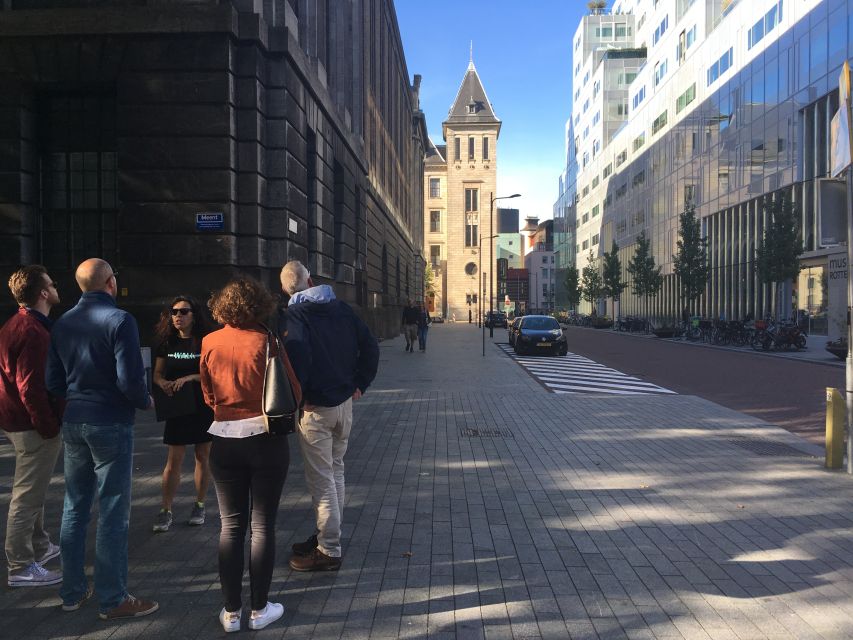
Rotterdam wears its history in concrete. I like this two-hour walk because a local architect explains why the city looks so different from other Dutch cities, and I like the route from Central Station to the river because it covers major sights without requiring transport. The main consideration is pace: you walk 3 to 4 kilometers, and two hours can feel short when every building raises a question.
The tour is especially useful if you are new to Rotterdam. Guides such as Tania, Tanya, Silvia, and Sylvie have been praised for making architecture understandable, even for people without any background in the subject. Still, this is a set route, so you should not expect a close look at every neighborhood or a special focus on social housing.
In This Review
- Key points at a glance
- Why Rotterdam makes such a good architecture walk
- Starting at Rotterdam Centraal Station
- The Lijnbaan and Rotterdam’s postwar ideas
- City Hall, older traces, and a city rebuilt
- Timmerhuis and Rotterdam’s changing city center
- Inside the Markthal
- The Cube Houses and a useful dose of debate
- Reaching the Maas and the Erasmus Bridge
- How much value do you get for $53?
- Who should take this walk?
- Practical advice before you go
- Should you book the Rotterdam architecture tour?
- FAQ
- Where does the Rotterdam architecture walking tour meet?
- How long does the tour last?
- How far do you walk?
- What language is the tour conducted in?
- Which buildings and areas are included?
- Do you enter the Markthal?
- Does the tour include food, drinks, or transport?
- Can children join the tour?
- Is the tour wheelchair accessible?
Key points at a glance
- The route links Rotterdam Centraal with the Maas waterfront, giving you a useful first look at the modern city.
- A local architect explains the buildings in context, including Rotterdam’s wartime destruction and long rebuilding process.
- The itinerary includes major sights, such as the Lijnbaan, City Hall, Timmerhuis, Markthal, Cube Houses, and Erasmus Bridge.
- The Markthal and Cube Houses provide strong visual variety, but the tour focuses on the outside of most buildings.
- The 3 to 4 kilometer walk is manageable but steady, with limited time for lingering at each stop.
- The $53 price is fair for a small or private group, especially if you care about design, planning, and city history.
Why Rotterdam makes such a good architecture walk
Rotterdam is not a city you understand fully by simply admiring pretty façades. Its modern appearance comes from a painful break with the past, followed by decades of bold decisions about traffic, housing, commerce, and public space.
The 1940 bombardment destroyed much of the city center. The rebuilding that followed did not try to recreate an old Dutch town. Instead, Rotterdam became a place where new ideas could be tested. That helps explain the sharp contrast between traditional remnants, postwar planning, experimental housing, glass towers, and recent waterfront construction.
I like having an architect guide for this reason. Without context, the city can look like a collection of unusual buildings. With explanation, you begin to see the choices behind them: where people walk, how cars move, how shops fit into large blocks, and how the city has tried to prepare for its future.
The tour is conducted in English and begins under the clock at Rotterdam Centraal Station. That is an easy meeting point if you arrive by train, and it puts you directly beside one of Rotterdam’s most visible recent projects.
More Walking Tours in Rotterdam
- Rotterdam Walk: Hilights, Gems, Architecture & WWII | 2 or 3hrs
★ 5.0 · 149 reviews - Rotterdam: Highlights & Gems Walking Tour with Dutch Local
★ 5.0 · 133 reviews - Rotterdam 2-Hour Walking Tour | Discover The City With A Local
★ 4.5 · 111 reviews
Starting at Rotterdam Centraal Station
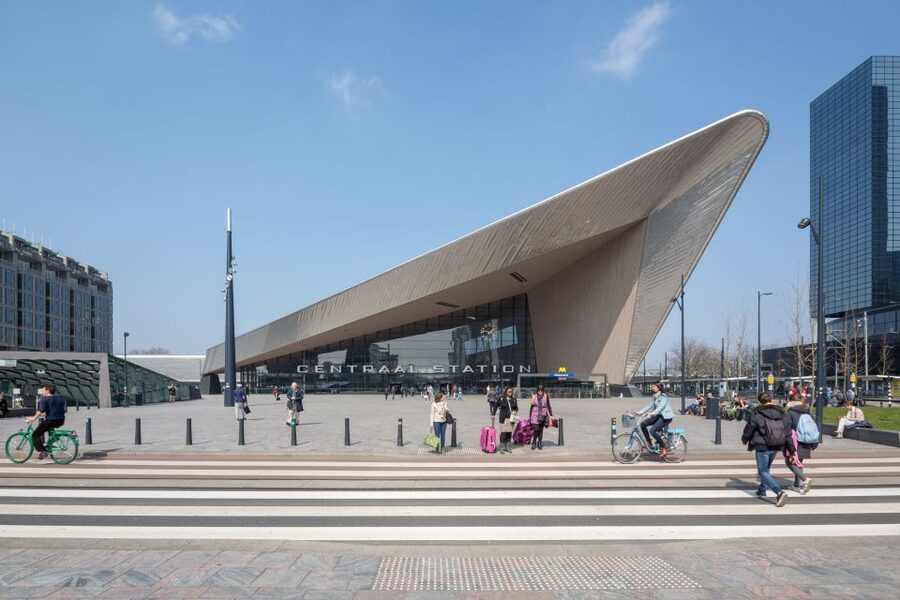
Rotterdam Centraal is more than a place to meet. Its dramatic, forward-pointing form introduces the city’s modern character before the walk has properly begun.
Your guide uses the station as a starting point for discussing Rotterdam’s growth and changing identity. From here, you begin walking toward the center and then the river, gradually moving through several periods of urban development.
This opening is useful because it sets up the larger story. You are not just looking at a new station. You are seeing how a major transport hub can reshape the way people enter and move through a city.
The exact amount of time spent here will depend on the guide and group questions. Guides including Tanya and Silvia have been praised for giving clear explanations and adjusting their pace. That matters on a walking tour, since the strongest guide is not only the one who knows the subject, but also the one who notices when the group needs to catch up.
Wear proper walking shoes. The distance is not extreme, but the tour keeps moving and operates in all weather.
The Lijnbaan and Rotterdam’s postwar ideas
The Lijnbaan area gives you an early look at Rotterdam’s postwar planning. It is an important stop because it reflects a period when architects and city planners were trying to create a new kind of shopping district after the destruction of the old center.
Here, your guide can connect everyday city life with design. The subject is not architecture as decoration. It is architecture as a way to organize shops, pedestrians, streets, and public activity.
I find this kind of explanation more useful than a list of dates and building names. You learn to ask practical questions: Who was this space meant for? How was it supposed to function? What changed as the city grew?
The Lijnbaan also helps explain why Rotterdam can feel more open and planned than older Dutch cities. Some people love that clarity. Others may find the postwar areas less intimate than historic centers such as Delft or Amsterdam.
If you want only postcard views, this section may feel less exciting than the Markthal or Cube Houses. If you want to understand how Rotterdam rebuilt itself, it is one of the more valuable parts of the route.
City Hall, older traces, and a city rebuilt
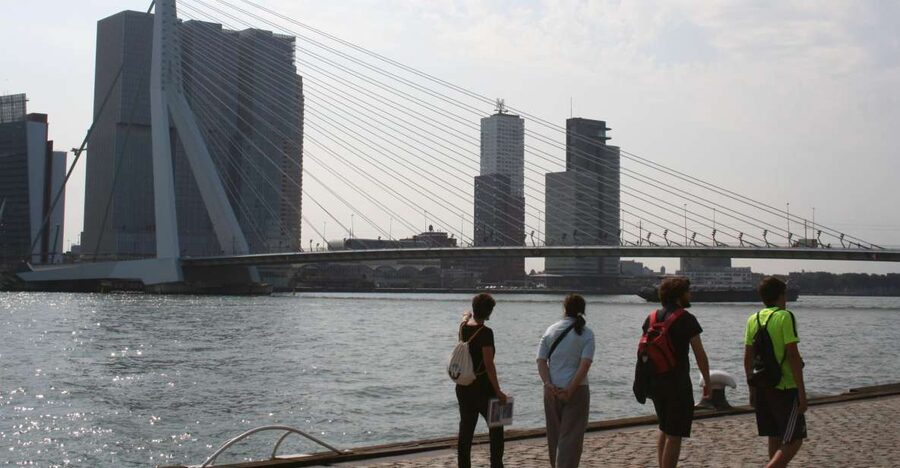
The walk then brings you to City Hall and the Sint Laurens church. These sights add much-needed contrast to the modern buildings around them.
City Hall helps show how older civic architecture fits into the rebuilt center. Sint Laurens church is especially important because it is one of the clearest reminders that Rotterdam’s prewar city was not erased entirely. Its presence gives the surrounding modern blocks a stronger sense of time.
This is where the guide’s historical skill matters most. A good explanation can help you picture the city before the bombing, understand the scale of the destruction, and follow the choices made during reconstruction.
Several guides, including Tania and Sylvie, have used historical images or old photographs to make that change easier to grasp. A historical photo book was particularly helpful during one tour, allowing the group to compare the present streets with the earlier city.
Look down as well as up. One guide has pointed out lights set into the sidewalks that mark the area destroyed by the 1940 bombing. Details like this give the rebuilding story a physical presence instead of leaving it as an abstract history lesson.
A different kind of day out entirely:
- Rotterdam: Harbor Sightseeing Cruise
★ 4.3 · 7,599 reviews - Rotterdam: 1-Hour Sightseeing Splash Tour
★ 4.5 · 3,299 reviews - Rotterdam: Rotterdam Zoo Blijdorp Entry Ticket
★ 4.6 · 2,754 reviews - Rotterdam: Euromast Lookout Tower Ticket
★ 4.4 · 2,549 reviews
Timmerhuis and Rotterdam’s changing city center
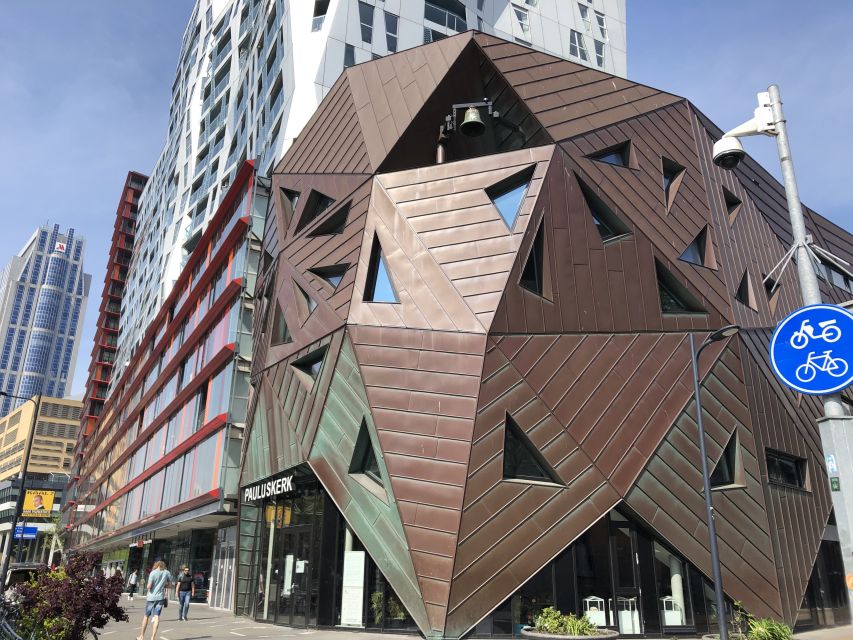
The Timmerhuis offers another view of Rotterdam’s architectural direction. Its design is very different from the older civic buildings and from the more isolated towers found elsewhere in the city.
Your guide discusses how contemporary buildings can combine offices, public functions, and city-center activity. The point is not simply that the Timmerhuis looks unusual. You are encouraged to consider how it fits into the surrounding streets and how modern construction changes the use of the center.
This is one of the places where an architect can give you information that is easy to miss on your own. You might notice the form immediately, but not the planning logic behind it.
The route covers a lot in a short period. That is a strength if you want a broad introduction, but it also means you may only have a few minutes at each location. One practical tip is to save detailed questions for the walking stretches, rather than waiting until every stop.
Inside the Markthal

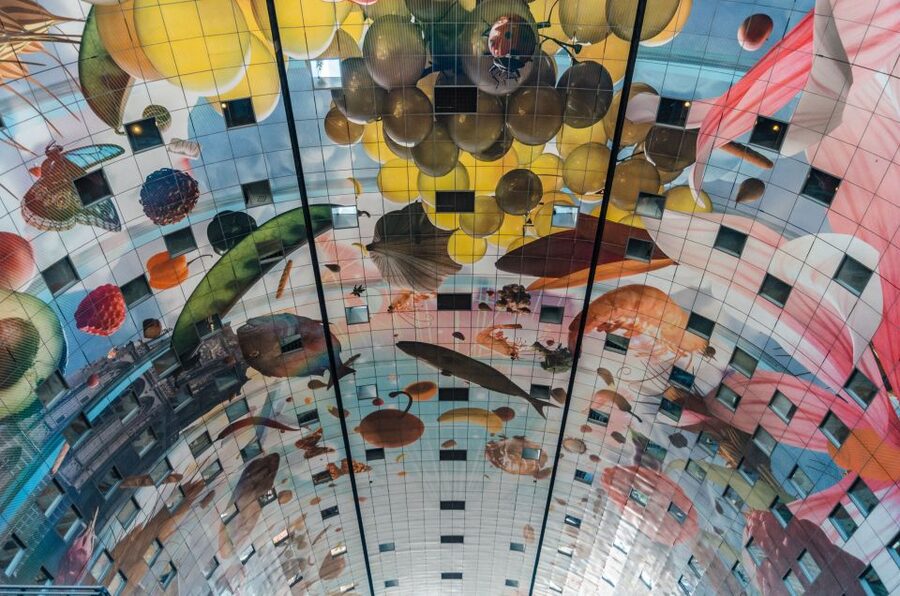
The Markthal is likely to be one of the most memorable stops. The tour takes you inside, where the scale and colorful interior provide a break from the street-level discussion.
This is a working public market and a major architectural statement at the same time. Your guide can explain how the building combines food stalls, public space, and housing in one large structure.
I like this stop because you can experience the building rather than only view it from outside. The Markthal is easy to appreciate visually, but its real interest comes from understanding how several uses are fitted together.
Food and drinks are not included, so plan to buy anything you want inside separately. The tour itself does not promise a tasting session or free time for lunch. Think of the Markthal as an architectural stop first, with food available if the schedule allows and you choose to purchase it.
Because the walk continues afterward, do not count on having a relaxed meal here during the two-hour route. If you want to eat at the Markthal, you may prefer to return after the tour.
The Cube Houses and a useful dose of debate
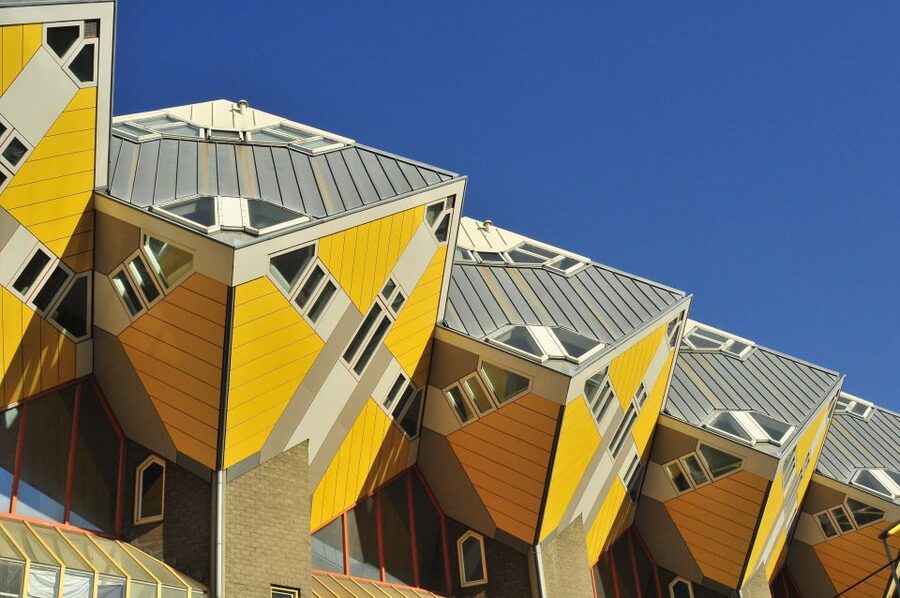
The row of Cube Houses is one of Rotterdam’s best-known sights, and the route passes by them after the Markthal.
Their tilted forms are instantly recognizable. They also invite a fair question: does a striking idea make a good home? The tour presents the buildings as part of Rotterdam’s experimental approach to housing and urban design, rather than asking you to admire them without criticism.
That is important because not every bold building works equally well for daily life. One participant specifically felt the Cube Houses had been praised for too long, while also appreciating that the tour covered many other parts of the city. You should expect the guide to place the Cube Houses within Rotterdam’s design culture, not necessarily to present them as perfect.
The route passes the houses, but the supplied details do not promise entry into one. If you want to see an interior, check the separate attraction arrangements rather than assuming access is part of this walk.
Reaching the Maas and the Erasmus Bridge
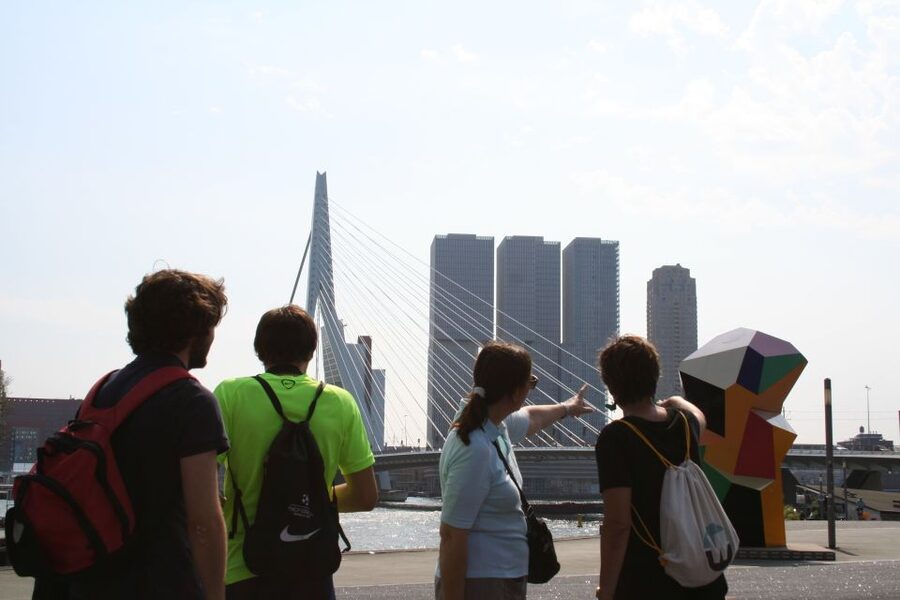
The final stretch heads toward the riverside and Rotterdam’s newer development on the South Bank. This is where the city’s high-rise skyline comes into view, including the Erasmus Bridge.
The bridge is Rotterdam’s most recognizable modern landmark, and seeing it from the riverfront gives the tour a strong finish. Your guide can connect its design with the city’s continuing effort to expand beyond the traditional center and strengthen links across the Maas.
The South Bank is useful for understanding Rotterdam as an active port city with ambitious plans. The architecture here feels newer, taller, and more metropolitan than the streets around City Hall and Sint Laurens church.
This portion also gives you a chance to think about the city as a whole. In two hours, you have moved from a major railway station through shopping streets, civic buildings, a market hall, experimental housing, and a developing waterfront.
The drawback is that the waterfront architecture deserves more time than this itinerary provides. One person wished the tour lasted four hours, while another suggested a bicycle version for seeing more of the harbor area. I agree with the practical point: this walk is an introduction, not a full study of Rotterdam’s port and South Bank.
How much value do you get for $53?
At $53 per person, the tour is not the cheapest way to walk around Rotterdam. You can visit many of these public areas without a guide. The value comes from the explanation, the route planning, and the chance to ask questions as the city unfolds.
I consider the price fair if you are interested in architecture, urban planning, or the rebuilding of European cities after the Second World War. It is also good value for a private group, since a private option is available and the guide can likely give more attention to your questions.
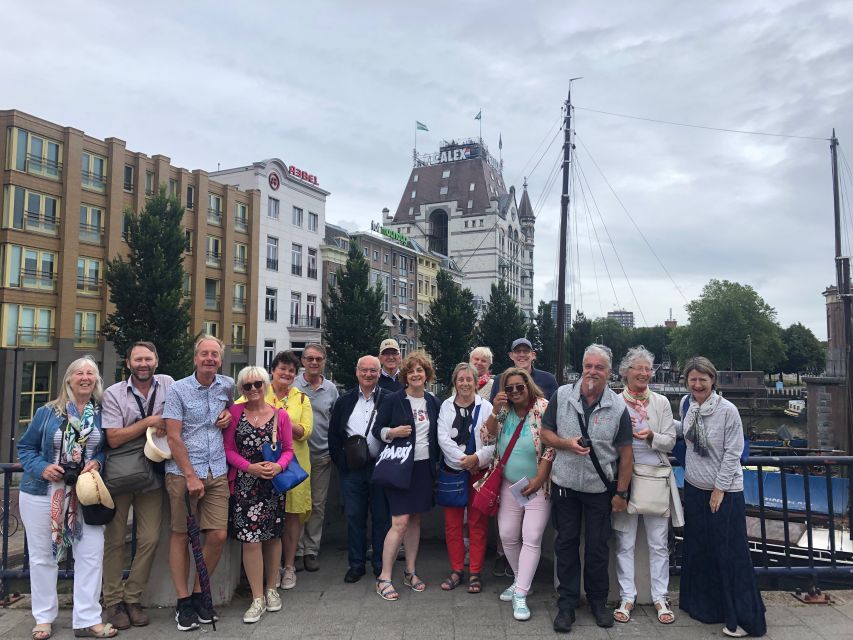
For a large group, the value depends more on the guide and the group pace. The strongest feedback has focused on guides who were friendly, prepared, and able to explain complicated subjects in plain language. Tania, Tanya, Silvia, and Sylvie are among the guides praised for this balance.
The rating is 4.8 from 215 ratings, with especially strong praise for the historical and architectural explanations. The main limits are consistent: the route is fixed, the walk is fairly brisk, and two hours is not enough for every interesting building.
Who should take this walk?
I would recommend it to first-time visitors who want a useful framework for Rotterdam. Afterward, you will look at the city with more questions and a better sense of where to spend your free time.
It suits:
- People interested in modern architecture and city planning
- Visitors who want to understand Rotterdam’s wartime destruction and rebuilding
- Train arrivals looking for a convenient first activity
- Small groups who enjoy asking questions
- Families with older children who can manage 3 to 4 kilometers
- Anyone who prefers an expert explanation to exploring buildings without context
Children from birth through age 12 can join free, but parents should consider the walk’s distance, subject matter, and two-hour duration. The tour is wheelchair accessible, though you may still want to confirm the route details for your particular group.
You may want a different activity if you prefer food tastings, museum interiors, historic canals, or a relaxed pace. You should also look elsewhere if your main interest is social housing, since that subject is not a central part of the set route.
Practical advice before you go
Meet under the clock at Rotterdam Centraal Station. Arrive ready to walk rather than expecting a seated introduction.
Wear comfortable shoes and dress for the weather. The tour runs rain or shine, and there is no promise of food, drinks, or included transport.
The tour is in English. Guide accents may vary, and one person found a strong Spanish accent occasionally difficult to follow. If you have hearing concerns or prefer a slower pace, a private group may be worth considering.
The walk covers 3 to 4 kilometers. Guides have generally been praised for a friendly manner and good preparation, but one person suggested adding more pauses for slower walkers. Keep that in mind if your group includes young children or anyone who needs frequent rests.
You can cancel up to 24 hours before the start for a full refund, and the reserve now, pay later option keeps your plans flexible.
Should you book the Rotterdam architecture tour?
Book it if you want Rotterdam to make sense, not simply look unusual. The architect-led approach turns the city’s bold buildings into evidence of war, commerce, housing policy, and long-term planning.
I especially recommend it for your first day in Rotterdam, when the route from Central Station to the Maas can help you get oriented quickly. You will see the city’s major architectural calling cards and gain ideas for what to explore afterward.
Skip it if you want a slow, highly specialized tour of one district, a bicycle ride through the harbor, or extended time inside individual buildings. For most visitors interested in how cities change, though, the $53 cost buys a strong introduction, and the short format leaves you plenty of time to continue exploring on your own.
FAQ
Where does the Rotterdam architecture walking tour meet?
Meet your guide at Rotterdam Centraal Station, underneath the clock.
How long does the tour last?
The walking tour lasts two hours.
How far do you walk?
The route covers approximately 3 to 4 kilometers.
What language is the tour conducted in?
The live tour guide conducts the experience in English.
Which buildings and areas are included?
The route includes Rotterdam Centraal Station, the Lijnbaan, City Hall, the Timmerhuis, Sint Laurens church, the Markthal, the Cube Houses, the South Bank development, and the Erasmus Bridge area.
Do you enter the Markthal?
Yes. The tour includes a walk through the Markthal.
Does the tour include food, drinks, or transport?
No. Food, drinks, and transportation costs are not included.
Can children join the tour?
Children from 0 to 12 years old can join for free. Parents should consider the distance, content, and two-hour duration.
Is the tour wheelchair accessible?
Yes, the activity is described as wheelchair accessible. A private group option is also available.
Just added in Rotterdam
- e-Scavenger hunt Dordrecht: Explore the city at your own pace★ 4.5 · 24 reviews
- Escape the City – Interactive city walk in Dordrecht★ 5.0 · 1 review
- Discover the best spots in Dordrecht with Outside Escape★ 4.5 · 11 reviews
- Historical Dordrecht: Private Tour with Local Guide★ 5.0 · 1 review
- The Netherlands: WW2 Private Day Trip★ 5.0 · 4 reviews
- Rotterdam: Guided Food Tour★ 4.4 · 16 reviews
- Rotterdam: Trompenburg Botanical Gardens Entry Ticket★ 4.1 · 77 reviews
- Rotterdam: UNESCO Van Nelle Factory Guided Tour★ 4.5 · 94 reviews
Walking Tours, compared.

Anne Frank’s Story – Guided Walking Tour through Amsterdam
Read our review →
Life of Anne Frank and World War II Walking Tour
Read our review →
Absolutely Amsterdam – the Essential Introductory Walking Tour
Read our review →
Anne Frank Walking Tour – Guided in EN/DE/IT/ES
Read our review →
Anne Frank Walking Tour Amsterdam Including Jewish Cultural Quarter
Read our review →Browse the lists this tour appears in