
Review · SELF-GUIDED TOURS
The Blue’s Clues in Delft Exploration Game and Tour
Delft turns sightseeing into a puzzle. This self-guided outdoor game sends you through the old city with an offline smartphone app, asking you to solve clues at historic places instead of simply walking past them. I like the low price of $7.53 per person and the freedom to start at any hour, pause whenever you want, and continue later. I also like that each person in your group can use their own phone at no extra charge.
The main drawback is the digital setup. One player reported being unable to access the game after purchase because the process between the booking code and the Questo app became confusing. The supplier says the Viator code should provide access without an extra payment, but I would still install the app and check the code before arriving at the starting point.
In This Review
- Key things to know before you play
- Why this Delft game works better than a plain city walk
- Starting at Oostpoort, Delft’s last surviving city gate
- Koornmarkt and the canal-side character of Delft
- The Medisch Farmaceutisch Museum and Delft’s medical past
- The older church buildings along Oude Delft
- City Hall and the Markt, Delft’s civic center
- The Nieuwe Kerk tower and the story of Hugo de Groot
- Vermeer Centrum Delft and the painter’s guild
- The Prinsenhof and the murder of William the Silent
- Finishing at De Roos, Delft’s last windmill
- What $7.53 gets you
- Who should choose this experience?
- Should you book the Delft exploration game?
- FAQ
- Where does the Delft exploration game start?
- Where does the game finish?
- How long does the experience take?
- What is the price?
- Do I need an internet connection while playing?
- Can I pause the game?
- Can children play for free?
- Can each person use their own phone?
- Is a physical guide included?
- What is the cancellation policy?
Key things to know before you play
- The route covers much of central Delft: You visit Oostpoort, Koornmarkt, the Markt, both major churches, the Prinsenhof, the Vermeer Centrum, and De Roos windmill.
- The game starts at Oostpoort: The app guides you step by step from Delft’s surviving medieval city gate to the windmill at Phoenixstraat.
- You solve clues on location: At each stop, you look around for an answer before the app sends you onward.
- The app works offline: You do not need an internet connection while exploring, which is useful for keeping the game moving through narrow old streets and canals.
- The format suits families and small private groups: Children play free, and only your own group takes part.
- Allow about 90 minutes: The stated playing time is approximate, and the pause-and-resume format lets you stretch it around a café stop or another Delft visit.
Why this Delft game works better than a plain city walk
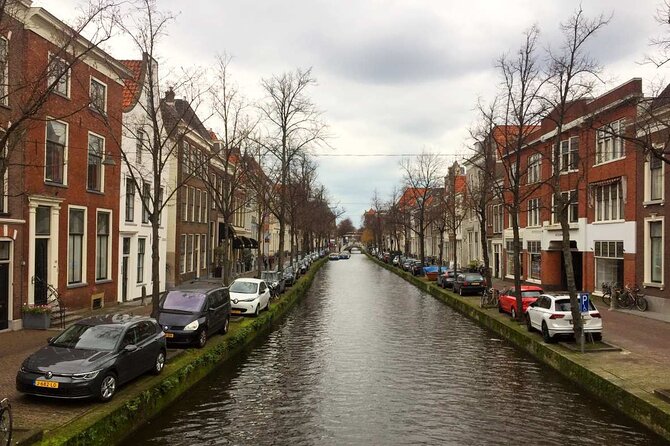
Delft is easy to enjoy at street level. Its canals, brick buildings, churches, and market square give you plenty to see without a plan. Yet an ordinary walk can leave you wondering what matters and what does not.
This game gives your walk a clear purpose. You are not only looking at a tower or a canal. You are searching for a detail that answers the next challenge, then learning why the place matters. That small task can make you pay attention to dates, signs, architecture, and unusual features that you might otherwise miss.
The route also gives you a useful first look at Delft. It does not focus on one single subject. You get medieval defenses, religious buildings, civic architecture, the story of William the Silent, Vermeer’s connection with the city, and Delft’s last surviving windmill.
I would think of it as a playful orientation walk rather than a replacement for a museum visit or a detailed human-led tour. The app provides structure and short stories, but there is no physical guide to answer follow-up questions or adjust the pace for your group.
More Self-Guided Tours in The Hague
- Discover The Hague with a self-guided Outside Escape city tour
★ 4.5 · 35 reviews - Discover Delft with a self-guided Outside Escape city game tour!
★ 5.0 · 32 reviews - Hague: The Heart of Old Town Exploration Game and Tour
★ 3.5 · 25 reviews
Starting at Oostpoort, Delft’s last surviving city gate
Begin at Oostpoort 15, at the eastern edge of the route. This gate is one of the most distinctive sights in Delft because it is the only city gate still standing. The other gates were demolished during the 19th century.
The gate dates from around 1400 and is a fine example of northern European Brick Gothic architecture. Around 1510, its towers gained an extra octagonal level and tall spires. Those details give the structure a storybook profile, but the game asks you to look more closely rather than simply take a photograph.
Your first challenge requires you to examine the setting and find an answer. This is a good opening because it teaches you how the game operates: inspect the surroundings, enter the answer, and follow the next instruction.
The location is outside the busiest part of the center, so you begin with a clear landmark and a definite direction. Follow the app carefully. Since the route is self-guided, a wrong turn or missed instruction can make the next stop harder to find.
Koornmarkt and the canal-side character of Delft
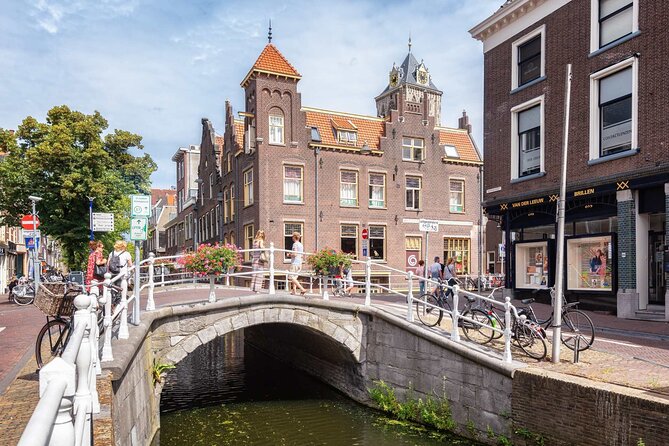
The route continues to Koornmarkt, one of Delft’s well-known streets and canals. The name means Corn Market, a reminder that these waterways and streets were tied to trade as well as daily life.
This is where the game’s format feels natural. Delft’s streets reward close looking. A clue-based walk encourages you to scan the buildings, canal edges, and street details instead of rushing from one major sight to the next.
You will stop, search for the answer, and read the short explanation connected with the place. Do not expect a long historical talk here. The value is in linking a small observation with the wider story of the city.
If you are playing with children, Koornmarkt gives them a simple job to do. They can search while you take in the architecture. Children play free, which makes the $7.53 adult price especially reasonable for a family outing.
The Medisch Farmaceutisch Museum and Delft’s medical past
The Medisch Farmaceutisch Museum adds a different subject to the route. Its collection includes antique medical and pharmaceutical instruments.
The game takes you to the museum’s setting and asks you to find the next answer around the site. The activity does not include admission to a physical museum experience, and the supplied details do not promise an indoor visit. Treat this stop as a point of interest within the outdoor route, not as a full museum tour.
That distinction matters. If antique medical objects are a major interest, you may want to make a separate plan to see what the museum offers. Within the game, the stop broadens your sense of Delft beyond churches, painters, and grand civic buildings.
More Delft trips:
- Royal Delft: Delftblue Factory and Museum Admission Ticket
★ 4.5 · 145 reviews - The Hague: One Way Boat Ticket to or from Delft
★ 4.5 · 52 reviews - Walking Tour of Delft – The City of Orange and Blue
★ 5.0 · 50 reviews - Vermeer Centrum Delft Museum Admission Ticket
★ 4.0 · 45 reviews
The older church buildings along Oude Delft
Another stop takes you to one of Delft’s oldest buildings, a Gothic church built around 1400 and recognized as a Rijksmonument since 1967. Its position on the east side of the Oude Delft gives you another chance to see how religious buildings fit into the city’s old street pattern.
The route also includes the Old Church, whose origins are linked to 1246. At that time, Count William II granted Delft its city charter, and the church was associated with Saint Bartholomew, the patron saint of its founder. Over later centuries, it grew into a Gothic basilica.
The two church stops help you compare different layers of Delft’s past. One is described through its status as an old protected monument. The other carries a direct connection to the city’s medieval charter and its growth over time.
You should keep your expectations in check. The game guides you to the buildings and gives you a challenge outside or near each location. It does not promise entry, interior interpretation, or a specialist explanation of the art and architecture inside. If you want to see the churches properly, check their separate opening arrangements.
City Hall and the Markt, Delft’s civic center
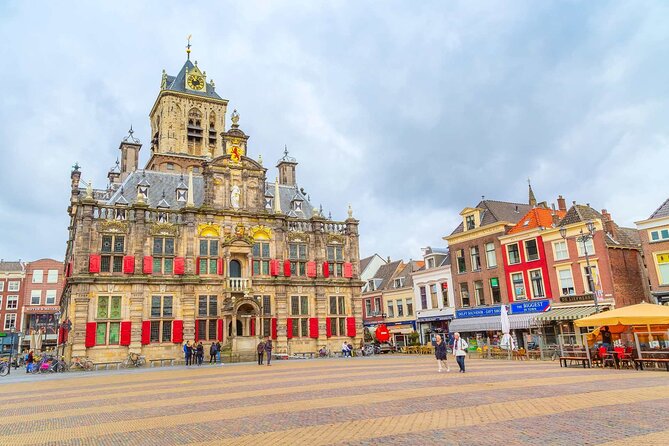
Delft’s City Hall sits on the Markt opposite the Nieuwe Kerk. The building is Renaissance in style and remains linked with city government. It is also used for civic wedding ceremonies, though much of the administration has moved to offices inside Delft railway station.
The game’s stop here gives you a chance to look at the relationship between the two buildings facing each other across the square. This is one of the clearest places on the route to see Delft’s religious and civic powers set side by side.
The Markt itself is large by European historic-square standards. It measures about 120 by 50 meters and is bordered at its short ends by the Nieuwe Kerk and City Hall. The connecting side streets also form part of the market area.
The square sits on a raised creek ridge formed by the silted channel of the Gantel. That slightly higher ground helps explain why this location became an important part of the city center.
Give yourself a little extra time here, even though the game takes about 90 minutes overall. The Markt is an open place with several major sights close together, and you may want to pause before entering the next answer. The ability to stop the game is especially useful in a square where you may want to take photographs or find a place to sit.
The Nieuwe Kerk tower and the story of Hugo de Groot
The next point focuses on the tower built between 1396 and 1496 by Jacob van der Borch, who also worked on Utrecht’s Dom. The tower includes a monument to Hugo de Groot, made in 1781.
Its clock has 18 bells cast by François Hemony in 1659, along with 30 modern bells. Those details turn the tower from a handsome landmark into a piece of working mechanical history.
The app challenge makes you look at the tower and its surroundings with a question in mind. That is useful in Delft’s crowded center, where a famous building can become visual background after a few minutes.
The game does not include tower admission or a guided climb. If you want panoramic views or a close look at the bells, you will need to arrange that separately. Here, the attraction is the outdoor discovery and the story attached to the landmark.
Vermeer Centrum Delft and the painter’s guild
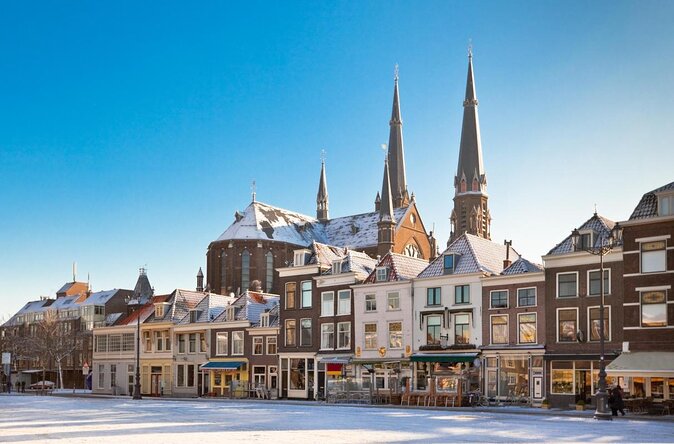
The Vermeer Centrum Delft connects the route with one of Delft’s best-known painters. The building once housed the Saint Lucasgilde, a guild for painters and glassmakers in the 17th and 18th centuries. Johannes Vermeer joined the guild in 1653.
That fact gives the stop more weight than a simple painter-themed photo opportunity. Vermeer’s connection to Delft was professional and local. The guild was part of the working structure that supported artists in the city.
The game asks you to inspect the location and solve another challenge. It gives you a useful introduction, but it is not a substitute for the Vermeer Centrum itself. If you want reproductions, further explanation of Vermeer’s work, or a longer look at the building, plan extra time beyond the game.
This is one of the route’s strongest stops for first-time visitors because it ties a famous name to a specific place. You are not only hearing about Vermeer in the abstract. You are standing where Delft’s painters organized their professional lives.
The Prinsenhof and the murder of William the Silent
The Prinsenhof began as a medieval monastery and later became an urban palace. William the Silent used it as a residence, and he was murdered there in 1584.
The most striking detail is still visible: bullet holes in the wall near the main stairs. The game sends you to the site and uses a challenge to make you look for the evidence.
This is exactly the sort of detail a self-guided game can handle well. A standard sightseeing walk might point out the Prinsenhof and move on. Here, you have a reason to find the place where the event happened.
The stop also gives Delft a strong connection to Dutch political history. The building is not just attractive old architecture. It is tied to a violent turning point, and the physical marks make the story more immediate.
As with the churches and Vermeer Centrum, the outdoor game should not be confused with admission to the museum inside the Prinsenhof. If you want the full collections and exhibitions, allow a separate visit.
Finishing at De Roos, Delft’s last windmill
The route ends at De Roos, at Phoenixstraat 111 and 112. The windmill was built in 1679 to grind corn, though a mill at this location is recorded as early as 1352.
De Roos is Delft’s only remaining windmill. Fifteen mills once operated in the Delft area, so the final stop gives the city’s industrial past a clear and memorable ending.
Ending here also creates a satisfying change from the churches and civic buildings of the center. You finish with a working symbol of grain, wind, and local production. The app guides you to the windmill step by step, so follow its directions closely.
The stated opening period runs through June 17, 2026, with availability listed from midnight to 11:30 p.m. daily. Those hours refer to the experience’s availability, not a promise that every nearby attraction will be open. The game itself is designed to be played outdoors and offline.
What $7.53 gets you
At $7.53 per person, this is an inexpensive way to add structure to a Delft visit. You receive a self-guided route of about 90 minutes, access to the app-based challenges, historical context at each stop, and the ability to play privately with your own group.
The value is strongest if you already plan to walk around Delft and want an activity that keeps children or less history-focused companions involved. You are paying for a route and a game, not a traditional guided tour.
The price is also helped by the group setup. Each group member can play on their own phone for free, and children are free. That removes the usual worry that a family activity will become expensive once every participant needs a ticket.
The main risk is technical access. One user described a complicated process that repeatedly sent them between platforms and never allowed the game to start. The provider states that the Viator code should work in the Questo app without another payment and offers support through the app, website chat, or [email protected].
My practical advice is simple: download or prepare the Questo app before you reach Oostpoort, enter the supplied code, and confirm that the game opens. That small check can save frustration at the gate.
Who should choose this experience?
I would choose this for an independent visitor who wants more direction than a loose city stroll but less commitment than a scheduled group tour. It works particularly well for families, couples, friends, and small private groups.
You will probably like it if you enjoy:
- Solving simple location-based puzzles
- Walking at your own speed
- Learning short stories tied to real buildings
- Taking breaks without losing your place
- Exploring without a live guide
It is less suitable if you want a detailed lecture, a specialist in Delft art, or guaranteed entry into every church and museum on the route. The app cannot replace a person who can answer questions or change the itinerary to match your interests.
The route also asks for attention. You need to look around at each stop and enter answers correctly. That is part of the fun, but it may feel like extra work if you only want a relaxed walk with no game mechanics.
Should you book the Delft exploration game?
Book it if you want an affordable, flexible way to see Delft’s main historic sights while keeping your group active. The route covers an impressive range, from the medieval Oostpoort and old churches to Vermeer’s guild, the Prinsenhof, and the surviving De Roos windmill.
I especially like the ability to pause and resume, the offline play, and the free access for children and additional group phones. Those features give you control, which is valuable in a city where you may want to stop for coffee, photos, or an unscheduled museum visit.
Before paying, make sure you are comfortable with a self-guided digital format and prepare the app access in advance. If you do that, the $7.53 cost is fair for a playful first look at Delft. If you want deep interpretation or a human guide, spend your money on a traditional guided walk instead.
Free cancellation is available if you cancel at least 24 hours before the local start time. Inside that window, the amount is not refunded and changes are not accepted.
FAQ
Where does the Delft exploration game start?
It starts at Oostpoort 15, 2611 RZ Delft, Netherlands.
Where does the game finish?
It finishes at Delft Windmill De Roos, Phoenixstraat 111 and 112, 2611 AK Delft, Netherlands.
How long does the experience take?
The estimated duration is about 1 hour and 30 minutes.
What is the price?
The listed price is $7.53 per person.
Do I need an internet connection while playing?
No. The game is designed to work offline while you explore Delft.
Can I pause the game?
Yes. You can take a break at any time and resume later.
Can children play for free?
Yes. The experience is free for kids.
Can each person use their own phone?
Yes. Group members can play on their own phone at no extra charge.
Is a physical guide included?
No. This is an app-based, self-guided experience and does not include a physical tour guide.
What is the cancellation policy?
You can receive a full refund if you cancel at least 24 hours before the experience’s local start time. Cancellations or changes made within 24 hours are not accepted for a refund.
Just added in The Hague
- The Hague Walking Tour★ 4.5 · 16 reviews
- The Hague Tower Guided Tour★ 4.5 · 45 reviews
- The Hague: Powerboat Tour Scheveningen★ 4.5 · 15 reviews
- The Hague: Private Boattour up to 10 persons★ 4.9 · 37 reviews
- The Hague: Private Custom Walking Tour With A Local Guide★ 4.5 · 13 reviews
- The Hague: Ping Pong Table Rental at a Secret Ping Pong Bar★ 4.5 · 7 reviews
- The Hague: Prison Gate Museum★ 4.5 · 58 reviews
- The Hague: One Way Boat Ticket to or from Delft★ 4.5 · 52 reviews
Self-Guided Tours, compared.
75 Minute City Canal Cruise with Audio Guide
Read our review →
Canal Cruise with Live Commentary & Audio Guide
Read our review →
Amsterdam Sightseeing Canal Cruise with Audio Guide
Read our review →

Amsterdam Van Gogh Museum with Audio or Guided Tour
Read our review →
Van Gogh Museum Skip the Queue with Audio Guide
Read our review →
Amsterdam 1h Canal Cruise by Semi-Open Boat with Audio Guide
Read our review →Browse the lists this tour appears in