
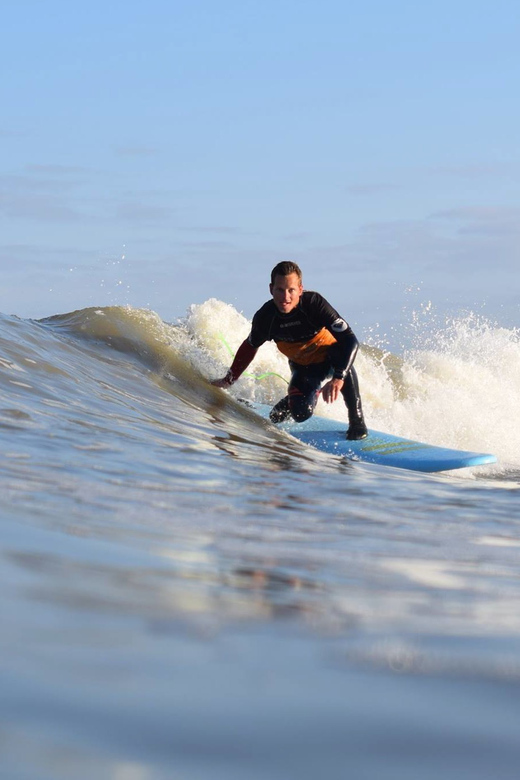
Review · WORKSHOPS
The Hague: Beginner’s Surf Lesson
Catch your first wave in The Hague. I like the small groups of six or fewer and the warm wetsuit, boots, gloves, and cap setup, which make a first lesson feel less intimidating. I also like the €15 rental credit you can use after class. The main drawback is that the lesson is for ages 16 and up, so younger family members cannot join.
This is a practical introduction rather than a full day at the beach. You spend two hours learning safety, board control, wave timing, and the basics of standing up in the water. The instructors teach in Dutch and English, and names such as Ayoub, Gijs, and Connor are associated with especially warm, helpful instruction. Still, ocean conditions can affect how much time you spend riding waves.
In This Review
- Key points to know before you book
- What this Scheveningen surf lesson is really like
- Starting on the beach with safety first
- Getting suited up for Dutch beach water
- Learning to control the board and read the waves
- The first-wave goal
- Why the small class size matters
- Price, rental credit, and overall value
- Who should book this experience
- Practical planning for Strandweg 3
- My verdict: book it if your goal is a real first try
- FAQ
- Where does the surf lesson start?
- Where does the activity finish?
- How long does the surf lesson last?
- What languages does the instructor speak?
- What equipment is included?
- What should I bring?
- Can I cancel or pay later?
Key points to know before you book
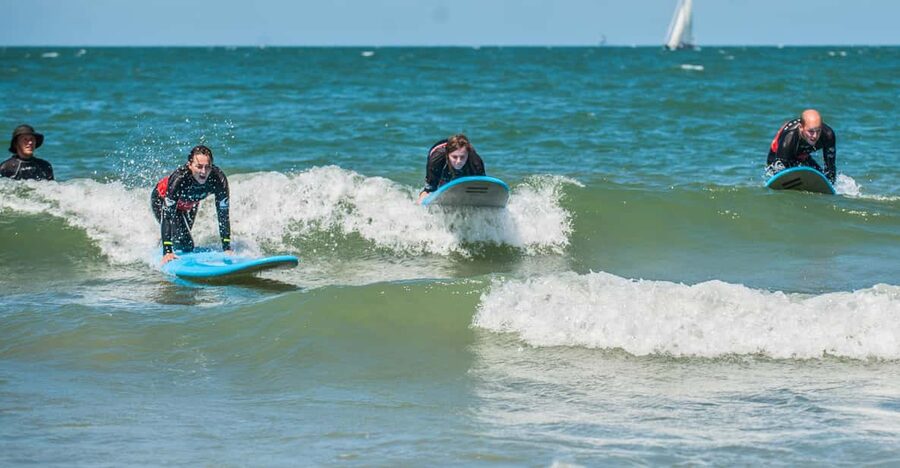
- Small groups of six or fewer: You get a better chance to ask questions and receive corrections than in a large beach class.
- A full cold-water clothing setup: Warm wetsuits and caps are included, with boots and gloves available when needed in winter.
- A lesson built around your first wave: You practice safety, reading waves, timing your takeoff, and keeping the board under control.
- A useful post-lesson credit: The price includes €15 in rental credit for use whenever it suits you after the class.
- A central Scheveningen meeting point: Start and finish at Strandweg 3, 2586JK, in The Hague’s seaside district.
- A beginner-friendly age limit: You must be at least 16, and Dutch and English instruction is available.
What this Scheveningen surf lesson is really like
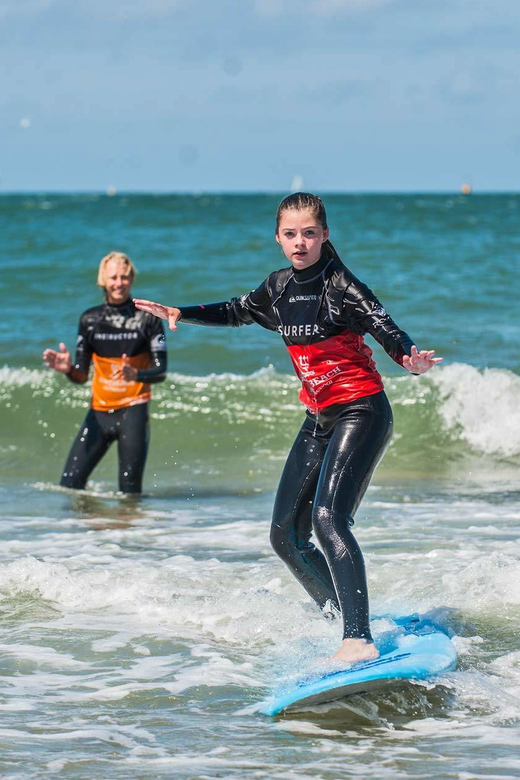
Scheveningen is The Hague’s beach district, and this activity puts you directly on the sand with a surfboard instead of behind a classroom desk. The goal is simple: learn enough technique and water awareness to get moving on a wave during a two-hour introduction.
You begin at Strandweg 3, 2586JK Scheveningen. The lesson returns to this same meeting point, which keeps the day easy to manage. You do not need to arrange a second pickup point or figure out where to collect your belongings afterward.
The class is limited to six participants or fewer. That number matters. Surfing involves quick physical corrections, and you will get more from the session when an instructor can see your stance, board position, and timing. A small group also makes it easier to hear the safety briefing and ask a question without holding up a crowd.
The instruction is offered in Dutch and English. If you are visiting The Hague and do not speak Dutch, English instruction gives you a clear way to follow the water rules and technique explanations.
A few more options to weigh up in The Hague
- The Hague: Mauritshuis Entrance Ticket
★ 4.7 · 2,706 reviews - The Hague: City Canal Cruise
★ 4.6 · 2,024 reviews - The Hague: Madurodam Miniature Park Entry Ticket
★ 4.6 · 1,559 reviews
Starting on the beach with safety first
The lesson begins on the beach with an explanation of how to stay safe in the water. That may sound less exciting than catching a wave, but it is one of the most useful parts for a complete beginner.
You learn how to go out safely, how to handle the board, and what to watch for before you start paddling. In a first surf class, confidence comes partly from knowing what to do when a wave approaches or when the board shifts beneath you.
The instructor also introduces several basic surf techniques. You are not expected to master every movement in one session. Instead, the class gives you a short set of skills you can use right away: control the board, read the incoming water, time your takeoff, and try to stand in a stable position.
I appreciate that the lesson combines technique with safety rather than treating safety as a quick warning. The sea can look friendly from the beach, but a beginner needs a clear plan for moving through the water and managing the board.
Getting suited up for Dutch beach water
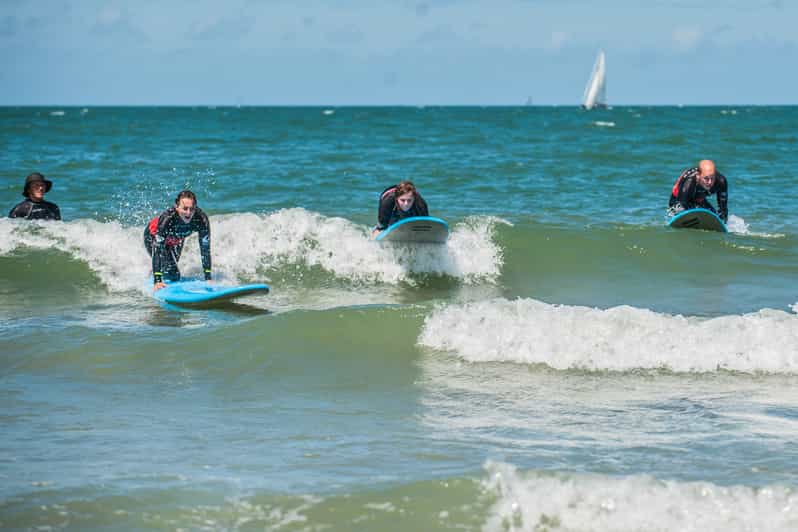
The experience includes a soft-top surfboard and a warm wetsuit. You also receive a cap, with gloves and boots provided if needed during the winter months.
A soft-top board is a sensible choice for new surfers. It is designed with a softer surface than a performance board, which makes the early stages less harsh when you lose balance. Beginners also get a stable platform for practicing the first stand-up movement.
The wetsuit is not a minor extra in the Netherlands. Warm clothing can make the difference between enjoying the lesson and spending the final part of it wishing you were back on the beach. The cap, boots, and gloves offer more protection in colder months, although the exact gear you use depends on the season and conditions.
Bring your own swimwear and towel. Separate changing rooms are available, along with hot showers and lockers for personal belongings. Those practical facilities mean you can change before and after the lesson and warm up afterward without carrying your phone or wallet onto the sand.
The activity does not include swimwear or a towel, so pack both. This is the kind of small preparation that prevents an otherwise good beach outing from becoming uncomfortable.
Learning to control the board and read the waves
Once the beach briefing is complete, you take a surfboard into the water and begin working on the basics. The instructor shows you how to keep the board under control and how to judge the waves before attempting a takeoff.
For a new surfer, reading a wave does not mean identifying a perfect barrel or planning a complicated turn. It means learning which waves are suitable for practice, when to position yourself, and how to notice the moment when the water can carry the board forward.
Timing matters just as much. Paddle too early and the wave may pass beneath you. Move too late and you may miss the push needed to get started. The lesson gives you a chance to repeat this process under guidance, rather than trying to work it out alone.
The first successful ride may be short. That is perfectly normal. The value is in understanding what made it work, then trying again with a better body position or better timing.
You should expect some trial and error. Surfing is physical, and a two-hour class cannot turn you into an accomplished surfer. It can, however, show you why people enjoy the sport and give you a sound first set of movements.
A different kind of day out entirely:
- The Hague: The Pier SkyView Ticket with Drink and Snack
★ 4.4 · 1,398 reviews - The Hague: Hop-on Hop-off Old-Fashioned Heritage Tram Tour
★ 4.4 · 1,083 reviews - The Hague: Escher in The Palace Museum Ticket
★ 4.6 · 896 reviews - Oranjehotel World War II Prison Entrance Ticket
★ 4.6 · 708 reviews
The first-wave goal
The central promise of this activity is the chance to catch your first wave. The instructors work toward that moment by breaking the process into manageable steps.
You first learn how to handle the board. Then you practice getting into position, timing the wave, and taking off. The sequence is important because standing up is not an isolated trick. It depends on everything that happens before it.
Your first wave may not look like the polished rides you see in surf videos. You may stand briefly, wobble, or fall quickly. That still counts as useful progress. The class is designed to help you experience the basic feeling of being carried forward by the water.
The supplied feedback is especially positive about the instructors’ attitude. Ayoub and Gijs are praised for being kind and helpful, while Connor is described as combining a fun approach with professional teaching. Those details matter because a beginner lesson depends as much on encouragement as on technical instruction.
One especially useful sign is that one participant enjoyed the experience enough to return the next day. You should not read that as a promise that every first lesson will go perfectly, but it does suggest the session can leave you wanting more rather than simply tired and finished.
Why the small class size matters
A maximum of six participants is one of the strongest features here. Surf instruction can lose much of its value when too many people share one instructor, particularly during the first attempts at standing up.
In a small group, you have a better chance of receiving direct feedback on your board position and takeoff. You can also watch the other students attempt the same skills, which often helps you understand the movement before trying it yourself.
The group format still means you will share the instructor’s attention. This is not a private coaching session. If having constant one-to-one correction is important to you, you should keep that distinction in mind.
The age requirement is also clear: you must be at least 16. That makes this a good option for older teenagers and adults, but not for families hoping to put younger children in the water.
The experience appears welcoming to different ages and backgrounds. One particularly telling note comes from a 54-year-old grandmother who felt she was treated no differently from younger participants. You do not need to fit a narrow image of a surfer to take part.
Price, rental credit, and overall value
The listed price is $45 per person for two hours. That is a reasonable package when you consider what is included: instruction, a soft-top board, a warm wetsuit and cap, winter accessories when needed, changing facilities, hot showers, and lockers.
The €15 rental credit adds value beyond the lesson itself. You can use it whenever it suits you after completing the class. The information provided does not specify the exact rental terms or equipment duration, so confirm those details when booking or at the surf school.
The credit is most useful if the class gives you an appetite for another session. A beginner lesson can answer the basic question of whether surfing feels enjoyable to you. If the answer is yes, the credit gives you a reason to return without paying the full cost of equipment rental.
For someone who only wants a quick beach activity, the price may feel like more than a casual stroll or a short waterside attraction. You are paying for instruction and equipment, not simply access to the shore. I see the value most clearly for people who genuinely want to try surfing rather than take a photo with a board.
Free cancellation is available up to 24 hours before the activity for a full refund. You can also reserve now and pay later, which helps if your schedule in The Hague is still changing. Since surf conditions can affect the feel of the day, flexible booking is useful.
Who should book this experience
I would recommend this class to first-time surfers aged 16 and over who want a guided introduction without committing to a long course. The two-hour length is enough to learn the basic process while remaining manageable as part of a day in The Hague.
It also suits people who prefer active sightseeing. You get out of the city center, spend time at the coast, and learn a skill instead of simply looking at the North Sea from the promenade.
The class is a good fit for solo participants, couples, and small groups of friends. The six-person limit keeps the session personal, and the English instruction makes it accessible to international visitors.
Older beginners should not rule themselves out. The available feedback specifically describes a 54-year-old grandmother being treated on equal terms with younger participants. That does not remove the physical demands of surfing, but it does suggest the teaching approach is not aimed only at athletic young adults.
You should think twice if you dislike cold water, have no interest in getting wet, or want advanced surfing instruction. This is a beginner lesson, not a performance clinic. It also cannot include children under 16.
Practical planning for Strandweg 3
Allow enough time to reach Strandweg 3 in Scheveningen and arrive ready for the start of your scheduled lesson. The duration is two hours, but the supplied information does not give a fixed daily start time, so you need to check availability for the session that fits your plans.
Wear or pack swimwear and bring a towel. Everything else listed for the water, including the surfboard and warm wetsuit, is provided.
The changing rooms, lockers, and hot showers make the meeting point practical for a half-day outing. You can arrive in ordinary clothes, change for the lesson, secure your belongings, and clean up afterward.
The lesson ends where it begins. That is helpful if you are combining surfing with other time in Scheveningen, since you will not need to organize transportation from a separate finish point.
Keep in mind that a surf lesson is tied to the sea. The instructors can teach you how to respond to the waves, but they cannot guarantee a particular number of successful rides. Go in expecting instruction, practice, and a first attempt, not a perfect surf session.
My verdict: book it if your goal is a real first try
Book this experience if you want to find out what surfing feels like in a supportive, small-group setting. The combination of certified instructors, warm equipment, safety guidance, and a first-wave focus gives beginners a sensible way to start.
I especially like the personal scale and the post-lesson €15 rental credit. The strong 4.7 rating from 78 ratings, along with praise for Ayoub, Gijs, and Connor, supports the picture of a friendly and well-run class.
Skip it if you are under 16, do not want to enter cold seawater, or are looking for advanced coaching. For everyone else, $45 is a fair price for two hours of instruction and equipment, with enough practical support to make your first attempt feel achievable.
FAQ
Where does the surf lesson start?
The lesson starts at Strandweg 3, 2586JK Scheveningen, The Hague.
Where does the activity finish?
The activity ends back at the meeting point on Strandweg 3.
How long does the surf lesson last?
The lesson lasts two hours. Starting times vary, so check availability for the date you want.
What languages does the instructor speak?
Instruction is available in Dutch and English.
What equipment is included?
You receive a soft-top surfboard, a warm wetsuit, and a cap. Gloves and boots are included if needed during the winter months.
What should I bring?
Bring swimwear and a towel. Changing rooms, hot showers, and lockers are provided.
Can I cancel or pay later?
You can cancel up to 24 hours in advance for a full refund. Reserve now and pay later is also available.
Just added in The Hague
- The Hague Walking Tour★ 4.5 · 16 reviews
- The Hague: Powerboat Tour Scheveningen★ 4.5 · 15 reviews
- The Hague Tower Guided Tour★ 4.5 · 45 reviews
- The Hague: Private Boattour up to 10 persons★ 4.9 · 37 reviews
- The Hague: Private Custom Walking Tour With A Local Guide★ 4.5 · 13 reviews
- The Hague: Prison Gate Museum★ 4.5 · 58 reviews
- The Hague: Ping Pong Table Rental at a Secret Ping Pong Bar★ 4.5 · 7 reviews
- The Hague: One Way Boat Ticket to or from Delft★ 4.5 · 52 reviews
Workshops, compared.

Traditional Dutch Syrup Waffle Making Workshop
Read our review →Amsterdam Traditional Dutch Syrup Waffle Making Workshop
Read our review →

3-Course Meal in Historic 1st Class Waiting Rooms
Read our review →
Amsterdam Light Festival Winter Walk with Stroopwafel Workshop
Read our review →
Distilling Class @ Spirited Union Rum Co. (Amsterdam)
Read our review →
Cocktail workshop @ Spirited Union Rum Co. (Amsterdam)
Read our review →
Browse the lists this tour appears in