
Review · HISTORICAL TOURS
Amsterdam City Center & History – Exclusive Guided Walking Tour
Amsterdam rewards those who look up. This 2.5-hour walk links grand churches, canal houses, old courtyards, and wartime landmarks into one useful introduction to the city. I like the wide sweep of the route, from the Basilica of St. Nicholas to the Jordaan, and I like the chance to ask a private guide for tips that fit your interests. The main drawback is pace: with 20 stops, many visits last only five minutes and several buildings are viewed from outside.
The tour is especially helpful during your first days in Amsterdam. Guides such as Anita, Diana, and Pedro have been praised for explaining the city clearly, answering questions, and keeping the walk enjoyable in poor weather. You should still wear good shoes, bring rain protection, and expect the tour to run in all weather.
In This Review
- Key points to know before you book
- Starting beside the Basilica of St. Nicholas
- Medieval towers, sea defenses, and Nieuwmarkt
- Big money and narrow homes on the Kloveniersburgwal
- Churches, Rembrandt, and Amsterdam’s modern civic center
- Canal architecture and the quiet Begijnhof
- Dam Square and the Golden Bend
- Anne Frank House and the Westerkerk
- Jordaan details: gable stones, hofjes, and Noorderkerk
- Finishing with apple pie at Het Papeneiland
- What the 62.48 dollar price really buys
- Pace, weather, and practical limits
- Who should choose this Amsterdam walk?
- Should you book Amsterdam City Center & History?
- FAQ
- How long does the walking tour last?
- Is the tour private?
- Where does the tour begin?
- Where does the tour end?
- Are attraction admission fees included?
- What happens if it rains?
Key points to know before you book
- Twenty landmarks in 2.5 hours: You get a broad introduction rather than long visits inside museums or churches.
- A private guide option: Your own group can receive undivided attention, unless you choose the save semi-private option.
- A route through several eras: The walk covers medieval defenses, the Dutch East India Company, the Golden Age, WWII, and modern Amsterdam.
- Mostly exterior sightseeing: Admission is free at some stops, but many are brief outside views and entrance fees are not included.
- A useful starting point: The route begins near Amsterdam Centraal and finishes at Het Papeneiland in the Jordaan.
- Rain or shine: Comfortable shoes, a bottle of water, an umbrella, and a summer hat are practical additions.
Starting beside the Basilica of St. Nicholas
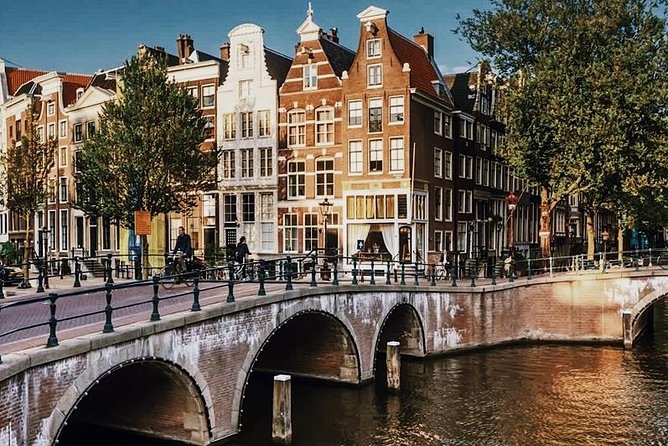
Meet at Prins Hendrikkade 73, near Amsterdam’s central waterfront and public transport. The location makes sense for a first look at the city, since the area around Amsterdam Centraal puts you close to the old center, canals, and the port that shaped Amsterdam’s rise.
The first stop is the Basilica of St. Nicholas, Amsterdam’s main Roman Catholic church. It was built in the late 19th century, after Catholic worship had faced centuries of restriction. That timing gives the building added meaning: it reflects a city slowly changing its religious rules and public identity.
You can admire the architecture without paying an admission fee, but the planned stop is only about 10 minutes. I would treat this as an introduction, not a full church visit. If you want time to study the interior, ask your guide how much flexibility the schedule allows.
More History Tours in Amsterdam
- Amsterdam Food and Cultural Tour with Tastings
★ 5.0 · 2,442 reviews - Amsterdam: Haunted History and Ghost Walking Tour
★ 4.5 · 488 reviews - Amsterdam High-End Dutch Food & History Tour – Up to 8 guests
★ 5.0 · 482 reviews
Medieval towers, sea defenses, and Nieuwmarkt
The Schreierstoren, often called the Weeping Tower, is one of those Amsterdam places that rewards a little explanation. This medieval tower was a point where women said goodbye to loved ones leaving by ship. The name and setting connect the city’s daily life to its dependence on water, trade, and long sea voyages.
Admission is not included, and the stop lasts about 10 minutes. The value here is the story and the old structure, not a long indoor visit.
From there, you walk along Zeedijk, one of Amsterdam’s oldest streets. It once worked as a sea dike, helping hold back water from the IJ. At Kolksluis, you can see one of the city’s attractive lock bridges, a small piece of engineering that makes Amsterdam easier to understand. The scheduled stop is short, so keep your eyes open as you walk.
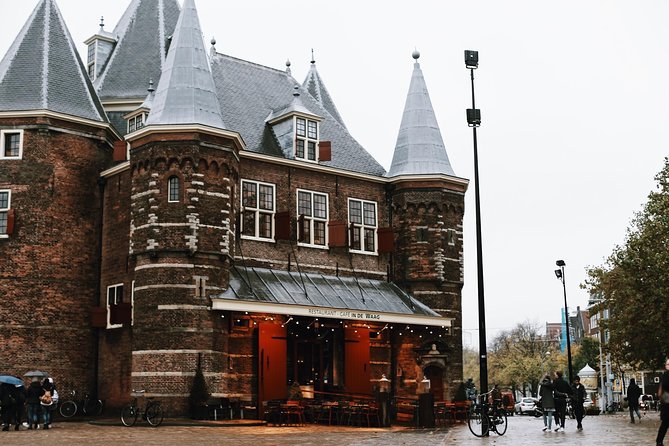
Nieuwmarkt brings you into one of the old city center’s main gathering places. The square has served commerce and social life since the 17th century, helped by its position just inside an old city gate. The Waag sits here, too. This 15th-century building began as a city gate and part of the town walls, then served as a guildhall, museum, and fire station.
The Waag is one of Amsterdam’s oldest surviving nonreligious buildings. You will probably get more from hearing how its purpose changed than from simply taking a photograph. The five-minute stop is enough for an explanation and a look around, but not a detailed architectural study.
Big money and narrow homes on the Kloveniersburgwal
The contrast at Trippenhuis is one of the cleverest moments on the route. This was the grand mansion of the wealthy Trip family, a large and confident 17th-century home. Directly opposite is the Kleine Trippenhuis, one of Amsterdam’s narrowest houses.
The two buildings make an old tax story easy to see. High land taxes encouraged owners to build upward on narrow plots, creating the tall, slim canal houses that now define much of central Amsterdam. The smaller home is not just a curiosity. It helps explain why so many Amsterdam façades look as if they were squeezed between their neighbors.
The stop at Trippenhuis and the smaller house is brief, and admission is not included. You will want to look up, since the most interesting details are often above eye level.
At the Oost-Indisch Huis, the tour turns to the Dutch East India Company, known as the VOC. This was the headquarters of an organization often described as the world’s first multinational corporation. You step into its courtyard, where the setting gives you a physical connection to the commercial system that helped make Amsterdam wealthy.
The stop is listed as free, but it is still short. Your guide’s explanation matters here because the courtyard alone will not tell the full story.
Churches, Rembrandt, and Amsterdam’s modern civic center
Zuiderkerk was Amsterdam’s first purpose-built Protestant church. Designed by Hendrick de Keyser, it has an elegant tower that remains one of the city’s recognizable markers. Its cross-shaped design and Protestant purpose help explain how worship spaces changed after the Reformation.
The stop is about five minutes and admission is not included. Think of it as a city walk with historical signposts, not a church tour.
The route then reaches Museum Het Rembrandthuis, the former home and studio of Rembrandt. He lived and worked there for nearly 20 years. Even if you do not enter, the address matters because it puts the famous painter into the ordinary street fabric of Amsterdam rather than treating him as a distant museum figure.
The National Opera and Ballet, part of the Stopera complex, shifts the story to modern Amsterdam. The building combines city hall with the Dutch National Opera and Ballet. Its construction took at least 60 years to reach completion, making it a useful reminder that Amsterdam’s civic projects can take patience.
These three stops are close enough in spirit to show a city changing over time: Protestant worship, Golden Age art, and a modern public complex. None is planned as a long indoor visit, so plan separate admission if you want to explore the Rembrandt house or other interiors.
More Walking Tours in Amsterdam
- Anne Frank’s Story – Guided Walking Tour through Amsterdam
★ 5.0 · 11,619 reviews - Amsterdam: Life of Anne Frank and World War II Walking Tour
★ 4.8 · 10,467 reviews - Absolutely Amsterdam – the Essential Introductory Walking Tour
★ 5.0 · 3,629 reviews - Amsterdam: Anne Frank Guided Small Group Walking Tour
★ 4.8 · 2,722 reviews
Canal architecture and the quiet Begijnhof

Huis aan de Drie Grachten is a rare 17th-century canal house positioned where three canals meet. Its façades face in three directions, a feature worth noticing as you move through the central canal district. Amsterdam’s houses often look similar at a quick glance, but small details such as unusual angles and multiple façades reveal how carefully each plot was used.
The Begijnhof provides a change of mood. This quiet medieval courtyard was home to Beguines, devout women who lived in a religious community without becoming nuns. It also contains one of Amsterdam’s oldest wooden houses.
The courtyard is one of the places where a guide can help you behave thoughtfully. Keep voices low and respect that it remains a quiet residential and historic space. The schedule allows only about five minutes, so you may wish to return on your own if you want more time.
Dam Square and the Golden Bend
Dam Square is Amsterdam’s historic center. The Royal Palace, the 15th-century New Church, and the National Monument to WWII victims frame the square. It can feel crowded and busy, but the guide helps you read it as a place of royal power, religious change, and public remembrance.
Admission to the square is free, while entry to individual buildings is not included. The five-minute stop gives you orientation and useful context, but not enough time for a palace or church visit.
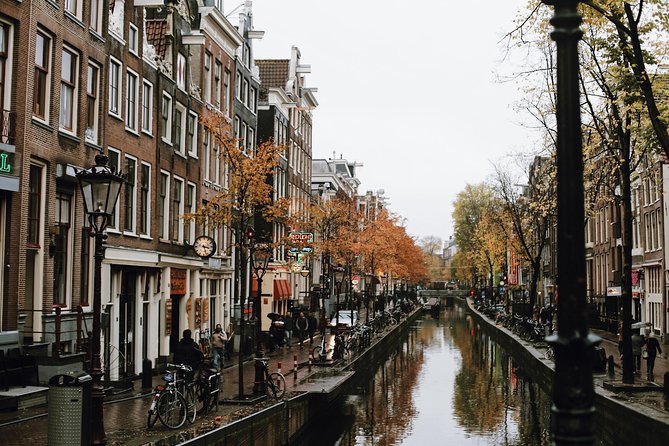
At Herengracht, you see the Golden Bend, the stretch lined with some of the city’s grandest canal mansions. These homes show how wealthy merchants used architecture to announce their success during the Dutch Golden Age.
This is a good place to slow your eyes even if you cannot slow the group. Look at the width of the houses, the ornament above the doors, and the gables at the top. The guide can point out the social meaning behind the façades, turning a pretty canal view into a lesson about money and status.
Anne Frank House and the Westerkerk
The walk pauses outside the Anne Frank House, the building where Anne Frank hid during WWII. Next door is the Westerkerk, whose tower is the tallest church tower in Amsterdam.
This is an emotionally important part of the route, but the tour does not include entry. The Anne Frank House requires its own ticket, and this walking experience is not a substitute for that visit. If you want to go inside, plan it separately and do not assume the tour provides access.
The short stop can still help you place the diary in the actual city. You see how close the hiding place is to the church and canals, rather than encountering the story only in a book or museum display.
Jordaan details: gable stones, hofjes, and Noorderkerk
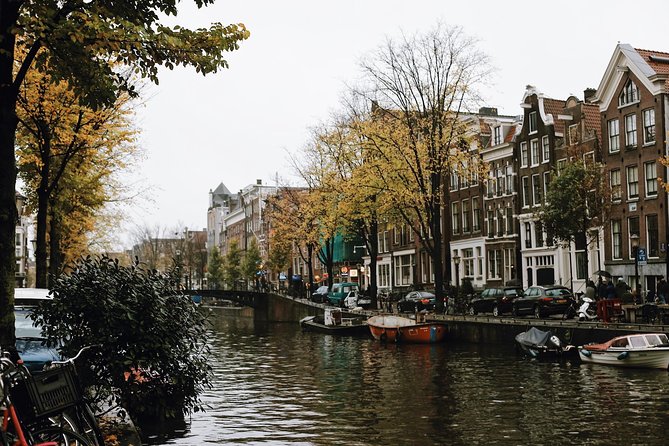
As you move toward the Jordaan, look up at the houses around Bloemgracht 87 to 91. The façades include carved gable stones with allegories and trade symbols. These small decorations once helped identify homes and businesses in a city where street numbers and written signs were not always enough.
The Karthuizerhof is the largest hofje in Amsterdam. It was built as almshouses around a quiet courtyard for poor and elderly residents. Hofjes are easy to miss if you rush through the city, so having a guide point one out is useful. The courtyard offers a calmer look at Amsterdam’s social history, away from the wealthy canal mansions.
Noorderkerk was built for the Jordaan in the 17th century. Its cross-shaped floor plan reflects new Protestant ideas about worship and community. The church is free to view from the outside, and the route allows about five minutes.
This final section shows a side of Amsterdam that grand squares cannot. You see practical charity, neighborhood religion, decorative house signs, and the compact streets that make the Jordaan feel different from the central commercial district.
Finishing with apple pie at Het Papeneiland
The walk ends at Het Papeneiland, a brown café dating from 1642, at Prinsengracht 2. It sits at one of the city’s prettiest canal corners and is said to serve Amsterdam’s best apple pie.
The café stop is a pleasant ending because it gives you a clear place to continue on your own. Food and drinks are not listed as included, so plan to pay separately if you stop inside. Even if you do not eat there, the location puts you in the Jordaan, a useful area for further wandering.
The start and finish are not at the same place. That is convenient if you want to keep exploring the Jordaan, but less convenient if you need to return quickly to a hotel near the station. Hotel pickup and drop-off are not provided, so use public transport, a taxi, or Uber as needed.
What the 62.48 dollar price really buys
At $62.48 per person, the value depends on how much you want from a guide. You are paying for a planned route, historical interpretation, local advice, and the ability to ask questions as you go. You are not paying for museum admissions, hotel transport, food, or a long interior visit.
For a private group, the price is easier to justify if you want personal attention. The guide can respond to your interests, explain a confusing point, or suggest what to see next. If you choose the save semi-private option, the exclusive guide promise does not apply, so check the exact booking choice carefully.
The tour is recommended by 100 percent of the 13 recorded ratings, with a five-star average. The most consistent praise is for clear history, pleasant company, and guides who keep the walk going even in difficult weather. Anita was praised for handling rain and wind while staying attentive to questions. Diana received credit for answering questions well, and Pedro was praised for keeping the history engaging.
The small number of ratings means you should treat the perfect score as encouraging, not as a guarantee. Still, the repeated focus on guide quality is important. For this route, the explanations are the main product.
Pace, weather, and practical limits
The walk lasts about two and a half hours and operates in all weather. Wear comfortable shoes and bring an umbrella if rain is possible. In summer, a hat and bottle of water make sense.
You need a moderate level of physical fitness. The route is on foot through central Amsterdam, with no promise of extended seated breaks. No large bags or suitcases are allowed, and increased security at some attractions means certain places cannot be entered.
National celebrations may change the route. The operator says an alternative route will still cover the highlights, but refunds or discounts are not offered for that change. Provide a mobile phone number with the country code when booking so the operator can contact you.
Free cancellation is available until 24 hours before the start time. Changes or cancellations inside that window are not accepted for a refund.
Who should choose this Amsterdam walk?
I would recommend it if you are visiting Amsterdam for the first time and want the city’s main stories connected in one sitting. It also suits you if you prefer history told in streets and courtyards rather than a full museum day.
Families, couples, and small groups who want a flexible conversation with a guide may get the most from the private format. It is also a good early-trip choice because the guide can point you toward later stops that match your interests.
I would choose another format if your priority is entering several attractions, spending time inside the Anne Frank House or Rembrandthuis, or moving at a slow photography pace. Twenty stops in 2.5 hours means you will see a lot, but you will not linger everywhere.
Should you book Amsterdam City Center & History?
Book this tour if you want a well-organized first look at Amsterdam with strong historical range and a guide who can make the city easier to read. The most valuable parts are the links between places: Catholic restoration, medieval sea defenses, merchant wealth, Protestant churches, WWII memory, and Jordaan charity.
Skip it if you dislike brisk walking or already have detailed plans for the same landmarks. If you do book, schedule it near the beginning of your stay, wear weatherproof shoes, and save time afterward for the Begijnhof, Rembrandthuis, Anne Frank House, or Het Papeneiland, depending on your interests.
FAQ
How long does the walking tour last?
The tour lasts approximately 2.5 hours.
Is the tour private?
It is a private activity in which only your group participates, unless you select the save semi-private option. The exclusive guide promise does not apply to that option.
Where does the tour begin?
The meeting point is Prins Hendrikkade 73, 1012 AD Amsterdam, Netherlands.
Where does the tour end?
The tour ends at Het Papeneiland, Prinsengracht 2, 1015 DV Amsterdam, Netherlands.
Are attraction admission fees included?
The guided walk is included, but admission is not included for several stops. Some locations are viewed from outside, and increased security may prevent interior visits.
What happens if it rains?
The tour runs in all weather. You should dress appropriately and bring comfortable shoes, a bottle of water, and an umbrella if rain is possible.
Just added in Amsterdam
- Private Tour Zaanse Schans Windmills and Volendam in Jaguar★ 5.0 · 10 reviews
- Zaanse Schans and Giethoorn Unique Day Trip with Boat Cruise★ 4.5 · 17 reviews
- Windmills-Volendam-Giethoorn Private Tour in Jaguar★ 5.0 · 2 reviews
- Half-Day Private Guided Sightseeing Tour of Zaanse Schans★ 5.0 · 14 reviews
- Best of Netherlands: Zaanse Schans Mills, The Hague & Rotterdam★ 4.5 · 10 reviews
- Zaanse Schans Private Tour Windmills★ 5.0 · 18 reviews
- Zaanse Schans Windmills Edam Volendam and Marken from Amsterdam★ 5.0 · 1 review
- Zaanse Schans Edam Volendam Private Day Tour from Amsterdam★ 5.0 · 3 reviews
Historical Tours, compared.
Amsterdam Food and Cultural Tour with Tastings
Read our review →
Kinderdijk UNESCO World Heritage Entry Ticket
Read our review →
Hop-on Hop-off Old-Fashioned Heritage Tram Tour
Read our review →


Amsterdam High-End Dutch Food & History Tour – Up to 8 guests
Read our review →
Cruise through the Historic City Center with Guide
Read our review →
Browse the lists this tour appears in