
Review · JEWISH HERITAGE & WWII TOURS
Amsterdam: Private World War Two History Walking Tour
History feels close in Amsterdam. This private walk links Nazi occupation sites with personal stories, wartime photographs, resistance memorials, and the fate of Jewish residents. I like the small group limit of four, which gives you room to ask questions, and I like the use of original photographs and a booklet naming Jewish residents from one Amsterdam street. The main consideration is that this is a serious, sometimes painful subject, and it does not include the Anne Frank House, the Resistance Museum, or the Hollandsche Schouwburg.
The walk lasts about three hours and begins at 9:30 a.m. outside the old Anne Frank House on Prinsengracht. Guide Peter Schaapman has earned especially warm praise for his clear explanations and exceptional stories, and the tour is led by retired historians who remain deeply engaged with this period. At $188 per private group of up to four, it is a strong value for a full group, but less so if you are booking alone or as a couple.
In This Review
- Key points to know before you book
- Starting at Prinsengracht 263, not entering Anne Frank House
- Seeing the German army enter Amsterdam
- Dam Square and the shooting incident of May 7, 1945
- Resistance photographs at the places they document
- Jewish deportations, Auschwitz, and Sobibor
- The statue of the violin player from Auschwitz
- Hunger winter and the struggle for food
- A three-hour walk with a personal pace
- Why four people changes the value
- What Peter Schaapman adds to the walk
- What this tour does not cover
- Who will appreciate this Amsterdam history walk?
- Should you book this tour?
- FAQ
- Where does the tour begin?
- Does the tour include the Anne Frank House?
- How long does the walking tour last?
- What language is the tour in?
- How many people can join the private group?
- Is the tour wheelchair accessible?
Key points to know before you book
- A maximum of four people means this feels like a conversation rather than a standard group tour.
- Peter Schaapman and fellow retired historians bring years of study and a personal passion for Amsterdam during the German occupation.
- Original resistance photographs are shown at the places where the events happened, giving the streets a second layer.
- A small booklet names Jewish residents from one Amsterdam street, including the camps where they died.
- The tour covers May 7, 1945, on Dam Square, including the shooting incident that took place after liberation celebrations had begun.
- A coffee and restroom stop comes halfway through, but drinks and food are at your own cost.
Starting at Prinsengracht 263, not entering Anne Frank House
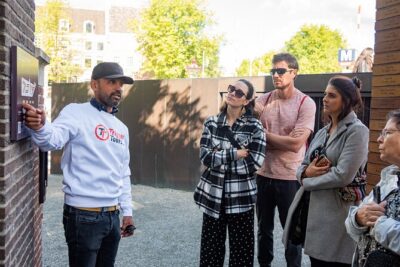
You meet at 9:30 a.m. in front of the old Anne Frank House at Prinsengracht 263. Look for the guide holding a large notebook and a sign marked Anne Frank Huis. The meeting point is between the museum and the Lunch Cafe, and touching the number plate 263 is the simplest way to confirm you are in the right place.
This location is useful because it is easy to identify, but it can also cause confusion. The tour does not include entry to the Anne Frank House. You begin outside and then move into a wider story about Amsterdam under German occupation from 1940 to 1945.
That distinction matters when you plan your day. If you have a separate Anne Frank House reservation, allow enough time between activities. This walk is a history tour on Amsterdam’s streets, not a museum visit with an indoor exhibition.
The start also sets the tone. You are not simply being shown attractive canals and old façades. The guide uses the city itself as the setting, pointing out where events took place and explaining how ordinary streets became part of the occupation, resistance, deportation, and liberation story.
More History Tours in Amsterdam
- Amsterdam Food and Cultural Tour with Tastings
★ 5.0 · 2,442 reviews - Amsterdam: Haunted History and Ghost Walking Tour
★ 4.5 · 488 reviews - Amsterdam High-End Dutch Food & History Tour – Up to 8 guests
★ 5.0 · 482 reviews
Seeing the German army enter Amsterdam
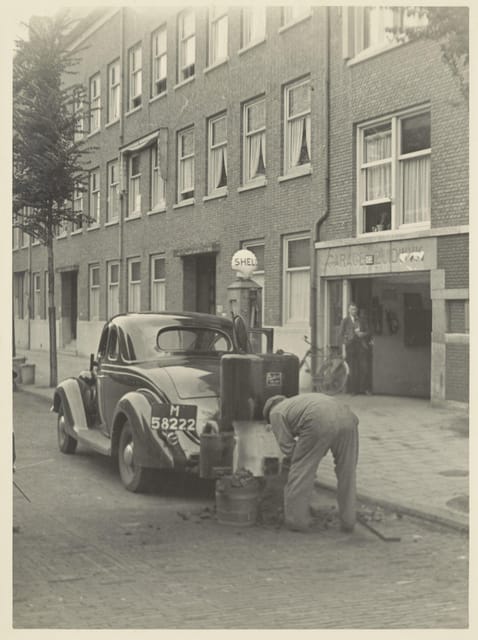
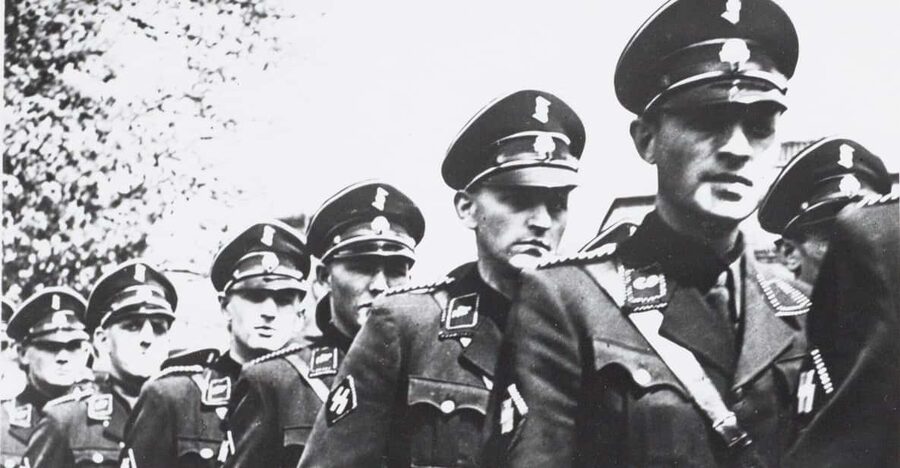
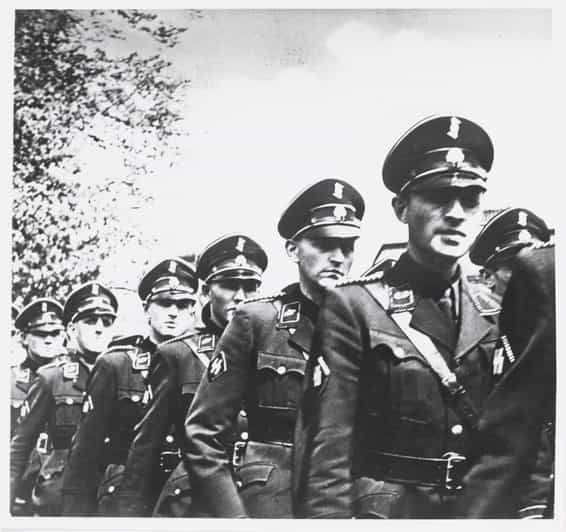
One of the early subjects is the entry of the German army, the Wehrmacht, into Amsterdam. The guide uses preserved photographs to help you picture the event rather than treating it as a date in a textbook.
A photograph can change how you read a familiar square or building. The same streets that now carry bicycles, trams, and shoppers once held crowds watching the German arrival. The guides connect those images with the buildings still around you, including the former town hall, now the Grand hotel.
The former town hall is especially useful as a lesson in changing public mood. You see images connected with the welcoming of the German army at that location, then hear about the later cheering for the Canadian army. The point is not to reduce the occupation to a simple before-and-after story. It shows how public spaces can carry sharply different memories within a few years.
I appreciate this approach because it keeps the history tied to real places. You do not need to remember every political detail to understand the emotional shift. A photograph shown where the event happened can make the guide’s explanation more concrete.
Dam Square and the shooting incident of May 7, 1945
Dam Square is one of the key stops. The tour discusses the shooting incident of May 7, 1945, after the German occupation had ended and celebrations were taking place.
The date is important because it complicates the usual liberation story. The war in Amsterdam was not emotionally tidy the moment the Canadians arrived. The guide explains what happened at the square and places the incident within the tense days surrounding the end of the occupation.
This is the kind of detail that makes the walk worthwhile for history-minded visitors. You may pass Dam Square several times during an Amsterdam stay and see only the Royal Palace, the National Monument, crowds, and street activity. The tour asks you to look again, this time at the square as a place marked by fear, relief, celebration, and violence.
The guide’s photographs and spoken account are central here. There is no audio system and no scripted narration coming through headphones. You stand together, ask questions, and receive the explanation directly from the guide.
Resistance photographs at the places they document
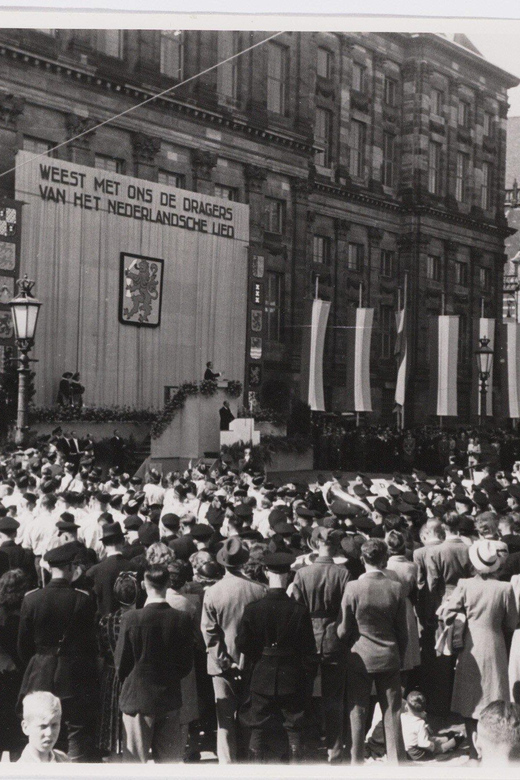
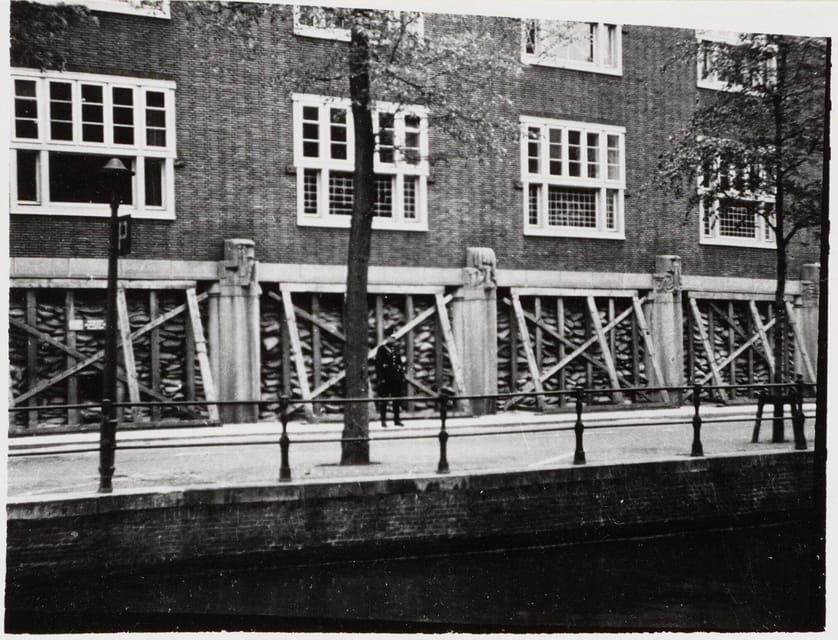
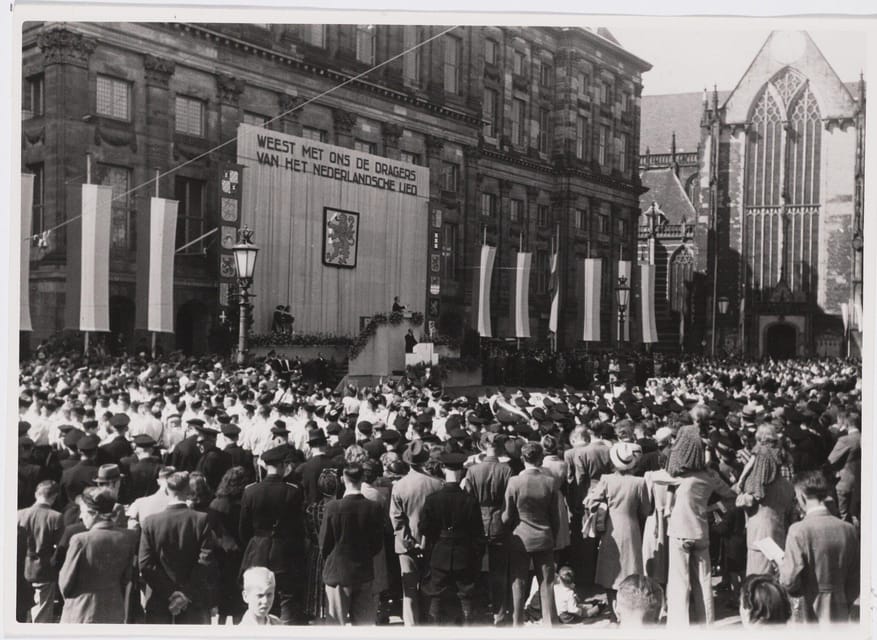
The Dutch resistance preserved many photographs from the occupation. Several are shown during the walk at the locations where the scenes took place.
This is one of the strongest parts of the experience. A photograph in a museum already has value, but a photograph held up beside the actual building or square gives you an immediate comparison. You can study what has changed and what remains.
The guides also explain the background of the pictures, including the circumstances around the German arrival and the later liberation. This makes the images more than visual decoration. They become evidence that helps you understand how people in Amsterdam saw and recorded the war.
Because the group is so small, you can stop to ask about details that catch your attention. If you are interested in how resistance members documented events, this personal format should suit you better than a large walk where the guide needs to keep moving.
There is a limit, too. This is a walking route through public places, so the amount of time at each location depends on the guide, the group’s pace, and the questions that come up. If you prefer a tightly timed itinerary with a fixed number of stops, the flexible style may feel less predictable.
More Walking Tours in Amsterdam
- Anne Frank’s Story – Guided Walking Tour through Amsterdam
★ 5.0 · 11,619 reviews - Amsterdam: Life of Anne Frank and World War II Walking Tour
★ 4.8 · 10,467 reviews - Absolutely Amsterdam – the Essential Introductory Walking Tour
★ 5.0 · 3,629 reviews - Amsterdam: Anne Frank Guided Small Group Walking Tour
★ 4.8 · 2,722 reviews
Jewish deportations, Auschwitz, and Sobibor
The most painful section concerns the deportation of Amsterdam’s Jewish population and the fate of those sent to extermination camps, including Auschwitz and Sobibor.
The guides have selected the Jewish residents of one Amsterdam street and assembled a small book with their names, photographs, and information about the camps where they died. This gives the story a human scale. Instead of hearing only a broad number, you encounter a street and the people who lived there.
The booklet is also something you can keep. That makes it more than a passing explanation during a walk. You can read it again later, though the material is difficult and should be approached with care.
The wording of the experience is specific: the book focuses on one street, not every Jewish victim in Amsterdam. That focus is a strength because it allows the guide to tell individual stories with greater care. It is also important to set expectations. This is not a complete memorial record of the city’s Jewish population, nor does the walk replace a museum visit.
You will hear about Auschwitz and Sobibor as part of the deportation story. The tour does not include entry to the Hollandsche Schouwburg, the former deportation center, so you should visit that site separately if it is a priority for you.
The statue of the violin player from Auschwitz
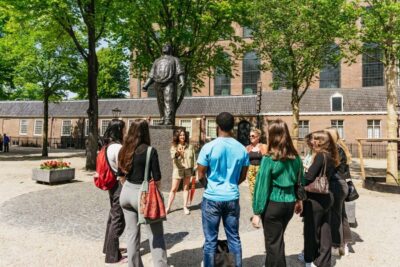
Another stop features a statue of the famous violin player from Auschwitz. The information provided for the tour does not identify the figure by name, so you should ask the guide about the person and the meaning of the monument when you arrive.
This stop adds a personal and artistic element to an otherwise site-based route. Monuments can sometimes become easy to pass without thought, especially in a city full of statues and plaques. A guide who explains the story behind one can help you see why it was placed there and what memory it carries.
The violin player’s connection with Auschwitz also links the local Amsterdam story to the wider system of persecution and extermination. The walk does not treat the camps as distant facts. It connects them to residents, streets, photographs, and memorials in the Dutch capital.
Hunger winter and the struggle for food
The tour also addresses food dropping during the winter of hunger. This subject brings the occupation into daily life: shortages, hunger, and the practical struggle to survive.
The topic helps balance the political and military story. You hear not only about armies, deportations, and resistance, but also about what people needed from day to day. The food drops offer a way to understand the relief that came to civilians during a bleak period.
Do not expect a food tasting or a themed meal. The tour discusses the subject as part of the historical route. A short break halfway through gives you the chance to buy coffee or something to eat, perhaps even a late breakfast. Refreshments are not included, so carry a payment method and plan for that small extra cost.
A three-hour walk with a personal pace
The advertised duration is about three hours, though it may run a little longer. That flexibility can be welcome on a serious history walk. You are not rushed from one point to the next, and the guide can give fuller answers when the group has questions.
The walk is conducted in English. The guides do not use an audio system because they prefer direct conversation. I see that as a clear advantage for a private group. You can hear the guide without competing with a large crowd, and you can ask for clarification immediately.
The pace is set with the group in mind. A wheelchair user can take part, but it is wise to contact the provider in advance so the route and coffee stop can be considered. The experience is described as wheelchair accessible, but Amsterdam’s streets and canal-side routes can vary, so advance communication is sensible rather than optional planning.
Bring an umbrella. Amsterdam weather can change quickly, and the tour takes place outdoors for several hours. Comfortable walking shoes are also a practical choice, even though they are not specifically listed among the required items.
Why four people changes the value
The $188 price covers a private group of up to four people, not four separate tickets. For four people, that works out to $47 per person. For three, it is about $63 each, and for two, it is $94 each. A solo booking would carry the full group price, making this most attractive to a family or small party.
The value comes from the format. You receive personal attention, printed information to keep, a flexible walking pace, and access to guides who focus on this particular period of Amsterdam’s past. You are paying for a private conversation with a historian rather than a general sightseeing walk.
The price is harder to justify if you want a broad overview of Amsterdam or prefer to spend most of your day inside museums. It is also not the right choice if your main goal is Anne Frank House entry, since admission there is not part of the experience.
For a group already interested in wartime history, the cost can be reasonable. You get three hours, a maximum of four participants, and a route designed around occupation sites rather than a standard city highlights circuit.
What Peter Schaapman adds to the walk
Peter Schaapman is the guide specifically named in the feedback, and his work receives particularly strong praise. He is described as excellent, with extensive knowledge and exceptional stories. Another assessment calls the walk with Peter wonderful and says he was very informed and interesting.
That praise points to the quality you should hope for from this experience: not just facts, but stories that explain why a place matters. The tour is operated by three retired historians with a passion for the German occupation. Their background suggests a serious, focused approach rather than a light historical aside added to a sightseeing route.
The guide’s personality will still shape your experience. Private tours can be rewarding because they adapt to your questions, but they also mean the guide and group dynamic matter more. The available feedback is very positive, including a French-speaking comment calling the guide incredible, though the tour language is listed as English.
What this tour does not cover
The exclusions are important. You do not enter:
- The Anne Frank House
- The Resistance Museum
- The Hollandsche Schouwburg
Tickets for those places are not included, and drinks during the coffee stop are also extra.
This does not weaken the tour, but it defines its purpose. You are getting a street-based history walk with photographs, monuments, stories, and printed material. If you want interiors, exhibitions, or a larger collection of wartime objects, add one or more of those museums to your Amsterdam plans separately.
I would not book this expecting a substitute for the Anne Frank House. I would book it because it adds places and stories that a museum visit alone cannot provide, especially the Dam Square incident, the food drops, the former town hall photographs, and the street-by-street Jewish history.
Who will appreciate this Amsterdam history walk?
I would recommend it most strongly to:
- People with a serious interest in World War Two
- Visitors who prefer small private tours
- Families or friends who can share the $188 group price
- Repeat visitors who have already seen Amsterdam’s main sights
- Anyone who wants to ask detailed questions at their own pace
- Visitors looking for a more difficult and reflective subject than ordinary sightseeing
It may not suit young children, visitors who dislike emotionally heavy material, or anyone wanting a relaxed introduction to Amsterdam’s canals and architecture. The tour is focused, and its subject includes deportation, extermination camps, hunger, and wartime violence.
The private format does make it easier to adjust the pace. You can ask the guide to explain a point more fully, and the walk can accommodate a wheelchair with advance planning. Still, the content remains serious even if the physical pace is comfortable.
Should you book this tour?
Book it if you want to understand Amsterdam through the years of German occupation, and if you value a guide who can connect photographs and personal names with the streets around you. The small group, printed booklet, and direct access to retired historians give it more substance than a general city walk.
I would especially choose it for a group of four. At $47 each, the price feels fair for three hours of private guiding. Couples should consider the higher per-person cost, then decide if the personal format and focused subject are worth it.
Do not book it as an Anne Frank House visit or a complete tour of Amsterdam’s wartime museums. Book it as a careful, outdoor history lesson that adds context to those places. Start with an umbrella, arrive at Prinsengracht 263 before 9:30 a.m., and prepare for a thoughtful morning rather than a cheerful sightseeing stroll.
FAQ
Where does the tour begin?
It begins at 9:30 a.m. in front of the old Anne Frank House at Prinsengracht 263, between the museum and the Lunch Cafe. The guide holds a large notebook and a sign marked Anne Frank Huis.
Does the tour include the Anne Frank House?
No. The tour starts outside the old Anne Frank House but does not include entry. Admission to the Anne Frank House, the Resistance Museum, and the Hollandsche Schouwburg is not included.
How long does the walking tour last?
The walk lasts about three hours and may run a little longer. A short coffee and restroom break is planned around the halfway point.
What language is the tour in?
The live tour is given in English.
How many people can join the private group?
The group never includes more than four people.
Is the tour wheelchair accessible?
Yes, the tour can accommodate a wheelchair. You should email the provider in advance so the route and coffee stop can be planned appropriately.
More Jewish Heritage and Wartime Walks in Amsterdam
- Anne Frank Walking Tour Amsterdam Including Jewish Cultural Quarter
★ 5.0 · 1,879 reviews - Amsterdam: Dutch WWII Resistance Museum Entry Ticket
★ 4.7 · 951 reviews - Anne Frank and Jewish Quarter Amsterdam Private Walking Tour
★ 5.0 · 684 reviews - Amsterdam: Anne Frank and Jewish Quarter Tour
★ 4.7 · 434 reviews
Just added in Amsterdam
- Private Tour Zaanse Schans Windmills and Volendam in Jaguar★ 5.0 · 10 reviews
- Zaanse Schans and Giethoorn Unique Day Trip with Boat Cruise★ 4.5 · 17 reviews
- Windmills-Volendam-Giethoorn Private Tour in Jaguar★ 5.0 · 2 reviews
- Half-Day Private Guided Sightseeing Tour of Zaanse Schans★ 5.0 · 14 reviews
- Best of Netherlands: Zaanse Schans Mills, The Hague & Rotterdam★ 4.5 · 10 reviews
- Zaanse Schans Private Tour Windmills★ 5.0 · 18 reviews
- Zaanse Schans Windmills Edam Volendam and Marken from Amsterdam★ 5.0 · 1 review
- Zaanse Schans Edam Volendam Private Day Tour from Amsterdam★ 5.0 · 3 reviews
Jewish Heritage & WWII Tours, compared.
Life of Anne Frank and World War II Walking Tour
Read our review →
Anne Frank Walking Tour Amsterdam Including Jewish Cultural Quarter
Read our review →
Oranjehotel World War II Prison Entrance Ticket
Read our review →
Anne Frank and Jewish Quarter Amsterdam Private Walking Tour
Read our review →
Anne Frank and Jewish Quarter Walking Tour (TOP RATED)
Read our review →
Browse the lists this tour appears in