
Review · HISTORICAL TOURS
Historical Walking Tour, private with local Dutch guide
Amsterdam makes its past easy to miss. This private walk brings it forward through medieval towers, old dikes, Golden Age canals, and the Jordaan. I especially like the one-to-one format and Anna’s ability to adjust the pace and subject matter to your group. The main tradeoff is simple: you will be on your feet for about two hours, with no mobility aids available.
You begin near Amsterdam Centraal and finish by Westerkerk and the Anne Frank House. That route gives you a useful first look at the old center, but the tour is not designed for travelers who want long indoor visits or a slow, seated outing. It is a walking introduction, guided in English by a local who has lived in Amsterdam for 25 years.
In This Review
- Key points at a glance
- Why this works well as your first Amsterdam activity
- Meet the Weeping Tower and trace Amsterdam’s beginning
- Zeedijk and The Waag: Amsterdam as a defended water town
- Oostindisch Huis and the business behind Amsterdam’s wealth
- The smallest house and the symbols of the old city
- Dam Square connects royal power and public memory
- The canal ring reveals the Golden Age city
- Jordaan trades grand canals for local character
- Westerkerk gives the walk a thoughtful ending
- Anna’s guiding style and the value of a private tour
- Price, timing, and who gets the best value
- Should you book the Historical Walking Tour?
- FAQ
- How long is the historical walking tour?
- Where does the tour begin?
- Where does the tour end?
- Is the tour private?
- What language is the tour offered in?
- Are admission tickets included?
- Is the tour suitable for people with limited mobility?
Key points at a glance
- A private first-day orientation: Your guide can shape the walk around your questions, interests, and pace.
- Nine central Amsterdam stops: The route links the Weeping Tower, Zeedijk, The Waag, Dam Square, the canal ring, Jordaan, and Westerkerk.
- A local guide with 25 years in the city: Anna brings dry humor, practical suggestions, and a personal feel to the tour.
- More than postcard Amsterdam: You hear about trade, architecture, Jewish history, shipbuilders, guilds, artists, and daily city life.
- A useful finish near major sights: The tour ends close to Westerkerk and the Anne Frank House, making it easy to continue exploring.
- A firm walking requirement: The experience is not recommended for people who struggle to walk or stand for two hours or who use a walker.
Why this works well as your first Amsterdam activity
I like starting with a city walk before booking museums or canal cruises. Amsterdam can feel confusing at first because canals, bridges, bike lanes, narrow streets, and old districts all overlap. A local guide helps you understand how the pieces fit together instead of leaving you with a collection of attractive but disconnected views.
This route also gives you useful context for later sightseeing. After hearing about the city’s dikes and early trade, you will look at the canal houses differently. After learning about Amsterdam’s merchants and the Dutch East India Company, the grand facades along the water carry more meaning.
The private setup matters. Your group is the only group on the tour, so you can ask why a building looks a certain way, pause for a snack, or spend more time on a subject that interests you. Anna is praised for handling changes in dates, times, and group size with good humor, and for making the walk feel personal rather than scripted.
Her style also seems to suit people who enjoy a dry joke along with their facts. She explains Amsterdam’s past in clear English and keeps the tone light enough that even a jet-lagged arrival day does not have to feel like school.
More History Tours in Amsterdam
- Amsterdam Food and Cultural Tour with Tastings
★ 5.0 · 2,442 reviews - Amsterdam: Haunted History and Ghost Walking Tour
★ 4.5 · 488 reviews - Amsterdam High-End Dutch Food & History Tour – Up to 8 guests
★ 5.0 · 482 reviews
Meet the Weeping Tower and trace Amsterdam’s beginning
The walk starts at Café the Schreiertower, at Prins Hendrikkade 95. Your meeting point is beside the Weeping Tower, one of the city’s few remaining medieval watchtowers and a useful place to begin a story about Amsterdam.
Here, Anna introduces the city’s origins and explains the early geographical and navigational setting. This opening is brief, about five minutes, but it gives you a frame for everything that follows. Amsterdam was not simply laid out as a pretty collection of canals. Water, defense, trade, and control shaped its growth.
The meeting point is near public transportation, which helps if you are arriving from Amsterdam Centraal or another part of the city. Because the tour begins outdoors, dress for changing weather and wear shoes you can use comfortably on city streets. Bottled water is not included, so bring your own.
Zeedijk and The Waag: Amsterdam as a defended water town
The next stop is Zeedijk, one of Amsterdam’s oldest streets. Its name refers to its role as a sea dike, with locks that helped protect the settlement from flooding.
This is a small stop, listed at about five minutes, but it is one of the most useful for understanding Amsterdam. The city’s waterways are not just decorative. They are part of the reason the town developed as it did, and they explain why streets, canals, and defenses often seem to follow practical rather than tidy patterns.
From there, you reach The Waag. This medieval city gate once formed part of a defensive wall and moat system. Today, it is easy to see it as an impressive old building in the middle of a lively district. Your guide helps you picture its earlier role and links the building to the city’s changing needs.
The route moves quickly at first, with several short stops. That suits you if you prefer a broad picture before spending time in the canal ring and Jordaan. If you want long examinations of individual buildings, you should tell your guide early, since the listed timing allows only a few minutes at these first sites.
Oostindisch Huis and the business behind Amsterdam’s wealth
At Oostindisch Huis, the focus shifts from defense to commerce. This former office and warehouse of the Dutch East India Company was founded in 1602, and it opens a discussion about the spice trade, the modern corporation, and the early stock market.
This is one of the tour’s strongest historical stops because it connects a building in central Amsterdam to larger changes in business and global trade. You do not just see a handsome old office. You learn how merchants organized long-distance trade and how financial ideas helped shape the city.
The subject also adds balance to the pretty canal views. Amsterdam’s Golden Age wealth did not appear by magic. It grew from trade, shipping, finance, labor, and overseas activity. A good guide can explain that without turning the walk into a lecture, and Anna’s style is described as clear, humorous, and full of vivid stories.
If economic history is not usually your thing, this is still worth your attention. The basic question is practical: how did Amsterdam become prosperous enough to build its grand houses and canal ring? Oostindisch Huis begins to answer it.
More Walking Tours in Amsterdam
- Anne Frank’s Story – Guided Walking Tour through Amsterdam
★ 5.0 · 11,619 reviews - Amsterdam: Life of Anne Frank and World War II Walking Tour
★ 4.8 · 10,467 reviews - Absolutely Amsterdam – the Essential Introductory Walking Tour
★ 5.0 · 3,629 reviews - Amsterdam: Anne Frank Guided Small Group Walking Tour
★ 4.8 · 2,722 reviews
The smallest house and the symbols of the old city
Het Kleinste Huis van Amsterdam provides a lighter change of pace. You stop at the city’s smallest house, which once stood beside a gate decorated with Amsterdam’s crest and other symbolic designs.
The stop takes only about five minutes, so do not expect an interior visit or a long architectural study. Its value is in the story and the scale. Amsterdam is famous for large merchant houses, but this tiny building reminds you that the old city was made up of many different homes, workplaces, and narrow plots.
This is also the sort of detail that is easy to pass without a guide. You might notice the unusual proportions, take a photo, and move on. With Anna, the small building becomes part of the larger story about space, status, and the city’s changing form.
Dam Square connects royal power and public memory
Dam Square is the old market square and the historic heart of Amsterdam. The Royal Palace occupies one side, while the national Second World War monument gives the square a more serious purpose.
The planned stop is about ten minutes, long enough to orient yourself and discuss the square’s roles over time. It is a good place to connect commerce, government, public ceremony, and memory.
Dam Square can be crowded and visually demanding, so having a guide is useful. Instead of simply seeing a palace and a monument, you learn why this open space matters to the city. The guide can also help you get your bearings before the route turns toward the canal ring.
The square is one of the tour’s more familiar sights, but the private format keeps it from feeling like a quick checklist. If your group wants to ask about the Royal Palace, the monument, or Amsterdam’s public life, this is a natural point to do so.
The canal ring reveals the Golden Age city
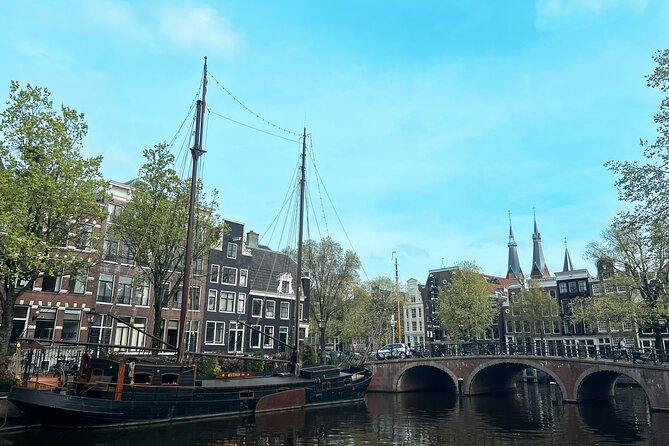
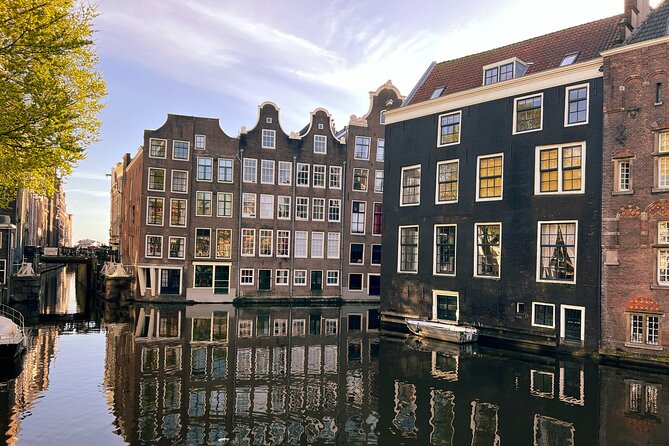
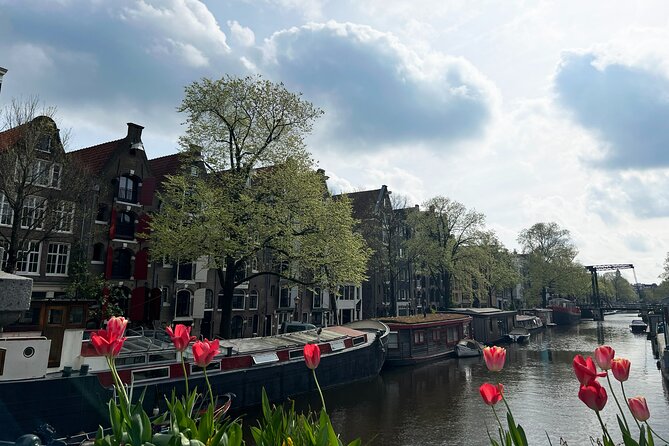
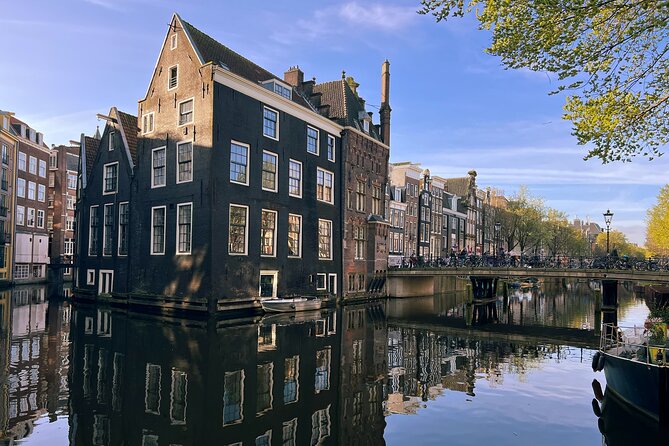
The canal ring is the longest major section of the walk, at about 30 minutes. Built for wealthy merchants during the Golden Age, it gives you a chance to see the canal houses, their narrow facades, and the many houseboats that now form part of Amsterdam’s identity.
This is where the route becomes especially visual. You will see northern baroque architecture along the water and a wide range of houseboat styles. The guide’s role is not just to point out attractive views. She explains how the canals relate to merchant wealth, urban planning, and the city’s growth.
I like this section because it helps you read Amsterdam’s streets. Facades, rooflines, doorways, and canal positions stop being background scenery. They become clues about who built the house, how the city expanded, and how water remained central to daily life.
The houseboats add a modern layer. They are not simply charming photo subjects. They show how Amsterdam continues to adapt old waterways to present-day housing and city life. The tour information does not promise entry into a houseboat, so expect to view them from the street and canal edges.
A private tour is especially useful here because you can ask for recommendations afterward. Anna has offered ideas for exploring Amsterdam beyond the walk, and that advice can help you decide which canals, neighborhoods, or museums deserve your limited time.
Jordaan trades grand canals for local character
The Jordaan receives another 30 minutes, making it equal in length to the canal ring. This popular neighborhood is known for picturesque streets, traditional brown cafes, and independent boutiques.
The change in mood is part of the route’s appeal. The canal ring shows the city’s merchant wealth and planned expansion. Jordaan feels more intimate, with smaller streets and a neighborhood identity that is easier to sense on foot.
You will not simply be shown a list of shops. The guide connects the area to Amsterdam’s culture and daily life, then leaves you with practical ideas for a later visit. If you enjoy cafes, local stores, and wandering without a strict schedule, Jordaan may become the part of the route you want to revisit.
The timing is generous enough for questions and pauses, but it is still a walking tour, not a shopping excursion. Any snack stop depends on the pace and interests of your group. One group appreciated that Anna made time for snacks during a longer personalized walk, so you can ask if a brief food break would fit your schedule.
Westerkerk gives the walk a thoughtful ending
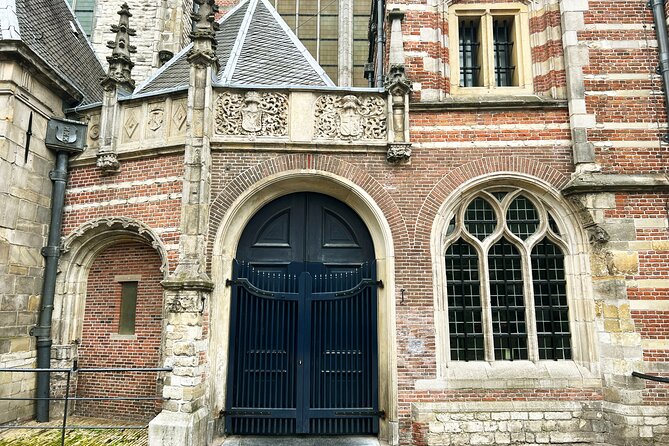
The final stop is Westerkerk, a Dutch Protestant church recognized for its design and distinctive spire. It is described as a landmark especially loved by local residents, and the walk ends nearby at Prinsengracht 279.
The location is practical. You finish close to the Anne Frank House and Westerkerk church, so you can continue sightseeing in the area after saying goodbye. Keep in mind that this tour does not include admission to the Anne Frank House, Westerkerk, the Royal Palace, or other interiors. The listed stops are outdoor visits with explanations from your guide.
Ending here also gives the route a nice sense of movement. You begin at a medieval watchtower near the old entrance to the city and finish among the famous canals of the western center. Along the way, you move through defense, trade, royal power, architecture, neighborhood life, and public memory.
Anna’s guiding style and the value of a private tour
The strongest reason to book this experience is the guide. Anna is described as engaging, easy to communicate with, well informed, and able to answer questions with clarity. She uses humor without losing the thread of the story, which is a useful skill on a history walk.
She also adapts. One group had several changes involving the date, time, and number of people, and Anna handled those adjustments cheerfully. During the walk, she kept the pace comfortable while still making sure the main route was completed.
That flexibility is harder to get on a large group tour. With a private booking, you can say that you want more architecture, more Jewish history, more local culture, or more background on Amsterdam’s trade. Anna has also added personal stops and discussed Amsterdam’s Jewish past beyond the Anne Frank House for groups interested in that subject.
The 23 available ratings give the experience a five-star score, with 100 percent recommending it. The praise centers on the same themes: clear communication before the tour, strong historical storytelling, personal attention, humor, and helpful suggestions for the rest of a stay.
Price, timing, and who gets the best value
At $96.02 per person, this is not the cheapest way to see Amsterdam. The price makes more sense if you are traveling as a small private group and value a guide who can tailor the walk instead of following a fixed speech for strangers.
For two people, the total cost is substantial. For a larger group, group discounts may improve the value, and the private format means the guide’s attention is reserved for your party. You are paying for interpretation and flexibility rather than entrance tickets, since the stops are listed as free and all fees and taxes are included.
The advertised duration is about two hours. One personalized outing lasted three hours, so the exact length can vary when the group asks questions, takes snack breaks, or follows a more tailored route. Plan for at least two hours and avoid scheduling another fixed activity immediately afterward.
The walk is best for first-time visitors, couples, families with older children, and small groups who want a city orientation. It also suits people who prefer historical context over a fast photo stop. You should choose something else if you have trouble walking or standing for two hours, use a walker, or need mobility equipment, since aids are not available and service animals are the only animals specifically noted as welcome.
Free cancellation is available if you cancel at least 24 hours before the start time. Changes or cancellations inside that window are not accepted for a refund, so check your plans before the cut-off.
Should you book the Historical Walking Tour?
Book it if you want Amsterdam to make sense before you tackle its museums and famous sights. The route covers a lot in a short time, and the private setting gives you room to ask questions, adjust the emphasis, and get suggestions for the rest of your visit.
I would especially choose it for an arrival day, when you need to understand the city quickly, or for a return visit when you want more than the usual canal photographs. Anna’s personal approach, dry wit, and local perspective are the main reasons this walk earns its price.
Skip it if you want interior access, a seated experience, or a very slow architectural tour. For everyone else, this is a practical, human introduction to Amsterdam, with enough history to sharpen your eyes and enough neighborhood life to keep the city from feeling like a museum.
FAQ
How long is the historical walking tour?
The tour lasts approximately two hours. A personalized outing can run longer if the group adds questions, pauses, or extra stops.
Where does the tour begin?
It begins at Café the Schreiertower, Prins Hendrikkade 95, 1012 AE Amsterdam, beside the Weeping Tower.
Where does the tour end?
The tour ends at Westerkerk, Prinsengracht 279, 1016 DL Amsterdam, near the Anne Frank House and Westerkerk church.
Is the tour private?
Yes. Only your group participates in the activity.
What language is the tour offered in?
The tour is offered in English.
Are admission tickets included?
The listed stops have no admission charge, and all fees and taxes are included. The experience does not list admission to the Anne Frank House, Westerkerk, or the Royal Palace.
Is the tour suitable for people with limited mobility?
It is not recommended for people who have trouble walking or standing for two hours or who use a walker. Mobility aids are not available, although service animals are welcome.
Just added in Amsterdam
- Private Tour Zaanse Schans Windmills and Volendam in Jaguar★ 5.0 · 10 reviews
- Zaanse Schans and Giethoorn Unique Day Trip with Boat Cruise★ 4.5 · 17 reviews
- Windmills-Volendam-Giethoorn Private Tour in Jaguar★ 5.0 · 2 reviews
- Half-Day Private Guided Sightseeing Tour of Zaanse Schans★ 5.0 · 14 reviews
- Best of Netherlands: Zaanse Schans Mills, The Hague & Rotterdam★ 4.5 · 10 reviews
- Zaanse Schans Private Tour Windmills★ 5.0 · 18 reviews
- Zaanse Schans Windmills Edam Volendam and Marken from Amsterdam★ 5.0 · 1 review
- Half Day Keukenhof Tulip Paradise Trip from Amsterdam★ 5.0 · 1 review
Historical Tours, compared.
Amsterdam Food and Cultural Tour with Tastings
Read our review →
Kinderdijk UNESCO World Heritage Entry Ticket
Read our review →
Hop-on Hop-off Old-Fashioned Heritage Tram Tour
Read our review →


Amsterdam High-End Dutch Food & History Tour – Up to 8 guests
Read our review →
Cruise through the Historic City Center with Guide
Read our review →
Browse the lists this tour appears in