
Review · WALKING TOURS
Rotterdam Travel to the Future Walking Tour
Rotterdam rewards curious walkers. This three-hour tour links rooftop farms, bold buildings, public art, old city ruins, and the wide views around Erasmus Bridge. I like the way it looks beyond the famous postcard sights, and I like that a private guide can adjust the pace and explain why the city keeps experimenting with public space. The main drawback is the price: at $274.03 per person, it is expensive for a three-hour walk, especially for a couple or solo visitor.
You will cover a lot of ground, so comfortable shoes matter. The route begins near Ode aan Marten Toonder and finishes at Erasmusbrug. I would choose it early in a Rotterdam visit because it helps you understand the city before you explore on your own. If you are mainly after museum interiors or a long stop for food, this is not that kind of tour.
In This Review
- Key points before you book
- Why this walk makes sense in Rotterdam
- Yellow streets and rooftop farming
- Street art that asks you to stop
- Laurenskerk and the city that survived
- Markthal, MVRDV, and lunch without a fixed menu
- Erasmus Bridge and OMA’s city views
- Cube Houses and the logic of tilted homes
- What the price means for your group
- Practical details for a smoother walk
- Who will enjoy this Rotterdam walk?
- Should you book the Travel to the Future Walking Tour?
- FAQ
- How long is the Rotterdam Travel to the Future Walking Tour?
- What language is the tour offered in?
- Is this a private tour?
- Where does the tour start?
- Where does the tour finish?
- Is food included at Markthal?
- Are entrance tickets included?
- Can I cancel for a full refund?
Key points before you book
- Private three-hour format: Only your group takes part, giving you a more personal walk than a large scheduled group.
- Future-facing Rotterdam: See projects such as the yellow De Luchtsingel, DakAkker rooftop farm, and other creative public spaces.
- Art with a story: Street sculptures and graffiti are treated as part of the city’s social story, not just background decoration.
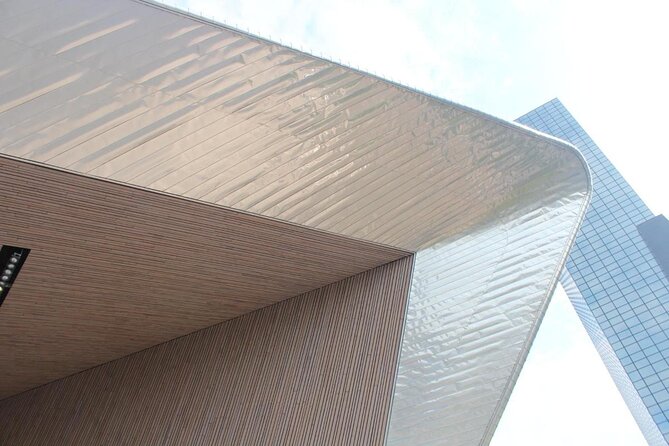
- Old and new in one route: The Laurenskerk and old city area provide a useful contrast to the Cube Houses and Markthal.
- Food stop with freedom to browse: Markthal gives you time to look at Dutch cheese, herring, truffle sausages, wine, and other foods, though purchases are your responsibility.
- Strong guide element: Danya, also referred to as Danil or Daniel in tour material, has been praised for clear storytelling, local insight, and keeping children interested.
Why this walk makes sense in Rotterdam
Rotterdam can feel puzzling at first. Much of the central city was rebuilt after the Second World War, so it does not offer the continuous old-world streets found in Amsterdam, Delft, or Leiden. Instead, its identity comes from rebuilding, testing new ideas, and giving architects room to take risks.
That is the central idea of this tour. You are not simply moving from one attraction to the next. You are looking at how a city uses bridges, markets, rooftops, housing, art, and gardens to change how people live.
I especially like the private format here. You can ask why a building looks the way it does, stop for a photograph, or spend more time on a topic that catches your attention. Families also have a good reason to consider it. The tour has kept both young children and teenagers interested, which is no small achievement on a walking route focused partly on architecture.
The guide matters greatly. Danya has been praised for making Rotterdam understandable without burying you in dates. Stories about wartime destruction, local character, street art, and current city life give the buildings a human side.
More Walking Tours in Rotterdam
- Rotterdam: Architectural Highlights Guided Walking Tour
★ 4.8 · 215 reviews - Rotterdam Walk: Hilights, Gems, Architecture & WWII | 2 or 3hrs
★ 5.0 · 149 reviews - Rotterdam: Highlights & Gems Walking Tour with Dutch Local
★ 5.0 · 133 reviews
Yellow streets and rooftop farming
The first section focuses on innovative public spaces. One of the most memorable features is De Luchtsingel, a bright yellow wooden footbridge that connects central Rotterdam with the northern part of the city. Its color is hard to miss, and its purpose is practical: it links areas that were once separated by roads, rail lines, and underused spaces.
The bridge runs for about 390 meters. It was designed by the Rotterdam firm ZUS and supported by the city. Local crowdfunding also helped pay for it, giving the project a useful lesson in civic participation. You see how a small public connection can help bring activity to an area that once felt neglected.
The walk may also include street art and a red car breaking through a wall, an image connected to breaking down barriers between neighborhoods. The point is not only to admire the paint. You learn how public art can send a social message and help change the mood of a place.
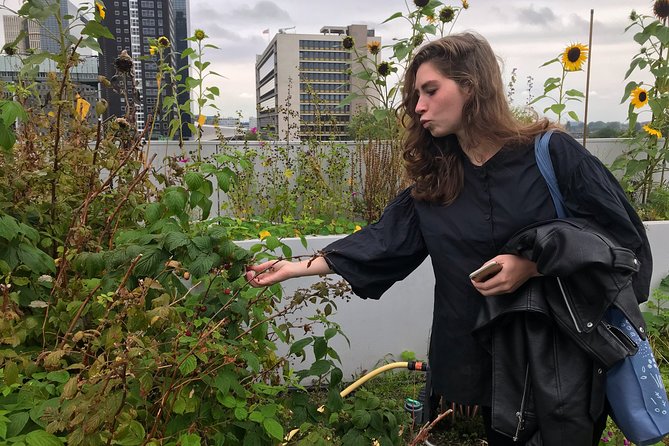
Above the Schieblock building is DakAkker, a rooftop farm of about 1,000 square meters. It grows vegetables, fruit, and edible flowers, and bees are kept there as well. A rooftop farm sounds like a novelty until you consider what it represents: unused roof space turned into food production, a meeting place, and a public project.
The exact food business on the roof has changed. An earlier bistro called Op Het Dak closed during the pandemic and moved toward a different concept at Ted’s Place. DakAkker still hosts public events such as harvest gatherings, lunches, and seminars. Your guide can explain the project and its role in Rotterdam’s current building culture, but you should not book this walk expecting a meal to be included.
The tour allocates about 30 minutes to innovative public spaces. That is enough for a useful introduction, but not enough for a leisurely meal, long rooftop visit, or detailed architectural study. I see this as a sampler that gives you places to return to later.
Street art that asks you to stop
Rotterdam’s art is not confined to galleries. On the route, you encounter wall paintings, street sculptures, and works placed in ordinary public areas. The scheduled street-art portion is about 15 minutes, though the art appears in other parts of the walk too.
This is where a good guide earns the fee. Without context, graffiti can look like a blur of names and colors. With an explanation, a wall may point to neighborhood change, local identity, or an artist’s message. Danya has been praised for showing parts of the city that are easy to rush past and for explaining images that would otherwise be ignored.
I would not book this as a specialist street-art tour of all Rotterdam. The route gives you an introduction, not an exhaustive survey. Still, it adds a welcome human layer to a city often discussed through concrete, glass, and daring angles.
The short timing also helps families. You get visual variety without standing through a long lecture. A five-year-old may not care about urban policy, but a colorful wall or odd sculpture can keep the walk moving.
Laurenskerk and the city that survived
Rotterdam’s modern appearance can make its older history easy to miss. The stop at Grote of Sint-Laurenskerk, or Laurenskerk, brings you back to the city before its current architectural identity took shape.
The tour also points out the old city hall building and introduces important figures from Rotterdam’s past. The scheduled stop lasts about 15 minutes, so expect a concise explanation rather than a full church visit or detailed historical lecture.
That brief pause is valuable because it gives the rest of the route context. After hearing about the older city and the damage it suffered during the Second World War, the new buildings feel less random. Rotterdam’s experimental character is partly a response to loss and partly a decision to build differently.
If wartime history is especially important to you, tell the guide at the start. Danya has been praised for explaining the city’s wartime experience and for describing the hardworking, independent spirit associated with Rotterdam. The exact depth of this subject will depend on your guide and the time available.
A different kind of day out entirely:
- Rotterdam: Harbor Sightseeing Cruise
★ 4.3 · 7,599 reviews - Rotterdam: 1-Hour Sightseeing Splash Tour
★ 4.5 · 3,299 reviews - Rotterdam: Rotterdam Zoo Blijdorp Entry Ticket
★ 4.6 · 2,754 reviews - Rotterdam: Euromast Lookout Tower Ticket
★ 4.4 · 2,549 reviews
Markthal, MVRDV, and lunch without a fixed menu
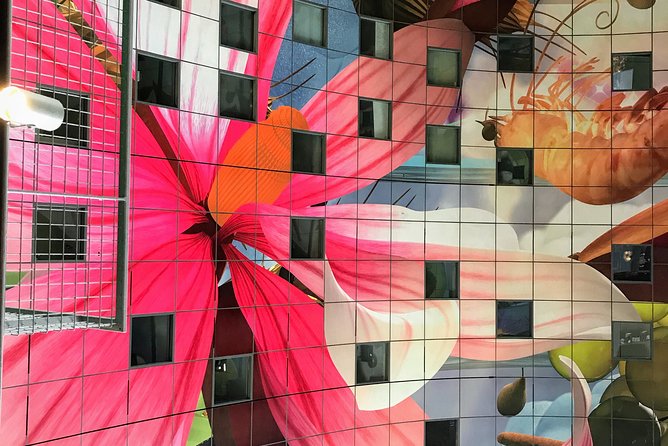
Markthal is one of the best stops for seeing how Rotterdam mixes daily life with striking design. The project by MVRDV combines housing with an indoor market hall, so the building works as both a place to live and a place to shop.
That combination is more interesting than a quick photograph from outside. Your guide can explain how architecture shapes public space, then lead you through the market itself. You have about 30 minutes here, enough to look around and sample something if you choose.
Possible foods include herring, farmer cheese, Dutch wine, homemade truffle sausages, and ethical food products. Coffee, tea, and snacks are not included, and neither are entrance tickets. In practice, Markthal is a flexible pause rather than a hosted tasting. Bring a payment method and allow extra money if you want to eat.
I like this part because it turns architectural talk into an ordinary city experience. You see where people shop, eat, and meet. The drawback is time. Thirty minutes may feel short if you want a proper lunch, several samples, and photographs of the ceiling artwork. If food is a priority, return after the tour.
Erasmus Bridge and OMA’s city views
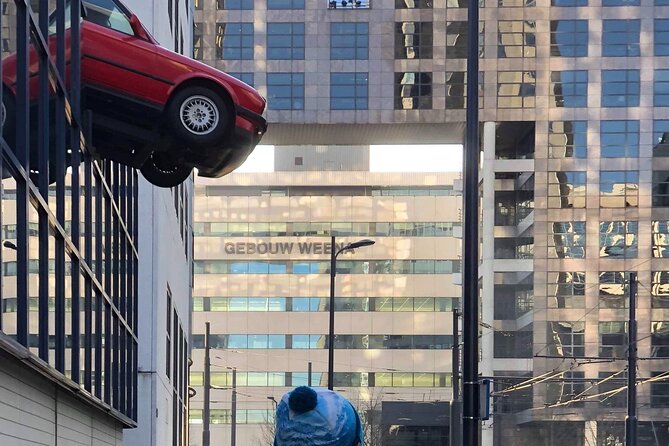
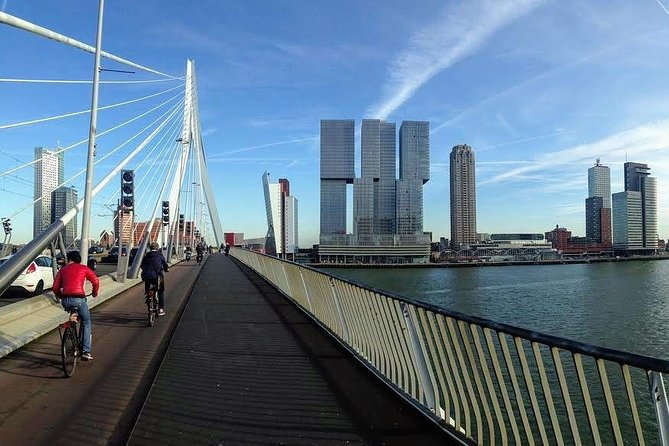
The route continues toward Erasmus Bridge, one of Rotterdam’s clearest symbols. The bridge offers a broad view of the city and helps you understand the relationship between the central area and the opposite side of Rotterdam.
This is a good place to pause for photographs, but the real value is orientation. After walking through compact streets, art-filled courtyards, and market spaces, the open view shows Rotterdam as a larger port city built around movement and connection.
The tour also introduces OMA and the work associated with architect Rem Koolhaas. The route presents architecture as part of the city’s daily operation, not just as a collection of unusual shapes.
The listed stop is about 15 minutes. Wind and weather can affect how enjoyable this section feels, so dress for an exposed bridge. The end point is Erasmusbrug, which is convenient if you want to continue exploring from there, but it also means the walk does not return you to the starting point.
Cube Houses and the logic of tilted homes
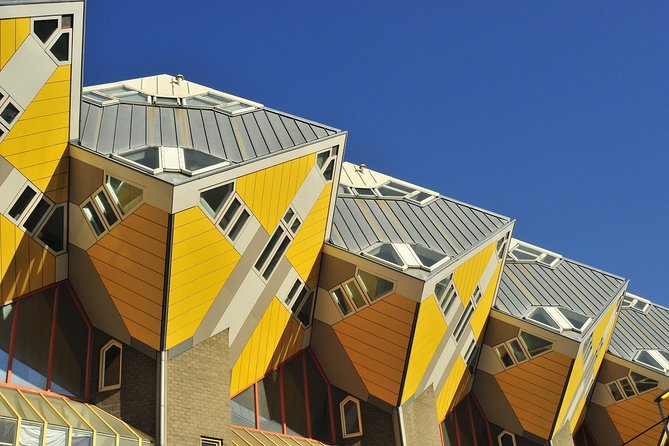
The Cube Houses are among Rotterdam’s most recognizable buildings. Their tilted yellow forms make an immediate impression, but the tour aims to explain more than their appearance.
You learn about twentieth-century architectural movements, social housing, and the ideas behind arranging homes in such an unusual way. Nearby buildings known as The Pencil and The Apple add to the collection of memorable forms.
This stop works best when you are willing to look past the novelty. The useful question is not only how the Cube Houses look, but how people use them. Bold housing can create memorable public space, yet unusual design also raises practical questions about light, furniture, privacy, and everyday comfort.
The itinerary lists the Cube Houses after the Erasmus Bridge, although the overall route description places several central sights close together. Confirm the exact order and meeting instructions with Snurk.Travel before setting out. The starting point is Ode aan Marten Toonder, Verlengde Nieuwstraat, 3011 GA Rotterdam, and the listed finish is Erasmusbrug, 3011 BN Rotterdam.
What the price means for your group
At $274.03 per person, this is not a budget walking tour. Its value depends on the size of your party and how much you use the private format.
For a larger family or group, the price may be easier to justify because you are not sharing the guide with strangers. You can ask questions freely and keep children moving at a sensible pace. For one person or two adults, the cost is harder to defend unless personal attention and a tailored route matter a great deal.
You are paying for a certified guide, not for food, drinks, or entry tickets. The listed stops are generally public areas with free admission, so the main purchase is the guide’s time and interpretation.
I would compare it with a self-guided walk only if you are comfortable researching Rotterdam’s architecture and social projects in advance. The yellow bridge, rooftop farm, street art, Markthal, Laurenskerk, Erasmus Bridge, and Cube Houses are easy to identify. The harder part is understanding how they fit together. That is where the tour has its strongest value.
Practical details for a smoother walk
Confirmation arrives when you book. The tour is offered in English, uses a mobile ticket, and is near public transportation.
Most people can take part, but this is a three-hour city walk. Wear shoes you can use comfortably on pavement and bring weather protection. The route includes bridges and open areas, and conditions may change quickly.
You should budget separately for food and drinks at Markthal. Entrance tickets are not included, although the listed stops are described as free-admission locations. Group discounts may be available, so check the price for your party rather than assuming the per-person figure tells the whole story.
Free cancellation is allowed up to 24 hours before the start time for a full refund. Cancellations or changes made within 24 hours are not accepted for a refund. The cut-off follows Rotterdam local time.
Who will enjoy this Rotterdam walk?
I would recommend it to first-time visitors who want a framework for the city, architecture fans who prefer real streets to formal lectures, and families who need variety. It also suits anyone who has visited Rotterdam before but has only seen the central landmarks. Danya has shown repeat visitors parts of the city they had never noticed, which is exactly the point of a good local walk.
It is less suitable if you want a slow food tour, a museum-heavy afternoon, or a specialist study of one architect. The pace is broad rather than deep. You see many ideas in three hours, then choose which ones deserve a second visit.
Should you book the Travel to the Future Walking Tour?
Book it if you want Rotterdam explained as a living experiment. The strongest parts are the yellow De Luchtsingel, DakAkker rooftop farm, street art, Markthal, and the contrast between Laurenskerk and the Cube Houses. The private setting and engaging guide style make the route especially useful for families and small groups.
Skip it if $274.03 per person feels too high for a short walk or if you mainly want included food and admissions. For the right group, the cost buys a clear sense of how Rotterdam rebuilt itself and keeps testing new ideas. For everyone else, use the route as a map for independent exploring and spend the saved money at Markthal.
FAQ
How long is the Rotterdam Travel to the Future Walking Tour?
The tour lasts approximately three hours.
What language is the tour offered in?
The tour is offered in English.
Is this a private tour?
Yes. Only your group participates in the activity.
Where does the tour start?
The listed meeting point is Ode aan Marten Toönder, Verlengde Nieuwstraat, 3011 GA Rotterdam, Netherlands.
Where does the tour finish?
The listed end point is Erasmusbrug, 3011 BN Rotterdam, Netherlands.
Is food included at Markthal?
No. Coffee, tea, snacks, and other food purchases are not included.
Are entrance tickets included?
No entrance tickets are included. The listed stops are described as free-admission locations.
Can I cancel for a full refund?
Yes, if you cancel at least 24 hours before the experience start time. Cancellations or changes made less than 24 hours in advance are not accepted for a refund.
Just added in Rotterdam
- e-Scavenger hunt Breda: Explore the city at your own pace★ 4.5 · 27 reviews
- Rotterdam: City Walk Audio Guide in 7 Languages on your Phone★ 3.5 · 6 reviews
- e-Scavenger hunt Rotterdam: Explore the city at your own pace★ 4.5 · 13 reviews
- Rotterdam Must Do Tour: Highlights, History, WW2 and Architecture★ 5.0 · 20 reviews
- The Goldheist – Trilling Private City Escape Game Rotterdam★ 5.0 · 1 review
- Explore the Instaworthy Spots of Rotterdam with a Local★ 5.0 · 1 review
- Discover Rotterdam: Classic Highlights Bike Tour with a Local★ 5.0 · 22 reviews
- Skip the Line: SS Rotterdam Steam Ship Entrance Ticket★ 4.5 · 18 reviews
Walking Tours, compared.
Anne Frank’s Story – Guided Walking Tour through Amsterdam
Read our review →
Life of Anne Frank and World War II Walking Tour
Read our review →
Absolutely Amsterdam – the Essential Introductory Walking Tour
Read our review →
Anne Frank Walking Tour – Guided in EN/DE/IT/ES
Read our review →
Anne Frank Walking Tour Amsterdam Including Jewish Cultural Quarter
Read our review →Browse the lists this tour appears in